The sea around Ganghwa Island has a large gap between high and low tide, and its currents run fast. In the summer of 1232, the Goryeo court moved its capital onto this island. It fought its war with the Mongols from the walled city there until it went back to Gaegyeong in 1270.
Was moving the capital to an island a choice to defend the country, or a choice to protect those in power? There is still no single answer. Both judgments appear side by side even within one encyclopedia entry.
This article follows the war from the first invasion in 1231 to the peace of 1259 and the end of the Sambyeolcho rising in 1273. The guides are entries in the Encyclopedia of Korean Culture, published by the Academy of Korean Studies, and records of the Korea Heritage Service. Different scholars wrote different entries, so some dates and lengths of time do not match, and those places are read side by side.
From a pact of brothers to a broken relationship
Goryeo and the Mongols first met while chasing the same enemy. As the Mongols attacked the Jin dynasty, a group of Khitan refugees fleeing the Mongols entered Goryeo in 1216. Pushed back by Goryeo troops under Jo Chung and Kim Chwi-ryeo, they held out in Gangdong Fortress.
At the end of 1218, the Mongol commander Hajin, who had followed them, asked Goryeo to attack together. The Khitan refugees in Gangdong surrendered the next year, and at the Mongols' request the two sides made what was called a "brotherhood pact."
After that, Mongol envoys came every year. Heavy demands for tribute and the envoys' rude manners built up resentment on the Goryeo side. In 1225, the envoy Jeogoyeo was killed on the bank of the Yalu River on his way home. The Mongols blamed Goryeo and cut off relations.
In 1231, Ögedei Khan launched campaigns to both the east and the west. Jeogoyeo's death became the stated reason for attacking Goryeo.
1231: the first invasion and Guju Fortress
In the eighth month of 1231, a Mongol army led by Sartai invaded Goryeo. By the twelfth month, the capital Gaegyeong was surrounded.
At Guju, a key inland point in the north, four major rounds of fighting took place from the ninth to the twelfth month of that year. Bak Seo, the military commissioner of the northwest, split his units among the four sides of the fortress. He commanded the whole defense and held the north side himself. More than 250 special-unit troops from nearby counties were also posted along the walls.
The Mongols built siege machines called nucha and daesang, dug tunnels and set fires with oil. Inside, the Goryeo troops poured molten iron to burn those machines and put out fires with wet mud. In the middle of the tenth month, the Mongols lined up catapults at 28 points on the west side and bombarded the walls. Each time a wall fell, Bak Seo had it rebuilt at once.
The "Guju Fortress" entry quotes words attributed to a veteran Mongol commander. In English translation, they run roughly as follows.
> "I have served in war since I was young and have seen many sieges under heaven, but I have never before seen a place that would not surrender under such fierce attack"
Yet Guju did not open its gates because it lost the fight. With Gaegyeong surrounded, the court decided to surrender and sent Wang Jeong, a member of the royal family, to the Mongol camp at Anbuk to ask for peace. After the court made peace in the twelfth month, it sent officials to press Guju to give up. Bak Seo refused three or four times, then opened the gates in the first month of 1232 because he could not break the law of the state.
Yun Yong-hyeok, who wrote the "Guju Fortress" entry, argues that Guju held down one Mongol force and slowed the advance of the main army. For this, Guju was raised in rank to Jeongwon Grand Protectorate.
The Mongols withdrew, leaving 72 darughachi in the northern frontier region. Darughachi was the title the Mongol Empire gave to the governors and overseers it placed in conquered lands.
Why Ganghwa Island
A few months after the first invasion ended, the Goryeo court chose to fight again. The man behind the decision was Choe U, the military ruler. In the sixth month of 1232, an officer named Song Deuk-chang, who had escaped from a mission to the Mongols, reported that they would soon invade. Talk of moving the capital quickly gained ground.
The opposition was strong, and most officials said Gaegyeong had to be defended. The minister Yu Seung-dan argued that the capital must be kept for the sake of the state. Kim Se-chung, an officer of the Night Patrol, opposed the move and was put to death by Choe U. On the day the king left, a man named Yi Tong rose up, vowing to defend Gaegyeong.
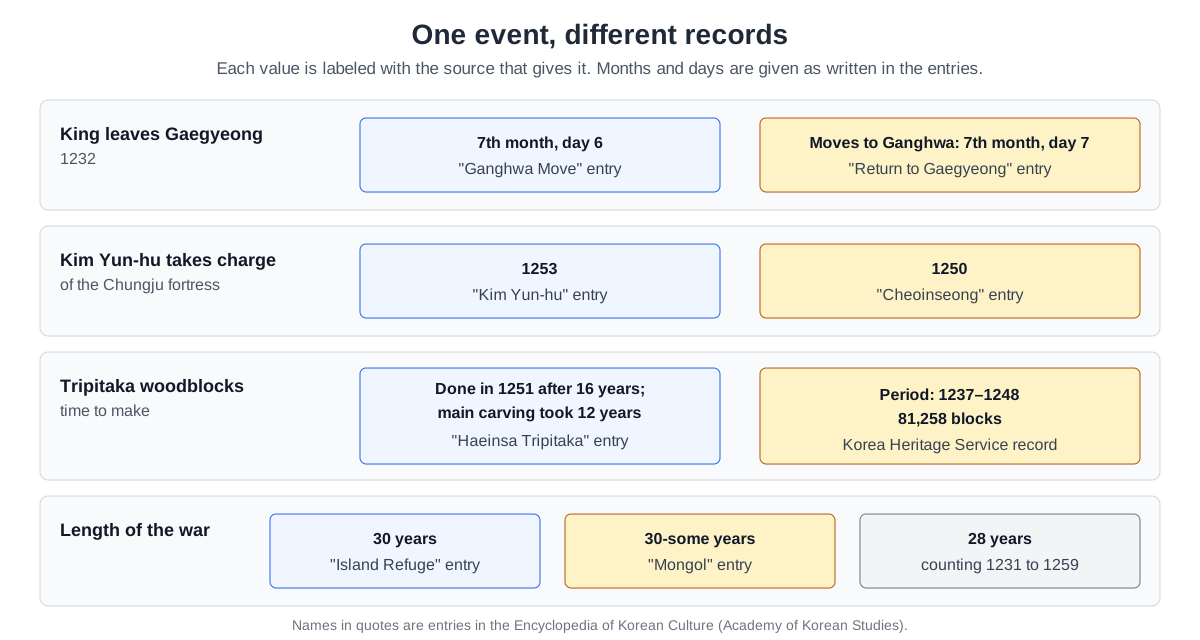
The entries differ by one day on when that was. The "Ganghwa Move" entry says the king left Gaegyeong on the 6th day of the 7th month. The "Return to Gaegyeong" entry says the plan was fixed on the 16th day of the 6th month. It has King Gojong moving to Ganghwa on the 7th day of the 7th month.
Why Ganghwa? Its large tides and fast currents made it hard to attack. It was also close to Gaegyeong and well placed for links with the provinces and for shipping tax grain by water.
In the ninth month of that year, Sartai built ships and seized a local clerk from Taeju named Byeon Ryeo to ask about the sea route to Ganghwa. Byeon Ryeo said only that it was very dangerous and never told more, and the Mongols dropped the plan.
Shin An-sik, who wrote the "Ganghwa Move" entry, gives as the first reason that Choe U had no sure way to stop another Mongol attack. He also sees unrest as a major factor: after the first invasion, bandit groups and local resistance forces were active. Political aims of protecting the regime, and a diplomatic strategy of avoiding or delaying Mongol demands for heavy tribute and hostages, also lay behind the move. It was the only time a capital was moved while under foreign attack.
The move was not prepared in advance. The palace and government offices went up in 1234, two years after the move, built by laborers drafted from many regions. The outer wall was enlarged in 1237, and in 1250 a middle wall was built, more than 2,960 kan around, with 17 large and small gates. This was how the capital called Gangdo, short for "Ganghwa walled capital," took shape.
Life in Gangdo was different from life outside it. While ordinary people suffered from the war, the Choe rulers lived in considerable luxury. Royals and nobles also enjoyed Buddhist festivals and the polo-like game gyeokgu.
People who moved into mountain fortresses and islands
Along with the move, officials were sent to each province. The order was to send people into mountain fortresses and onto islands. Going into a fortress or onto an island to hold out is called ipbo. Going to a mountain fortress is sanseong ipbo, and going to an island is haedo ipbo.
Before the Mongols came, people facing an invader went into the fortress of the county seat. These fortresses stood on hills or low mountains in the middle of the county. In the first invasion, such fortresses showed their limits and lost their use over wide areas. Holding out for a long time against the fast-moving Mongol army needed other places.
The new refuges were high, steep mountain fortresses far from the county seats, and strategic islands fairly close to the mainland. Many areas could not easily reach an island, or could not reach one at all, so most of the time a mountain fortress became the refuge. People from several counties went into the same fortress. The court sent as many as 37 defense commissioners to mountain fortresses to repair walls and lead special units.
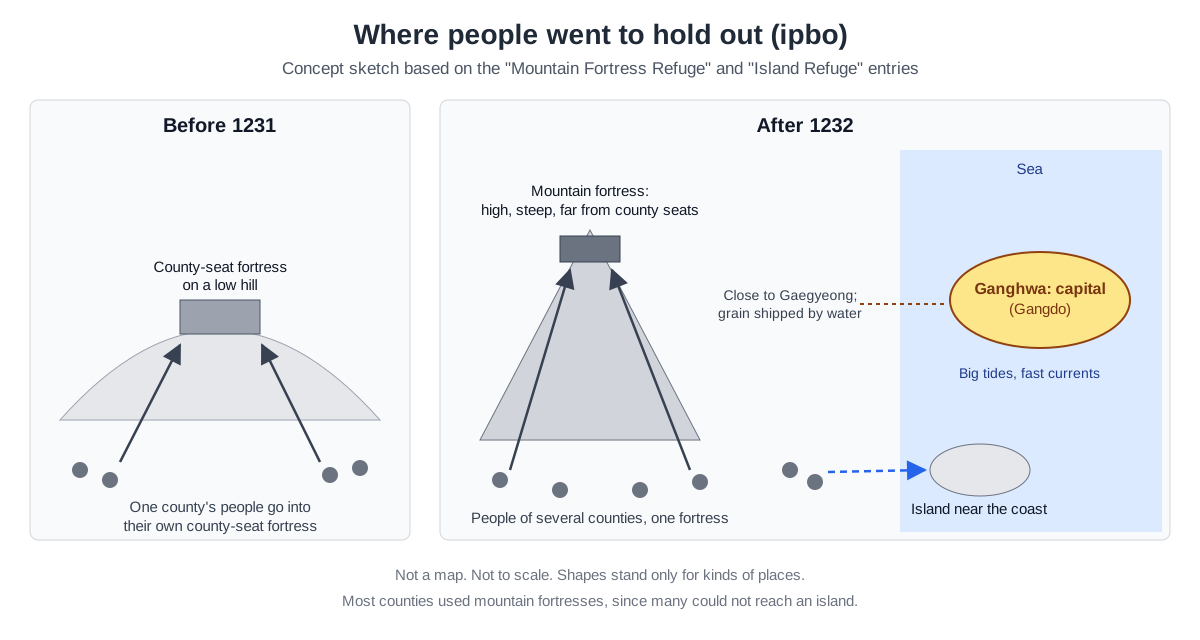
An order to leave home for an island or a deep mountain was not easily accepted. People hesitated or resisted, and officials pushed the island moves through even by burning houses and grain and handing out harsh punishment. On the other hand, the court also gave out land on the islands or along the coast and exempted the moved counties from land tax.
The "Island Refuge" entry judges that the island refuges worked well against a Mongol army relatively weak in naval fighting. It also calls them, in themselves, a passive form of defense. Until the 1250s, the Mongols did not attack the island refuges directly, and only after 1254 did they change course and strike the islands. As the war dragged on, some people ignored orders to move, and some rose in revolt on the islands.
Cheoinseong and Chungju
In some places the people in the refuges stood at the front of the fighting. In 1232, Sartai invaded again, rebuked Goryeo for moving its capital to Ganghwa and demanded that the king come out to the mainland. Goryeo refused, and the Mongol army moved south.
On the 16th day of the 12th month of that year, Sartai was struck by an arrow and killed at Cheoinseong. The fortress stood in what is now Cheoin District of Yongin, Gyeonggi Province. The man recorded as the archer is Kim Yun-hu, a monk of Baekhyeonwon. He had taken refuge in the fortress and led the people of Cheoin hamlet and the monks who had come in with him.
Having lost its commander, the Mongol army soon pulled back to the north. Cheoin hamlet was raised to the rank of a county. Kim Yun-hu was named a senior general but firmly declined and took a lower rank instead.
Twenty-one years later, Kim Yun-hu's name appears again. In the tenth month of 1253, a Mongol army under Yegu surrounded Chungju Fortress, and the defense commissioner holding it was Kim Yun-hu. The year he became defense commissioner of the Chungju mountain fortress is 1253 in the "Kim Yun-hu" entry and 1250 in the "Cheoinseong" entry.
The siege lasted 70-some days, and food ran nearly out. Kim Yun-hu promised that if they won, everyone would receive official rank, high-born or low-born. He burned the registers of government slaves to show he meant it and handed out captured oxen and horses. In the 12th month, the Mongols withdrew and did not go farther south.
The promise was kept. Those who had earned merit, down to government slaves and butchers, received ranks according to their deeds, and Chungju was raised in rank the next year. The "Kim Yun-hu" entry treats this as a leading example of the central government and ordinary people fighting together.
Reading thirty years in numbers
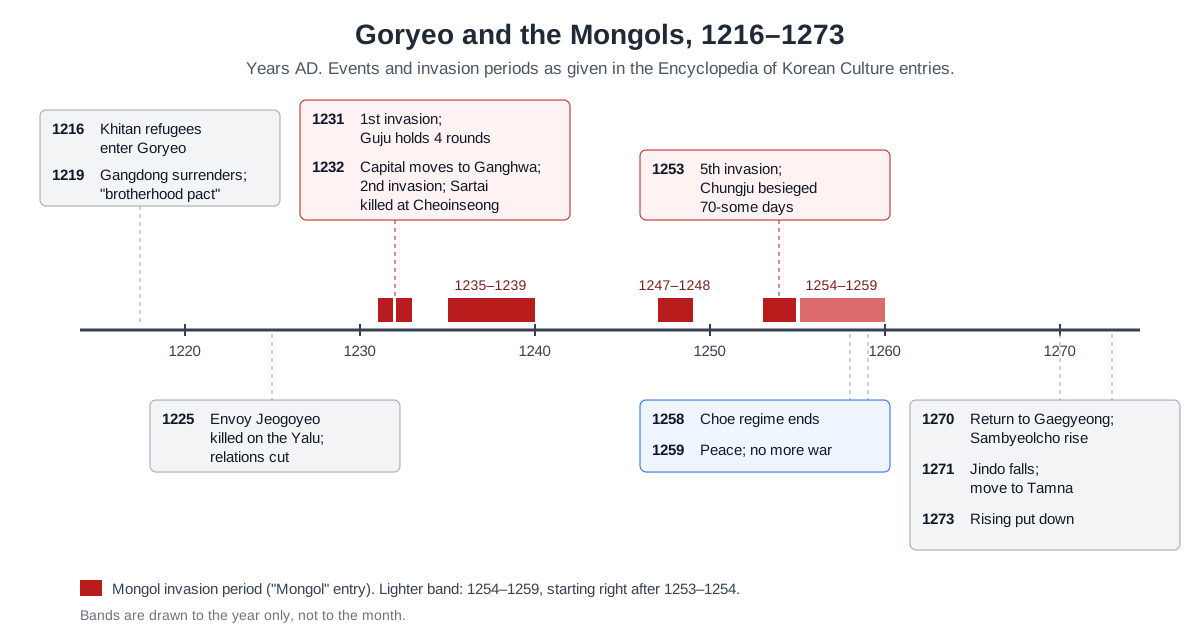
The "Island Refuge" entry calls it a 30-year war, and the "Mongol" entry says 30-some years. Counting the years from the first invasion in 1231 to the peace of 1259 gives 28. The fighting did not go on without a break during that time.
After 1231 and 1232, invasions came in 1235–1239, 1247–1248, 1253–1254 and 1254–1259. The entries that call 1231 the first invasion, 1232 the second, 1253 the fifth and 1254 the sixth follow the same order.
Between invasions there were talks, and the Mongols demanded that the court leave Gangdo and return to Gaegyeong. They also wanted the king to come in person to pay homage and a royal son to be sent as a hostage, among other things. When an attack began, Goryeo would promise to return, then delay once the Mongols withdrew and go on resisting. The return to the mainland became the biggest diplomatic issue between the two sides.
| Number | What | Source |
|---|---|---|
| 72 | Darughachi left in the north by the Mongols in 1231 | "Mongol" entry |
| 4 | Major rounds of fighting at Guju, 9th to 12th month of 1231 | "Guju Fortress" entry |
| 37 | Defense commissioners sent to mountain fortresses | "Mountain Fortress Refuge" entry |
| 70-some days | Length of the siege of Chungju in 1253 | "Chungju" entry |
| 30 years, 30-some years | Length of the war | "Island Refuge" and "Mongol" entries |
| 28 years | From the first invasion in 1231 to the peace of 1259, counted in years | Calculation |
Peace, the return to Gaegyeong, and the Sambyeolcho
In the late 1250s, voices inside Goryeo calling for peace on Mongol terms grew stronger. In 1258, the military ruler Choe Ui, who had argued for fighting on, was killed by Yu Gyeong, Kim Jun and others, and the Choe regime came to an end. The next year, Crown Prince Jeon set out for the Mongols to end the war.
The Mongol emperor Möngke died during his campaign against the Southern Song, and the crown prince met Kublai, who was heading north, and stayed in his camp. When King Gojong died in Goryeo at that moment, Kublai named the crown prince king of Goryeo and sent him home as King Wonjong. Goryeo asked, among other terms, that it would not have to change its customs, and the Mongols agreed. After the peace of 1259, there was no more war between the two sides.
The capital did not move back at once. Military rule went on after the Choe regime fell, and the rulers who followed, from Kim Jun to Im Yeon and Im Yu-mu, refused or delayed the return. King Wonjong announced the return on his way back from the Mongol court, and military rule ended in 1270 when Im Yu-mu was killed by his own commanders. On the 23rd day of the 5th month that year, senior ministers met to discuss returning to Gaegyeong, and the Gangdo era came to a close.
The Sambyeolcho did not accept this decision. Under Choe U, a Night Patrol was formed to hunt down thieves every night, and as it grew it was split into a Left and a Right Patrol. Together with the Sinuigun, a unit made up of people who had escaped after being taken prisoner by the Mongols, they were called the Sambyeolcho, the "Three Special Patrols." From around 1253, the regular government army did very little, and these units became much more active.
The Sambyeolcho set up their own government with Wang On, the Lord Seunghwa, as king and made Jindo Island their base. When a Goryeo army under Kim Bang-gyeong and a Mongol army under Hindu attacked Jindo, Kim Tong-jeong led the rest of the group to Tamna in 1271. In 1273, 160 ships from Jeolla carried an allied force of 10,000 to Tamna, and the rising was put down that year. The remains of the fortress they built, known as Hangpaduriseong, still stand around Goseong-ri in Aewol, Jeju City.
Views of the Sambyeolcho differ. One view sees them as the private troops of the Choe regime. Another sees them as a public force, since they were raised with state funds and paid from the treasury. The "Return to Gaegyeong" entry says their resistance had a positive meaning in keeping Goryeo's independence alive, and a negative one in dragging out the fighting.
What remains: the woodblocks and divided judgments
The first Tripitaka woodblocks, carved under King Hyeonjong, burned during the Mongol invasion of 1232. Choe U and others set up a Tripitaka Directorate to carve the canon again. The blocks made at the directorate on Ganghwa and at branch directorates in Namhae and Ganghwa are the Tripitaka woodblocks now kept at Haeinsa Temple in Hapcheon.
The sources give the time it took in different ways. The "Haeinsa Tripitaka" entry says the work was finished after 16 years, on the 25th day of the 9th month of 1251, which is October 11 in the solar calendar. The same entry explains that the carving of the main canon itself took 12 years. It reads the 16 years in the Goryeosa as the whole time from setting up the directorate to finishing the blocks.
The Korea Heritage Service record gives the period as "Goryeo dynasty (1237–1248)" and the count as 81,258 blocks. The blocks were designated a National Treasure in 1962.
Judgments on the move to Ganghwa are not one either. One view holds that it was an unavoidable choice for the Goryeo government and may even have helped against repeated Mongol attacks aimed at a short war. Another view plays it down as a step to protect the regime, made without any plan for the mainland.
On the return to Gaegyeong, too, one view holds that giving up the resistance did great harm to Goryeo's independence. A critique from the side that favored peace holds that the return should have come sooner, because the long resistance cost ordinary people so much.
The weight of the war fell above all on the farmers. People were lost to Mongol killings and captivity, much property was looted, and the loss of livestock such as oxen and horses brought great hardship. Many cultural treasures of national rank were lost as well. The "Ganghwa Move" entry also notes that metal movable type, the Tripitaka woodblocks and inlaid celadon came out of this same period.
After the war, Goryeo and the Mongols kept close ties for some 100 years, and those ties had a deep effect on Goryeo's politics and society. In 1274, when the Mongols first sent an expedition against Japan, Goryeo took part with more than 8,000 troops and warships, with Kim Bang-gyeong as commander.
What to read next
- The Mongol Conquests: An Empire Built on Horses and Relay Stations: a planned article on how the empire that attacked Goryeo grew.
- The Mongol Invasions of Japan: What the Records Say About the "Kamikaze": a planned article that follows how Goryeo was drawn into the 1274 expedition.
- Military logistics: performance must be sustainable: Like Chungju, where food ran nearly out after a siege of 70-some days, the power to hold out comes from supply. This article looks at how modern armed forces group the work of logistics, ending with the "depth of magazine" question for laser weapons.