Taking a single castle could take two months. In 1215, Rochester Castle in England held out even after one corner of its keep came down, and its defenders gave up only when the food ran out. A medieval siege was a contest of stone-throwing machines, but it was also a contest of time and hunger.
Over those centuries, the attackers' machines changed a great deal. Engines that threw stones when a team pulled on ropes became counterweight trebuchets, driven by a falling weight. Those trebuchets in turn gave way to gunpowder cannons. Walls changed too, first into double rings and then, in the gunpowder age, into a completely different kind of fort.
This article follows that story through recorded events and castles that still stand. Along the way, it looks at how a trebuchet actually threw its stone.
What a siege was
A siege is the military method of trying to take a town or fortress. France's army museum in Paris, the Musée de l'Armée, has an exhibition explaining that sieges in the early 15th century used two kinds of artillery side by side. One kind was a wooden frame that used mechanical force to hurl stones. The other was the cannon, which fired large stone balls with the force of burning gunpowder.
Not just anyone could run the mechanical kind. The museum calls the specialists who handled these machines, the engineurs, "the forebears of our present-day engineers." From early on, attacking a castle was also a job for technical experts.
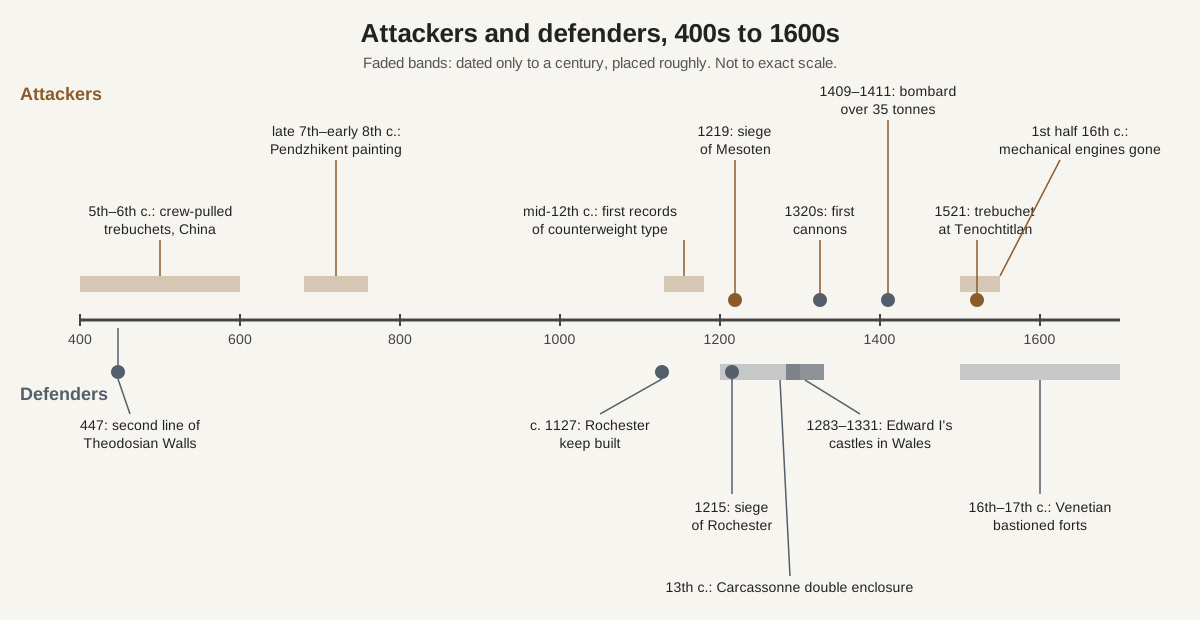
Yet a siege was not always about breaking walls. The record of Rochester Castle shows this well. Its keep was built around 1127, and in 1215, when rebel barons held the castle, King John surrounded it.
According to English Heritage, John's forces first dug under the outer wall. They then burned the fat of 40 pigs inside a tunnel beneath the keep, which brought its southern corner down. Even then, the defenders kept going. What finally made them surrender after two months was starvation.
From crew-pulled engines to the counterweight
The trebuchet's history starts in China in the 5th–6th centuries. The first trebuchets had no counterweight. Instead, they carried a set of ropes that a crew pulled together. The oldest known picture of such a machine is a wall painting in the palace at Pendzhikent, near Samarkand, from the late 7th or early 8th century.
Human strength had its limits. Only so many people could stand around the machine, and the rope-pullers themselves faced danger. A 2006 article by Tanel Saimre in the Estonian Journal of Archaeology explains that these were the reasons builders turned to a counterweight in place of people.
The earliest accounts of counterweight trebuchets come from the mid-12th century, from Islamic countries, Byzantium, and the Mediterranean part of Europe. The first picture of one is from late 12th-century Egypt. It is still unclear whether the idea of the weight came from the East or was invented separately in Europe.
In English, "trebuchet" names a siege machine worked by a counterweight. At first, the word applied only to the biggest and strongest machines of this kind.
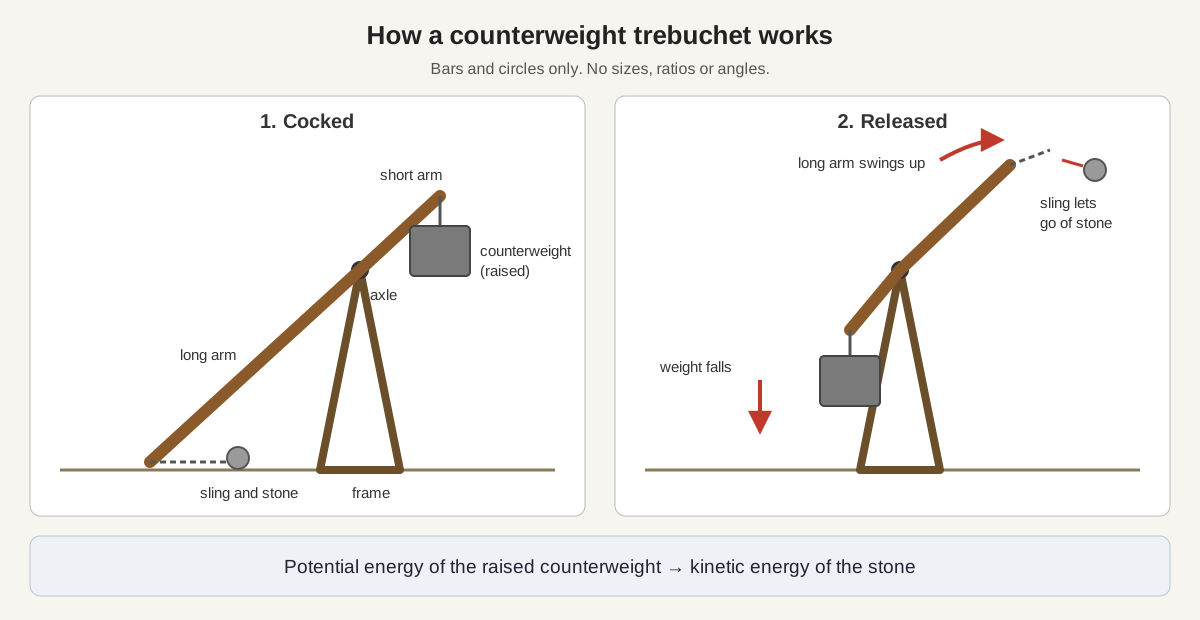
The way it moves is simple. A long beam sits on a turning axle, and the axle splits the beam into a long arm and a short arm. A heavy weight hangs from the short arm, and a sling holding the stone hangs from the long arm. Once the machine is cocked, the end of the long arm rests on the ground and the weight is lifted high.
When the trigger is let go, the weight falls and the long arm and sling whip upward fast. At the right moment, the sling lets the stone fly. The potential energy stored in the raised weight becomes the kinetic energy of the flying stone.
A playground seesaw gives a rough picture, but the real machine is quite different. On a seesaw, two people take turns pushing down. A trebuchet instead gathers the force of one falling weight at the end of the long arm and sling, then spends it in one go. In principle it is close to the ancient pole-sling, with the heft of a weight replacing human muscle.
Trebuchets in the written record
From the 13th century, trebuchets became common across Europe. In Estonia, such machines were used again and again from the early 13th century, when German and Danish forces conquered the region. That history is one reason interest in trebuchets runs high there, and Saimre himself built an experimental trebuchet to test.
The Livonian Chronicle of Henry describes how Teutonic crusaders besieged the fort of Mesoten in December 1219. As the chronicle tells it, once "the larger machine was put up," great stones flew at the fort. The people inside were terrified by the size of the rocks. As the stones kept coming, planks and logs broke away from the rampart and the defenders left it, and with nowhere to shelter, they finally asked for terms.
There is a record of a trebuchet appearing again in the 16th century. When Hernán Cortés besieged Tenochtitlan, today's Mexico City, in 1521, his cannons had no ammunition left, so he accepted the idea of building a trebuchet. The machine failed on its first shot. This is one of the last recorded uses of a trebuchet in war.
The answer from the walls: rings of defense
The attackers' machines were not the only things that changed. The defenders' walls have a long history of their own. The Theodosian Walls of Constantinople served as an old benchmark. UNESCO counts the 6,650 m land wall of Theodosius II, with its second line of defense added in 447, among the leading references for military architecture.
By the late 13th century, double walls had become a mark of military building. These are concentric castles, with one ring of wall set inside another. In north Wales, Beaumaris Castle and Harlech Castle are on the World Heritage List as examples that join this double-wall concentric layout to a tightly organized central plan.
These castles are examples of the colonizing and defensive building carried out under the English king Edward I, who reigned from 1272 to 1307. Work began in 1283 and was at times held up by the Welsh rising led by Madog ap Llewelyn in 1294. Building went on until 1330 at Caernarfon and 1331 at Beaumaris.
The man who designed the castles and directed the work was the king's chief architect, James of St George, who lived from about 1230 to 1309. Medieval castle features such as barbicans, drawbridges, fortified gates, towers, and curtain walls survive intact in these castles.
Carcassonne, in the Occitanie region of France, is another city with double walls. A huge defensive system, built up mainly in the 13th century, wraps the city in two rings of wall separated by barriers. What visitors see today, however, also carries the long restoration by Viollet-le-Duc in the second half of the 19th century, who is counted among the founders of modern conservation. His work reached the double walls as well.
What gunpowder changed
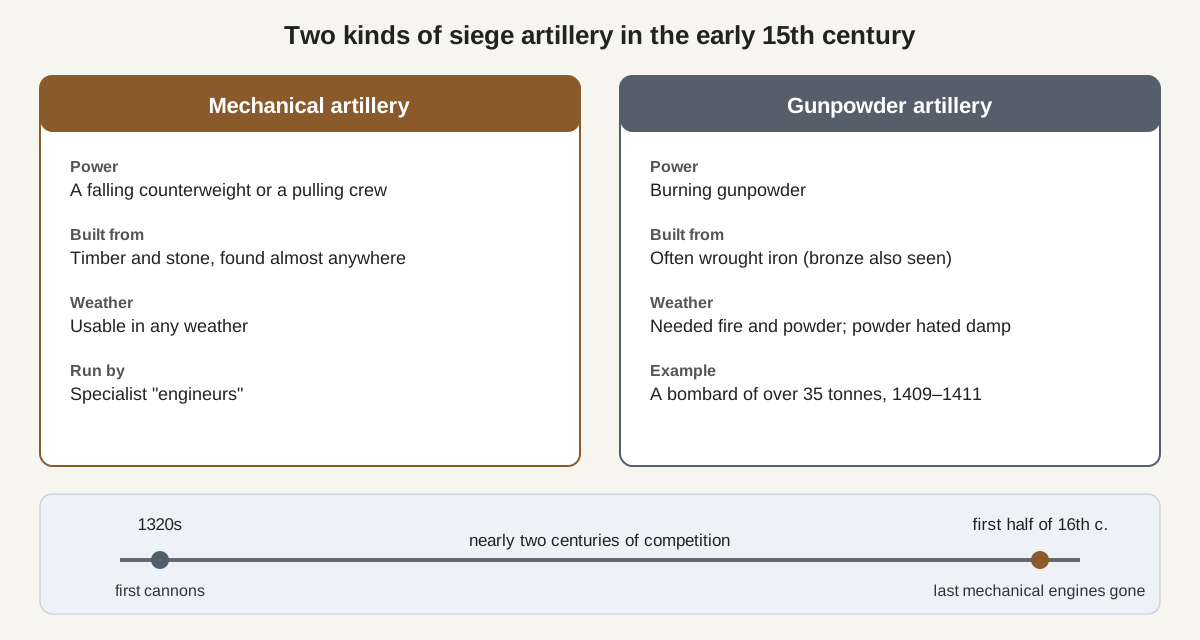
The first gunpowder cannons appeared as early as the 1320s. Even so, trebuchets could hold their own against cannons for nearly two centuries. A cannon always needed fire at hand and a stock of powder, and the powder could not stand damp. A trebuchet worked in rain or snow, and it was built from timber and stone found almost anywhere.
Cannons pulled ahead of trebuchets only after the more advanced guns of the 15th century arrived. By then, cannons, often made of wrought iron, could grow very large. The army museum in Paris records that between 1409 and 1411, Antoine de Bourgogne, Duke of Brabant, had a bombard built that weighed more than 35 tonnes. A bombard is a large cannon that fires big stone balls.
Gunpowder artillery spread step by step and pushed the mechanical engines aside. The last mechanical engines were gone within the first half of the 1500s.
At Fort Nelson, run by the Royal Armouries in Britain, visitors can see the bronze "Great Turkish Bombard." The museum describes the bombard, which fired huge stone balls, as "the heavy demolition weapon of the Middle Ages." Sultan Mehmet II commissioned this gun from Munir Ali. Its barrel and powder chamber were cast separately and screw together.
Once gunpowder weapons were in wide use, the shape of forts changed. UNESCO writes that gunpowder brought major changes to military methods and architecture, and that these show in fort designs called alla moderna, the bastioned system. During the Renaissance, this system was born almost entirely on lands of the Republic of Venice.
The defenses Venice built in the 16th and 17th centuries are on the World Heritage List as six sites in Italy, Croatia, and Montenegro, stretching over more than 1,000 km. This bastioned system later spread across Europe.
What survives and what remains unknown
Many castles survive, but the trebuchets do not. The Middelaldercentret, a Danish medieval center, states that no trebuchet is known to survive from the Middle Ages. Its own rebuilt trebuchet follows medieval drawings and written descriptions.
Unlike swords or armor, siege engines were too big to last in one piece. So researchers lean on indirect evidence. One example is an earth bank raised for a trebuchet, found in the 2000 excavations at Viljandi Castle in Estonia, and written records and rebuilding experiments fill in the rest.
That is why rebuilding experiments matter. Saimre sees the trebuchet as a fairly complex machine whose behavior can only be fully grasped by working with one. That hands-on experience fills gaps the records leave, and simple mechanical analysis helps readers judge the old accounts with a critical eye.
In the end, knowledge of medieval sieges comes from three sources. There are castles that survive in stone, chronicles that survive in writing, and wooden machines rebuilt today. No single one of them gives the whole picture.
What to read next
- Crusader castles and the military orders: Krak des Chevaliers and the Templars: who built and held the castles of the Holy Land in the same era.
- Self-propelled howitzers: what changes when a gun moves itself: how the gunpowder cannon led to today's artillery.
- Electromagnetic railguns: launching with electricity: after the falling weight and gunpowder, an attempt to launch objects with electricity.
- Turning points in military technology: from the proximity fuze to stealth and unmanned systems: what else changes when weapons change, carried into the 20th century and after.