At 8 a.m. on the 14th day of the 4th month of 1592, the lead Japanese force left the port of Oura in more than 700 ships. They reached the waters off Busan at 5 p.m. and entered Busan harbor that same day; Dongnae fell the next day. The Joseon court got its first report only on the fourth day of the war. On the 2nd day of the 5th month, the lead Japanese troops entered Seoul.
The war went on for more than six years after that. How did a kingdom that lost its capital in less than a month hold out? The navy at sea, the volunteer armies that rose in county after county, and the Ming army that crossed the Yalu River each have a place in the answer. In between came years of peace talks and a second invasion in 1597.
This article follows 1592 to 1598 through a timeline and numbers. The guides are three entries in the Encyclopedia of Korean Culture, published by the Academy of Korean Studies: "Imjin War," "Jeongyu War" and "Jingbirok." Different scholars wrote them in different years, so some dates and troop numbers do not match, and those places are read side by side.
What the war is called, and what it covers
The first invasion came in the imjin year, so Koreans call the war Imjin Waeran. The second invasion came in the jeongyu year and is called Jeongyu Jaeran. In common use, "Imjin War" covers both invasions, from 1592 to 1598.
Each country has its own name for the war. In Japan it is called the Bunroku and Keichō campaigns, and in China the Wanli campaign. In one place, the "Imjin War" entry also calls it the Joseon–Japan War.
Joseon and Japan before the war
Before the war, Joseon was worn down at home. Four political purges from King Yeonsangun on and a long feud between the old elite and the scholar-officials had taken their toll. After King Seonjo took the throne, factional fighting grew even fiercer.
The defense system set up in early Joseon had also broken down. The court set up a joint council called the Bibyeonsa, but it did not do its job. The scholar Yi I proposed raising an army of 100,000 to meet threats from the south and north, but the state's weak finances kept the plan from going ahead.
Across the sea, Toyotomi Hideyoshi ended Japan's long Warring States period and brought the country under one rule. He had the lord of Tsushima press Joseon to send envoys. His real aim was an alliance with Joseon to attack Ming China. Japan was preparing for war and turning out large numbers of the musket called jochong, a new weapon that had come from the West.
Joseon sent an embassy in the 3rd month of 1590. Hwang Yun-gil was chief envoy, Kim Seong-il deputy envoy and Heo Seong secretary.
The two leaders came back in the 3rd month of the next year with opposite reports. Hwang, of the Westerner faction, said Japan was preparing many warships and war was sure to come. Kim, of the Easterner faction, said he had seen no sign of an invasion.
The court went with Kim's view and even stopped the provinces from rushing to build walls. The "Imjin War" entry says factional fighting was so bitter that people seemed to defend their own side's envoy more than ask what was true. Only after the Japanese at the trading post in Busan were called home one by one, and the post stood empty, did the court start repairing weapons and walls.
Spring 1592: from Busan to Pyongyang
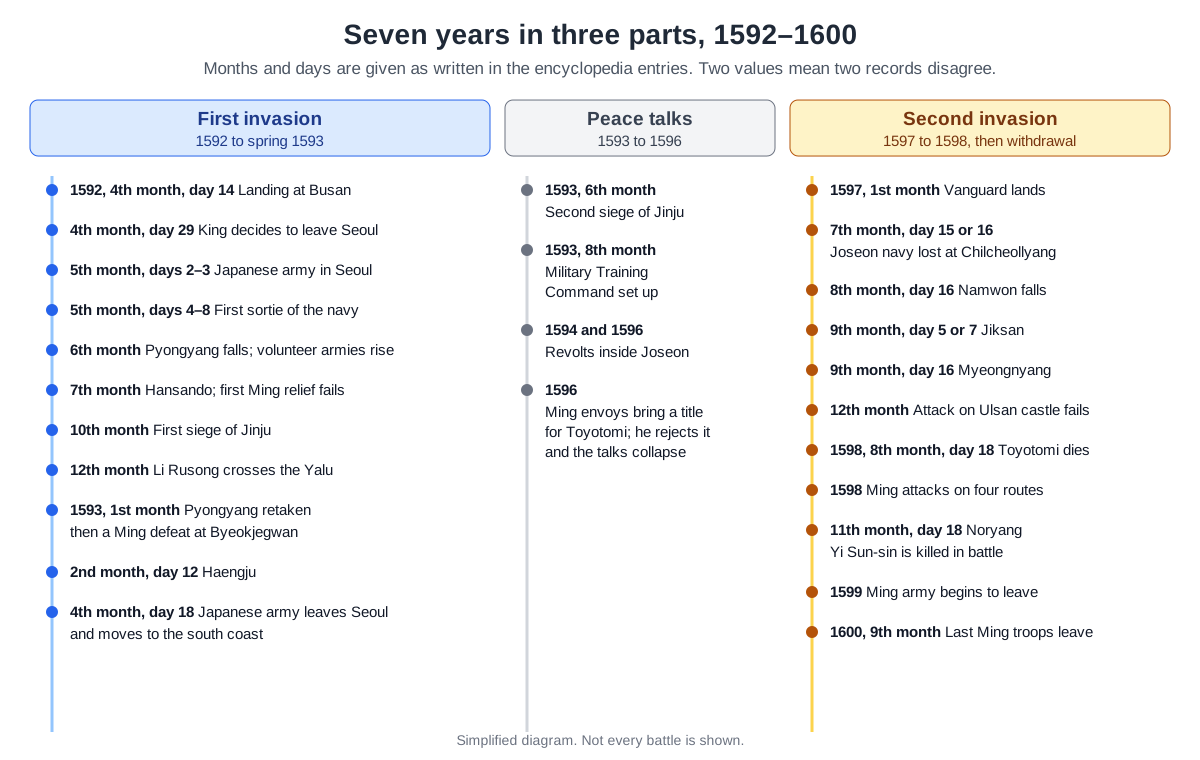
The Japanese army crossed in nine divisions. The numbers in the "Imjin War" entry are 158,700 regular land troops, 9,000 navy troops on board and 12,000 rear guards, or more than 200,000 in all. On the 14th day of the 4th month, Konishi Yukinaga's First Division entered Busan harbor. Jeong Bal, commander of Busanjin, and Song Sang-hyeon, magistrate of Dongnae, were killed fighting.
The Japanese moved north along several routes.
At Sangju, the commander Yi Il searched villages through the night and gathered a few hundred men. They were farmers who had never trained as soldiers, and a sudden attack by Konishi's division routed them. At Chungju, Sin Rip drew up more than 8,000 troops at Tangeumdae with a river at their backs. The Japanese came on along split routes, firing muskets; when his whole army collapsed, Sin Rip threw himself into the Dalcheon River.
The news of Chungju reached Seoul on the 29th day of the 4th month, and King Seonjo decided that night to leave for the west. His ministers urged him to move to Pyongyang and ask the Ming for troops, and around the same time his second son, Gwanghaegun, was named crown prince. Konishi's division reached Seoul on the 2nd day of the 5th month and Katō Kiyomasa's on the 3rd.
While the king was away, the palaces burned. The records disagree about who set the fires.
The Revised Annals of King Seonjo say that once the king left, rioters burned the offices that kept the slave registers. They add that Gyeongbokgung, Changdeokgung and Changgyeonggung all burned at that time. The Seojeong ilgi, the diary of a monk who traveled with Konishi's division, says Gyeongbokgung burned down on the 7th day of the 5th month. The "Imjin War" entry adds that this suggests the Japanese army burned Gyeongbokgung.
The king moved on through Gaeseong and Pyongyang to Uiju. Konishi's division took Pyongyang in the 6th month, and Katō's division went into Hamgyeong Province. Two princes, Imhaegun and Sunhwagun, had gone north to raise troops for the king. In Hamgyeong, local people who had turned against the court seized them and handed them to the Japanese.
How the tide turned at sea and in the counties
The tide first turned at sea. Just before the war, Joseon is thought to have had about 250 panokseon warships. Early on, however, the Gyeongsang Province fleets were nearly wiped out, and only four warships were left on the Left Gyeongsang side. The navy came to rest on the fleets of the two Jeolla commanders, Yi Sun-sin on the left and Yi Eok-gi on the right, and Yi Sun-sin took command.
Yi Sun-sin's first sortie ran from the 4th to the 8th day of the 5th month of 1592. His fleet burned or broke 37 enemy ships at Okpo and nearby waters. From the battle of Sacheon in the second sortie, the turtle ship was in use.
In the 7th month, the fleet drew a Japanese squadron out of the Gyeonnaeryang strait into the open water off Hansando and spread out in the crane-wing formation. With the battle of Angolpo that followed, Joseon took control of the sea, meaning it decided who could use the sea lanes. This cut off the Japanese advance into the Yellow Sea.
On land, volunteer armies rose.
From the 6th month on, volunteers and monk soldiers took up arms across all eight provinces. The volunteers ranged from yangban aristocrats to the lowest classes, and most of their leaders were former officials, above all civil officials. Gwak Jae-u of Uiryeong in Gyeongsang Province wore red and was called the Red-Robed General. The old monk Hyujeong (Seosan Daesa) of Mount Myohyang raised monk soldiers from his thousands of disciples.
In the 1st month of 1593, the count of volunteers reported to the Ming camp was more than 22,600. That was a quarter of the size of the government army, and much lower than in 1592, when volunteer activity peaked. In the 10th month of 1592, the Jinju magistrate Kim Si-min joined with soldiers, officials and townspeople to win a major victory in the first siege of Jinju.
The Ming army and the long peace talks
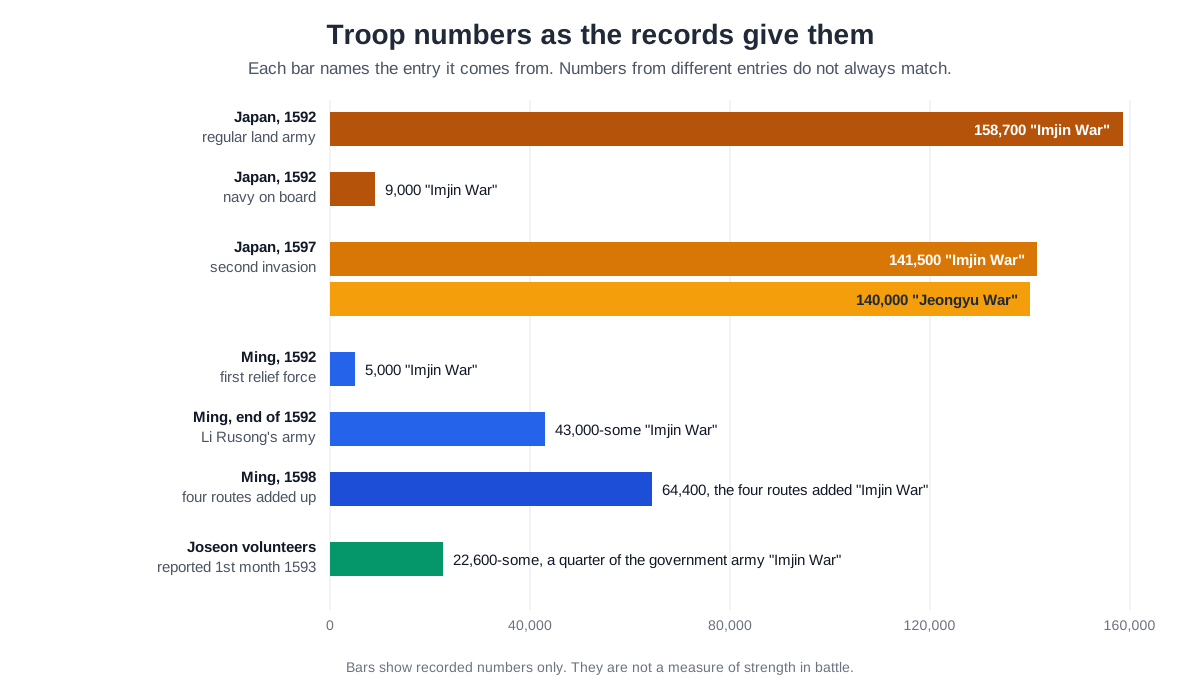
While fleeing, King Seonjo sent envoys to the Ming to ask for help. The first relief force was 5,000 men under Jo Seung-hun, a deputy commander from Liaoyang. They were border guards, not an army sent by the Ming court. They reached Pyongyang on the 15th day of the 7th month, attacked, and suffered a heavy defeat.
The Ming then sent Shen Weijing to talk peace with Konishi.
In the 12th month of 1592, Li Rusong crossed the Yalu with more than 43,000 troops. In the 1st month of 1593, the allied Joseon and Ming armies attacked Pyongyang, and Konishi's division pulled back across the frozen Taedong River. Hyujeong's monk soldiers joined this fight. But as Li Rusong pushed south, he walked into a Japanese ambush on a ridge south of Byeokjegwan, north of Seoul, and fell back to Gaeseong after a heavy loss.
On the 12th day of the 2nd month of 1593, the Japanese in Seoul attacked Haengju fortress in force. Gwon Yul, governor of Jeolla, and the monk commander Cheoyeong drove them off. This battle is counted with Kim Si-min's Jinju and Yi Sun-sin's Hansando as one of the three great victories of the war.
Volunteer armies, the Ming army, supply problems and an epidemic together drained the Japanese will to fight. Under the peace talks, they left Seoul on the 18th day of the 4th month and moved to the south coast. There they built forts between Seosaengpo and Ungcheon to wait for the outcome.
In the 6th month of 1593, during the talks, they attacked Jinju again. In the second siege of Jinju, Kim Cheon-il, Choe Gyeong-hoe, Hwang Jin and others were killed, and when the fortress fell, tens of thousands of people inside lost their lives.
The talks dragged on for years and then broke down.
The "Imjin War" entry lists four terms from Toyotomi. A Ming princess was to become a Japanese consort, and the gamhabin trade seal was to be restored. Four of Joseon's eight provinces were to be handed over, and Joseon was to send a prince and 12 ministers as hostages. The "Jeongyu War" entry says the peace terms had seven articles and names the princess and the four southern provinces among them.
Knowing the terms could not be accepted, Shen Weijing and others hid them and kept the talks going by deceiving both the Ming emperor and Toyotomi. In 1596, Ming envoys brought a document naming Toyotomi king of Japan, along with a gold seal, and he refused them. The "Jeongyu War" entry says the deception came to light at the Osaka meeting in the 9th month of 1596 and the talks collapsed.
The second invasion of 1597 and the end in 1598
In the 1st month of 1597, a vanguard of 14,500 crossed the sea again. From the middle of the 3rd month, the main army followed; the "Imjin War" entry puts the total at 141,500 and the "Jeongyu War" entry at 140,000. The first goal of this invasion was to take Honam, that is, Jeolla Province. Around this time Yi Sun-sin, who had been guarding the sea, was jailed, and Won Gyun took his place.
At the battle of Chilcheollyang in the 7th month, the Joseon navy was almost destroyed. The date is the 15th day in the battle table of the "Imjin War" entry and the 16th in the main text of the "Jeongyu War" entry.
On land, Namwon fell on the 16th day of the 8th month, and Jeonju passed to the Japanese without a fight. The "Jeongyu War" entry says this war led to the thorough ravaging of Jeolla. In counties such as Namwon, Yeonggwang, Jinwon, Geumgu and Gimje, tens of thousands of people had their noses cut off.
The Japanese army moving north was stopped by the Ming at Jiksan. The "Imjin War" main text dates it to the 5th day of the 9th month. Its table and the "Jeongyu War" entry give the 7th.
On the 16th day of the 9th month, Yi Sun-sin, back in command of the navy, defeated the Japanese navy at Myeongnyang. After that, the Japanese built forts along the south coast from Ulsan to Suncheon and stayed in them.
According to the "Jeongyu War" entry, more than 40,000 Ming troops under Yang Hao attacked the Japanese castle at Ulsan in the 12th month of that year. More than 10,000 troops under Gwon Yul joined them, but they could not take it. In 1598, the Ming split into four routes and struck Ulsan, Sacheon and Suncheon at the same time. The "Imjin War" entry gives 24,000 for the east route, 13,500 for the central route, 13,600 for the west route and 13,300 for Chen Lin's navy.
Toyotomi died of illness on the 18th day of the 8th month of 1598. Following his last order to hide his death and bring the army home, the Japanese began to pull out. On the night of the 18th day of the 11th month, more than 500 ships under Shimazu came to Noryang to rescue Konishi's division at Suncheon. The allied fleet under Yi Sun-sin and the Ming naval commander Chen Lin met them, and Yi Sun-sin was killed by a bullet in this battle.
The Ming army also began to leave in 1599, and the last 24,000 troops in Seoul left in the 9th month of 1600. So ended the seven-year war.
The two entries stress different forces in turning the war. The "Imjin War" entry says the Ming helped, but Yi Sun-sin's control of the sea and volunteer armies across the country were the decisive forces. The "Jeongyu War" entry tells the story after 1597 around the Ming counterattack, meaning the battle of Jiksan and the four-route attack of 1598, and around the battle of Myeongnyang.
Weapons and military reforms of the time
The weapon named most often in this war is the jochong musket. Japan made it in large numbers to prepare for war, and it appears in the account of the battle at Tangeumdae. Joseon's long-standing main weapons were bows and arrows, spears and swords, and the chongtong, wangu and hwajeon.
At sea, the difference in ships comes up. Among the reasons the navy kept winning, the "Imjin War" entry says Joseon's warships were sturdier than Japan's and had more firepower. At Hansando, too, the fight opened with fire from various chongtong guns.
New weapons appeared during the war. The bigyeok jincheonroe and the hwacha were invented at this time.
The bigyeok jincheonroe was a shell made by Yi Jang-son, a gunsmith of the royal arsenal under King Seonjo. A surviving example is a designated Treasure at the National Palace Museum of Korea. Joseon learned musket making and how to obtain saltpeter from Japanese soldiers who had surrendered, used both in battle, and also copied a weapon called the bullanggi.
The way the army was organized changed too. Joseon obtained Qi Jiguang's military manual, the Jixiao Xinshu, and followed its Zhejiang-style training. In the 8th month of 1593 it set up the Military Training Command to train the "three-skill soldiers." In the provinces it formed sogo units and sent instructors.
The changes reached beyond weapons to the system that trained soldiers.
Grain was another thing that kept the war going. After the Ming army arrived, the Joseon government gave the country's grain to the Ming troops before its own army, and gathering that grain cost ordinary people dearly. Shipping by sea came into wide use when the Ming army came a second time during the Jeongyu War. What modern armies group under logistics was one pillar of this war too.
The damage left behind, and the records
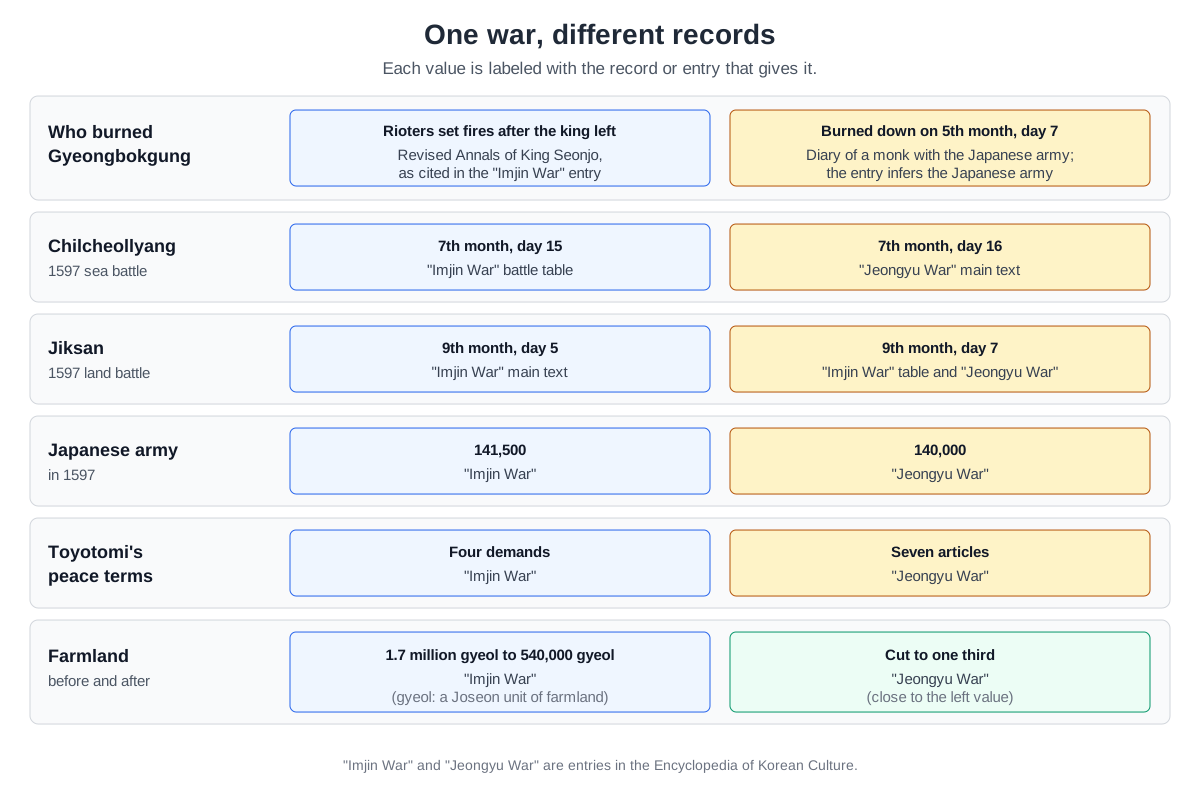
The war did great damage. The "Imjin War" entry says the country's farmland shrank from 1.7 million gyeol before the war to 540,000 gyeol, and the "Jeongyu War" entry says farmland fell to one third. A gyeol was the unit Joseon used to count farmland. The two values describe a loss of roughly the same size.
Palaces and many other buildings, books and works of art were burned or looted. Of the archives that held the royal annals, only the one at Jeonju survived. Many people were taken to Japan as captives, forced to farm or sold as slaves. Potters taken from Joseon greatly advanced Japan's ceramics industry, and printing type and books were carried off to Japan too.
Order inside the country was shaken. In return for war service or grain, sons of concubines could enter official careers and slaves could be freed, loosening the barriers between classes. The "Jeongyu War" entry says the class system was badly shaken as slave registers were lost and a policy gave rewards or posts in return for grain. During the war, revolts broke out too, such as Song Yu-jin's in 1594 and Yi Mong-hak's in 1596.
The effects spread beyond Joseon. The "Imjin War" entry says the power of Japan's regional lords fell sharply, making it easy for Tokugawa Ieyasu to take control of the country. Sending a large army drained the Ming state and threw its finances into disorder, and it gave the Jurchens of Manchuria room to grow. Both entries treat this as a turning point toward the change from the Ming to the Qing.
This war can still be read today because records survived. Yu Seong-ryong, who as chief commissioner had overseen the commanders early in the war, wrote the Jingbirok after leaving office, covering the years 1592 to 1598.
The title comes from a line in the Book of Songs about taking warning from the past to guard against trouble to come. The book was printed in 1647 and printed again in Kyoto, Japan, in 1695. In 1712, the Joseon court ordered that the Jingbirok not be sent to Japan.
Many events are recorded in different ways, such as how Gyeongbokgung burned, the dates of Chilcheollyang and Jiksan, and troop numbers. Reading only one record makes it easy to miss what another one saw. That is why the numbers in this article carry the names of their entries.
What to read next
- Yi Sun-sin and the Battle of Hansando: a closer look at the records of the sea battle that turned the tide in 1592.
- The Battle of Myeongnyang: Thirteen Ships and the Uldolmok Strait: the sea battle of the 16th day of the 9th month of 1597.
- The Turtle Ship: What the Records Confirm and What We Don't Know: the ship in use from the battle of Sacheon on.
- Righteous Armies and Monk Soldiers in the Imjin War: picking up the volunteer armies this article passed over quickly.
- Logistics, Supply and Maintenance: just as moving grain was one pillar of this war, this article looks at what modern armies group under logistics.