On the 30th day of the 1st month of 1637, King Injo walked out of the West Gate of Namhansanseong. The Injo Sillok, the court's official annals, records that he wore indigo-dyed clothes and rode a white horse. He had removed all royal insignia and took only about 50 attendants. At Samjeondo, a crossing on the Han River below the mountain, he bowed three times and touched his head to the ground nine times before Emperor Taizong of Qing.
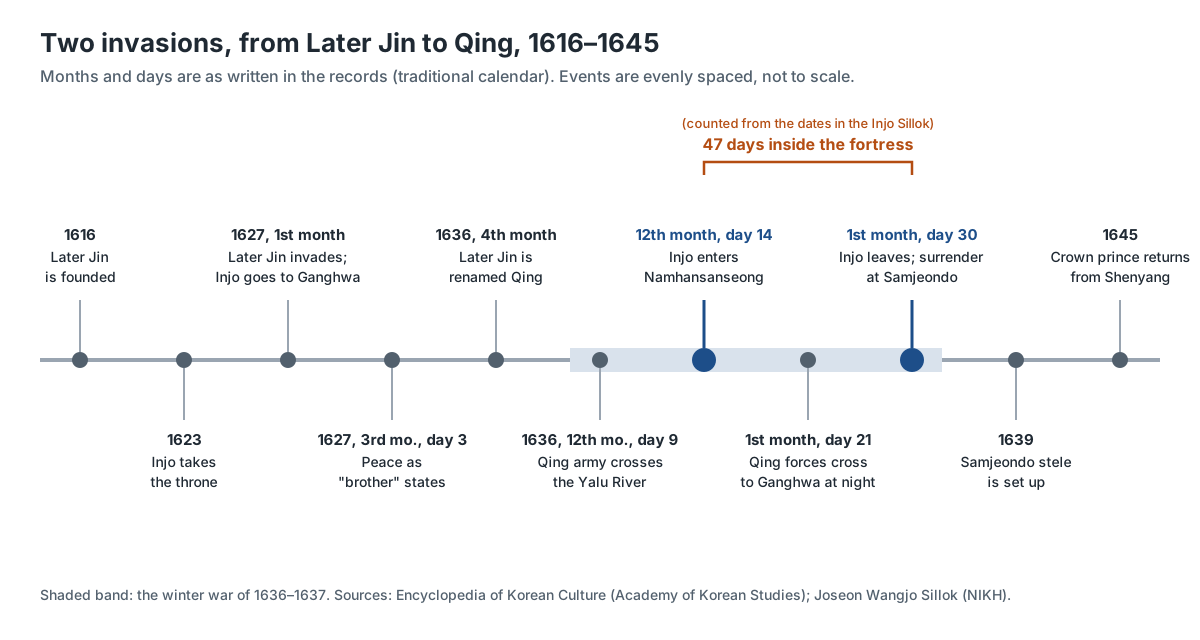
The king had entered the fortress late on the 14th day of the previous 12th month. Counting both the day he went in and the day he came out, the dates in the Sillok give 47 days.
This article starts nine years earlier with the invasion of 1627. It follows both wars through the Sillok and through entries in the Encyclopedia of Korean Culture, written by modern historians. All dates are the months and days of the old calendar used in the records.
A pact of brothers: the 1627 invasion
The Jurchen tribes scattered across Manchuria united under Nurhaci and founded Later Jin in 1616. When Later Jin clashed with Ming China, Ming asked Joseon to send troops as well. King Gwanghaegun sent Gang Hong-rip with 13,000 men to help the Ming army, but secretly told him to act according to how the situation turned. The "Jeongmyo Horan" entry calls this "a cautious, neutral foreign policy."
In 1623, a faction known as the Westerners took power by removing Gwanghaegun and placing Injo on the throne. They rejected his foreign policy outright. They cut ties with Later Jin and supported the Ming general Mao Wenlong. With trade blocked by both Ming and Joseon, Later Jin suffered severe shortages of goods.
In the 1st month of 1627, the Later Jin commander Amin invaded with 30,000 troops. His army took Anju, passed Pyongyang, and reached Hwangju, while Injo moved to Ganghwa Island. Volunteer militias rose in many places, and leaders such as Jeong Bong-su and Yi Rip stood out.
Peace was made on Ganghwa. A vice minister, Choe Myeong-gil, argued for talks, and the court agreed. On the 3rd day of the 3rd month, the two countries agreed to call each other brothers. Later Jin troops would not go beyond Pyeongsan and would withdraw at once, and Joseon would not treat Ming as an enemy despite the pact.
The war ended after about two months, and the court came back from Ganghwa in the 4th month.
The demand to become a subject state
Joseon saw the brotherly relationship as a humiliation. Heavy annual tribute and frequent demands for goods were a real burden, and the court leaned more and more toward rejecting Later Jin. Even so, from 1628 it supplied a small amount of necessities beyond formal gifts through trade at Junggang and Hoeryong.
Later Jin kept growing. It took most of Manchuria and raided past the Great Wall to near Beijing. It now asked to turn the pact of brothers into a bond of ruler and subject. It also demanded much heavier tribute, such as 10,000 nyang of gold and silver and 3,000 war horses, plus 30,000 picked soldiers.
Joseon was being asked to become a subject state, not a younger brother.
In the 2nd month of 1636, the envoys Yonggoldae and Mabutae came and pressed this demand. Injo refused to receive them and would not accept their letter. In the 4th month, Later Jin changed its name to Qing and its era name to Chongde. In the 11th month, Qing gave Joseon envoys in Shenyang a final demand to send a prince, ministers, and those who argued against peace, and Joseon ignored it.
The 14th day of the 12th month: Namhansanseong instead of Ganghwa
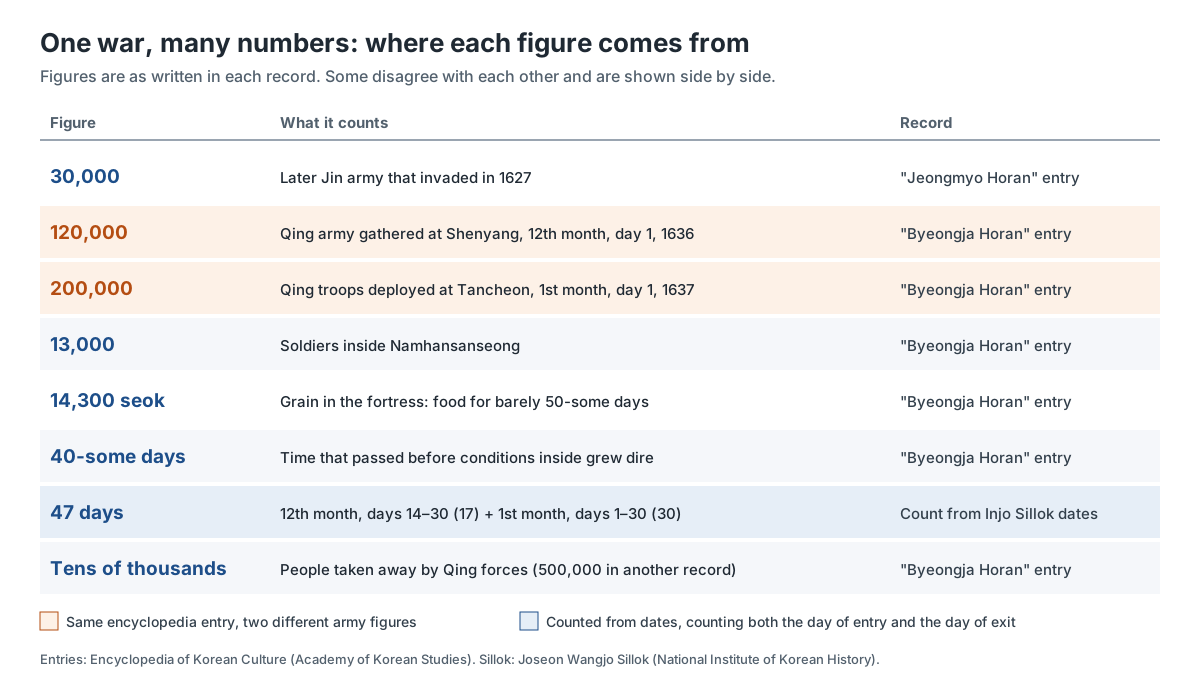
Emperor Taizong decided to lead the war himself. The "Byeongja Horan" entry says that on the 1st day of the 12th month of 1636, 120,000 troops gathered in Shenyang: 70,000 Qing, 30,000 Mongol, and 20,000 Han Chinese.
The vanguard crossed the Yalu River on the 9th. It went around Baengma Fortress, which Im Gyeong-eop held firmly, rode day and night, and neared Seoul about ten days after leaving Shenyang.
The urgent report reached the court on the 12th.
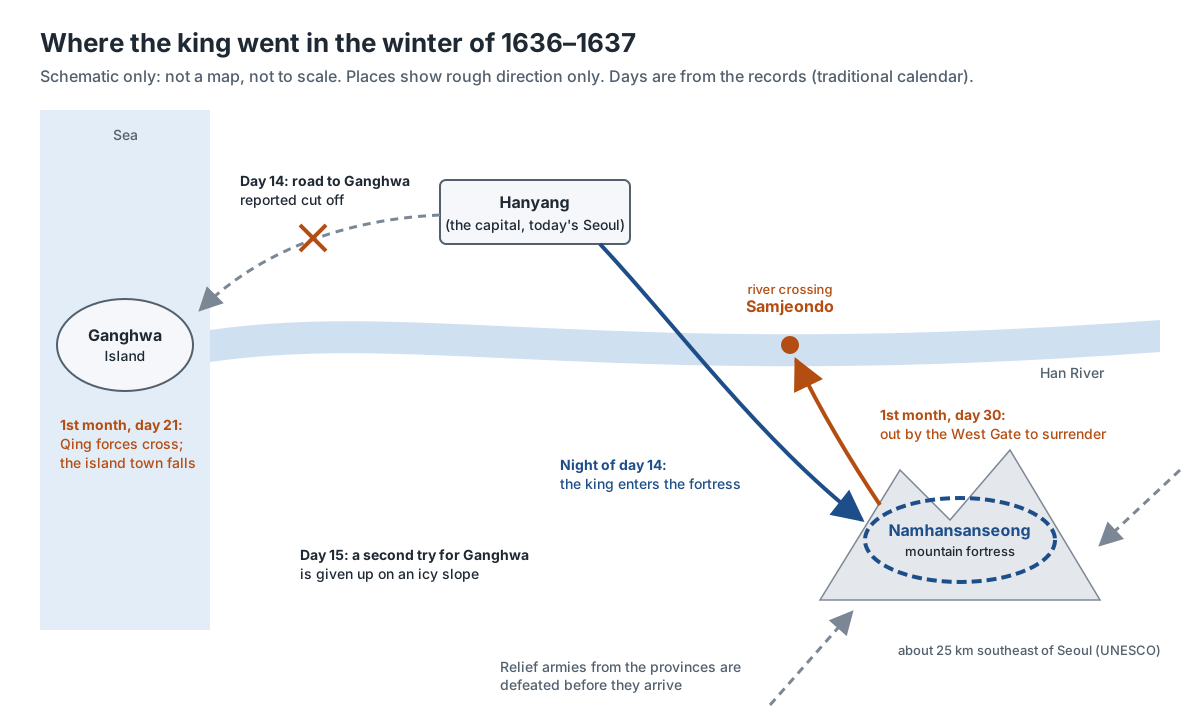
On the 14th, the court sent Yun Bang and Kim Sang-yong to Ganghwa with the royal ancestral tablets. With them went the crown princess, the eldest royal grandson, and the princes Bongnim and Inpyeong.
Injo also set out for Ganghwa that night, but a report came that Qing troops had blocked the Yangcheon River crossing and cut the road. While Choe Myeong-gil went to the Qing camp to stall for time, the king headed for Namhansanseong with the crown prince and his officials. The Sillok says the royal carriage reached the fortress "after the first watch of the night."
That same night, some still urged a move to Ganghwa. Kim Ryu warned, "If you stay in an isolated fortress, there will be no help from outside, and fodder and food will run short." He added that Ganghwa was convenient for Joseon and hard for the enemy to reach.
Before dawn on the 15th, the king left the fortress, but his horse slipped on slopes frozen after snow. He dismounted and walked, slipped again several times, gave up on Ganghwa, and returned.
What kind of fortress stood on the mountain
Namhansanseong stands in mountains 25 km southeast of Seoul. UNESCO describes it as a place designed as an emergency capital for the Joseon dynasty. The Samguk Sagi records that a fortress called Jujangseong was built in this area in 673, and the present walls are the result of rebuilding in 1624.
The work was led by Yi Seo, and the monk Gakseong was put in charge of monk soldiers called up from all eight provinces. UNESCO likewise notes that the fortress was built and defended by Buddhist monk-soldiers and could hold 4,000 people. Two years later it had 1,897 parapet sections, 3 ongseong outworks, 4 gates, 16 hidden gates called amun, 80 wells, and 45 springs.
The county offices of Gwangju moved inside. A detached palace for the king was built in the 9th month of 1624.
The outer face of the walls is steep, while the inner side slopes gently. The ground favors the defenders and makes approach hard. The parapets have narrow openings called tagu, cut so that defenders could shoot bows or guns through them.
In its inscription criteria, UNESCO links the defensive system to a fresh look at Chinese and Korean fortification standards. It also links it to fears raised by new firearms from the West.
Not every structure seen today existed in the winter of 1636, though. The parapets had their bricks removed and were roofed with tiles in 1744, and more facilities were added up to the reign of King Sunjo. Namhansanseong was inscribed as a UNESCO World Heritage site in 2014.
Forty-seven days inside the walls
The "Byeongja Horan" entry puts the soldiers inside the fortress at 13,000. Food came to 14,300 seok of grain and 220 jars of soybean paste, enough for barely 50-some days. Sin Gyeong-jin held the eastern wall at Mangwoldae, Gu Goeng the south, Yi Seo the north, and Yi Si-baek the west.
The Qing vanguard reached the fortress on the 16th day of the 12th month and surrounded it. From the 18th, small groups slipped out a few times to fight and lift morale, but there was no major battle. On the 1st day of the 1st month, Emperor Taizong deployed his troops at Tancheon below the mountain. He climbed Mangwolbong, east of the walls, to look down into the fortress.
The same entry gives the Qing force at Tancheon as 200,000. That differs from the 120,000 it gives for the army leaving Shenyang. The entry alone cannot settle which is right, so the number chart below shows both.
Those inside were waiting for relief from outside. Regional commanders and provincial governors were told to raise loyalist armies, but the Chungcheong troops broke at Heomcheon and the Gyeongsang troops at Ssangnyeong in Gwangju. Kim Jun-ryong of Jeolla won at Gwanggyosan, then was counterattacked, fell back, and saw his army collapse.
Joseon also asked Ming for help. Ming, troubled by rebels at home, was in no position to send troops, and a plan to send ships was stopped by wind and waves. Namhansanseong was left alone with nothing to lean on.
The "Byeongja Horan" entry says that after 40-some days without a major battle, conditions inside were miserable.
The figure of 47 days comes from the Sillok dates. The 14th to the 30th day of the 12th month makes 17 days. The 1st to the 30th day of the 1st month, when the king came out, makes 30 more. Counting both the day of entry and the day of exit gives 47 days.
Ganghwa falls first
The royal family and the ancestral tablets had gone ahead to Ganghwa, the island Kim Ryu had called hard for the enemy to reach. Kim Gyeong-jing, the inspector in charge of its defense, boasted that Qing troops could never invade Ganghwa. Yet he was at odds with Jang Sin, magistrate of Ganghwa and commander of its naval forces, and the two rejected each other's authority.
On the night of the 21st day of the 1st month, Qing troops began crossing to Ganghwa. From the ferry landing they fired a large cannon called the hongi daepo, and its shots flew over the water and landed several ri inland. Joseon troops fired matchlock guns in return, but damp gunpowder made them misfire.
The town of Ganghwa fell. Qing soldiers captured the crown princess and the princes Bongnim and Inpyeong, while the royal grandson escaped to Gyodong. Officials including the former minister Kim Sang-yong, and many children and women, lost their lives.
The Qing army showed Namhansanseong letters from the captured princes and reports from officials to press for surrender. Once Injo had confirmed that Ganghwa had fallen, he decided to leave the fortress.
Peace or resistance: one crisis, two answers
The court inside the fortress was split in two. One side argued for peace talks to save the country, and the other for refusing peace and fighting on. Choe Myeong-gil, Minister of Personnel, was at the center of the peace side, while Minister of Rites Kim Sang-heon and Vice Minister Jeong On led those who opposed it.
Choe had argued that peace was unavoidable in 1627 as well and had been widely condemned for it. The "Choe Myeong-gil" entry explains that he kept arguing that if the country could not prepare strong measures in advance, it had no choice but to deal with reality. Kim Sang-heon, named Inspector General in 1635, had called for securing military supplies and expanding defenses in the north. Inside the fortress, he argued to the end for fighting.
A well-known story shows the gap between the two men. When Kim tore up the Joseon draft of the peace letter and wept, Choe gathered the pieces. He said the court needed someone who would tear up this letter, and also needed someone like himself.
The "Byeongja Horan" entry writes that the side calling for war had no way out of the crisis either, and that opinion swung toward peace. On the 3rd day of the 1st month, a letter drafted by Choe went to the Qing camp. Emperor Taizong replied that the king must come out of the fortress and surrender in person, and send two or three leaders of the anti-peace side in bonds.
After the war, the two men took different roads. Choe, as Third State Councillor, worked hard to restore a government in disarray. Kim opposed a Qing demand in 1639 for troops to attack Ming, was taken to Qing, and was released six years later. When King Hyojong later planned a northern campaign, Kim was honored as its ideological symbol.
Samjeondo and what came after
On the 30th day of the 1st month, Injo left by the West Gate with the crown prince and went to Samjeondo. According to the Sillok, the king bowed three times and touched his head to the ground nine times before Emperor Taizong. On the road back to Seoul, captives lined the way and cried out, and the Sillok says they numbered ten thousand.
The surrender terms had 11 articles. Joseon had to act as a subject of Qing, hand over the patent and seal it had received from Ming, and drop the Ming era name. It had to send the king's eldest and second sons and the sons of ministers as hostages. It also had to send troops when Qing attacked Ming, stop building or repairing walls, and pay tribute from 1639.
Qing took Crown Prince Sohyeon, the crown princess, and Prince Bongnim as hostages. It also seized Oh Dal-je, Yun Jip, and Hong Ik-han, who had argued against peace, and took them back to Shenyang.
The war lasted little more than a month, yet the "Byeongja Horan" entry says its damage rivaled that of the Imjin War. Tens of thousands of people were taken away by Qing forces, and another record gives 500,000. Most of them were poor people who could not raise money for their release. The divorce of women who came back even became a political and social issue.
Joseon cut ties with Ming and submitted to Qing, a relationship that lasted until Qing lost the Sino-Japanese War in 1895. Official documents used the Qing era name Chongde, but private papers and ritual prayers still used the Ming era name. The "Byeongja Horan" entry adds that the troops Joseon sent at Qing's demand in 1641 went under coercion and fought with very little will.
In 1639, a stele praising Emperor Taizong was set up at Samjeondo. Qing forced Joseon to build it. The front carries Mongolian and Manchu script, the back carries Chinese text, and the inscription was composed by Yi Gyeong-seok. The stone body stands 395 cm tall, and it was designated a historic site in 1963.
Crown Prince Sohyeon and Prince Bongnim came home in 1645, but the crown prince died two months later. Bongnim, who became King Hyojong, expanded the army and planned a northern campaign, but he died after ten years on the throne without carrying it out. Inside the East Gate of Namhansanseong stands Hanjeolsa, a shrine set up in 1688. It holds the memorial tablets of Hong Ik-han, Yun Jip, Oh Dal-je, Kim Sang-heon, and Jeong On, who had argued against peace.
What to read next
- The Imjin War at a Glance: Seven Years from 1592: the great war Joseon went through before the Manchu invasions.
- Goryeo Against the Mongols: The Move to Ganghwa and Thirty Years of War: an earlier war in which people held out on Ganghwa and in mountain fortresses.
- The Gunpowder Revolution: How Muskets and Cannon Changed Armies: the wider story of gunpowder weapons, including cannon and matchlocks like those used at Ganghwa.
- A history of laser weapons: from chemical to electric lasers: how defensive weapons have changed since the age of walls and cannon.