In November 1950, an unfamiliar jet with wings swept back appeared in the sky near the Yalu River. It was the Soviet-designed MiG-15. Until the armistice more than two and a half years later, jet fighters clashed again and again in the sky between the Chongchon and Yalu rivers in northwest Korea. That sky earned the nickname "MiG Alley."
Why that narrow piece of sky? Part of the answer lies in a border: the Yalu River. Using public records, this article looks at where MiG Alley was and why UN pilots did not cross the Yalu. It also traces where the two jets came from and how the numbers differ between sources.
November 1950: an unfamiliar jet
Sources do not agree on who flew the first MiG-15s. The Smithsonian National Air and Space Museum (NASM) says that late in 1950, Russian pilots were flying the MiG-15s that showed up over North Korea. It adds that MiG-15s from China and North Korea joined them before the war ended. The Australian War Memorial (AWM) says the Chinese Air Force brought the Soviet-built MiG-15 into the fighting in November 1950.
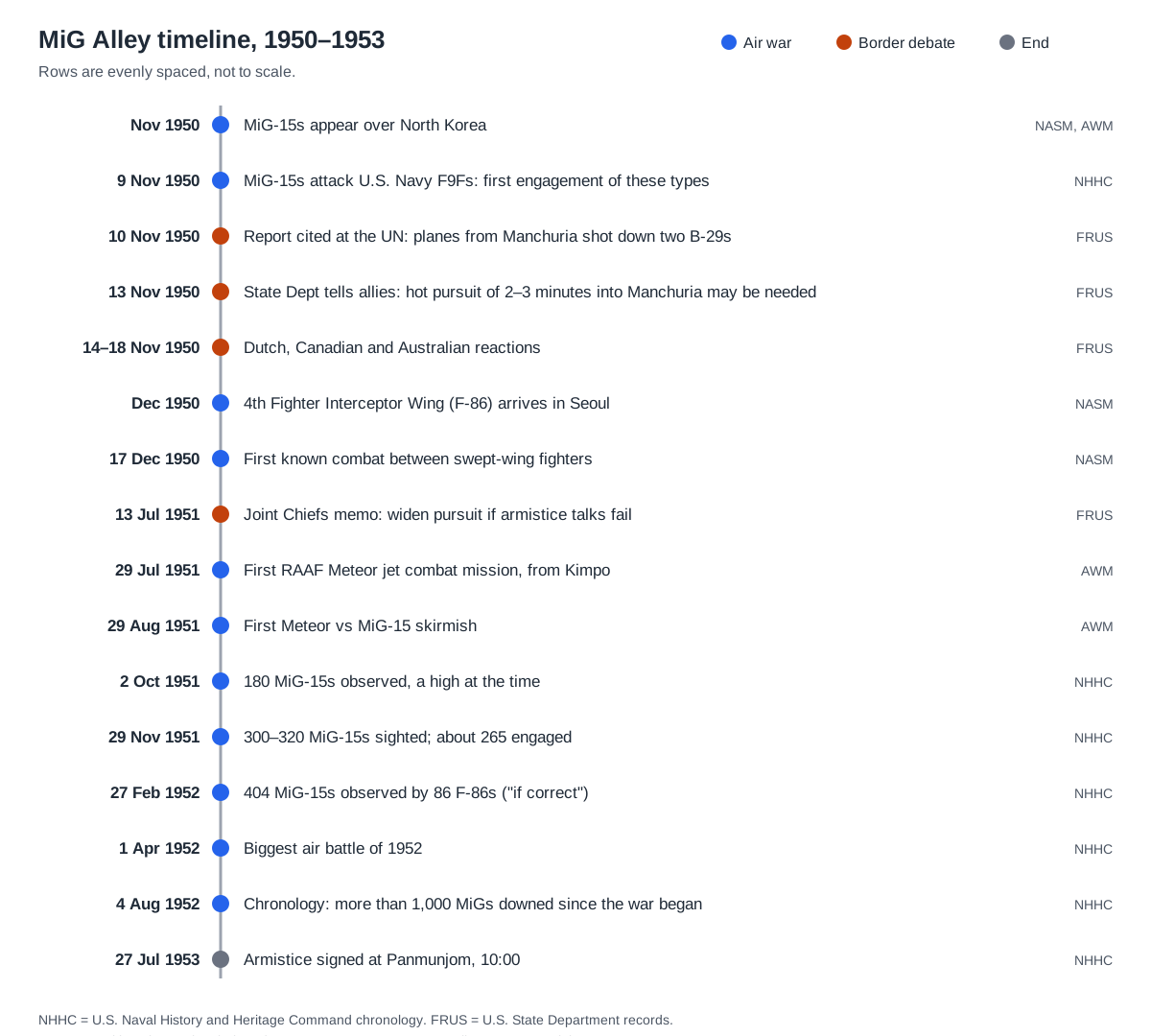
The Korean War chronology of the Naval History and Heritage Command (NHHC) records 9 November in a few lines. That day the carrier force, Task Force 77 (TF 77), made its first attack on the international bridges over the Yalu. On the same day, MiG-15s attacked F9F jets from the carrier USS Philippine Sea, and the chronology lists this as the first engagement between planes of these types. On 18 November, eight F9Fs met eight to ten MiG-15s, and one MiG-15 was reported shot down and five damaged.
The MiG-15 carried one 37 mm cannon and two 23 mm cannon. In NASM's account, it drove piston-engined aircraft, including the B-29 bomber, from the skies. First-generation jets such as the F-80 and F-84 could not handle it, so the United States rushed the F-86 to Korea to regain air superiority.
A narrow sky south of the Yalu
"MiG Alley" was the nickname for the area between the Chongchon Valley and the Yalu River, on the border between Manchuria and Korea. The AWM entry for the place explains that the opponents there were MiG fighters based at an airfield across the border in Antung. It was a band of sky at the far northwest corner of North Korea, just south of the border.
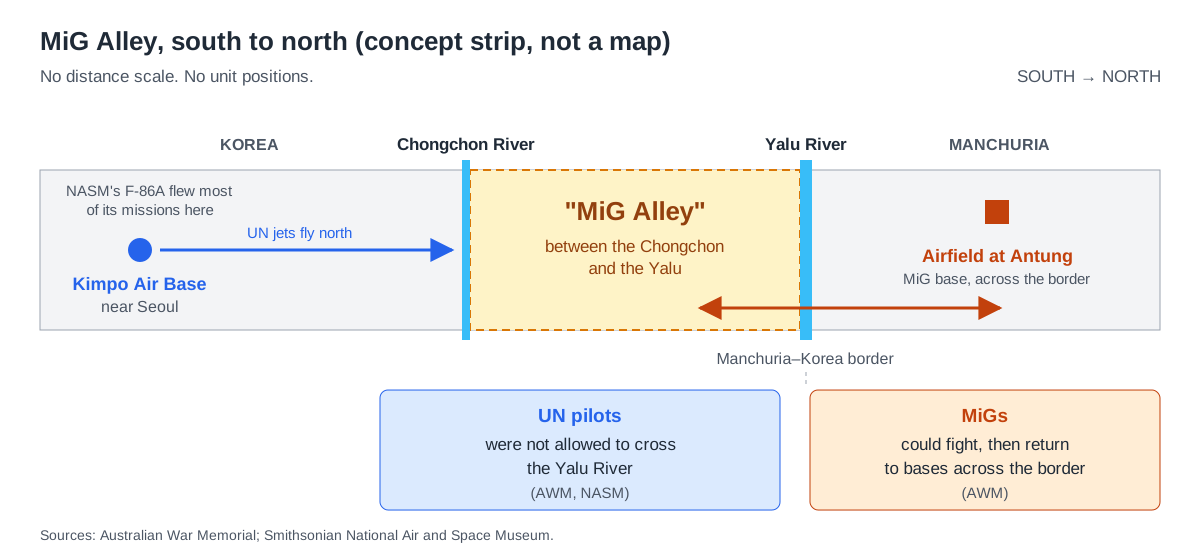
Over the rest of Korea, UN air power was generally superior. Even so, MiG Alley was the most dangerous area for Royal Australian Air Force (RAAF) pilots. With the border so close, MiGs could fight and then fly straight back to bases across the Yalu, while UN pilots were barred from flying across that river.
One line in the May 1952 chronology shows how this sky was used. That month MiG-15s again attacked UN fighter-bombers aggressively as they went after rail targets in the northwest. The chronology read this as a sign that the enemy meant to make fuller use of its defenses in the area between the Yalu and the Chongchon.
The border that could not be crossed
The border became a question for Washington almost as soon as the MiGs appeared. At the Security Council, U.S. Ambassador to the UN Austin cited reports received on the afternoon of 10 November 1950. They said planes operating out of Manchuria had shot down two UN B-29 bombers.
The same day, Clubb, the State Department's director of Chinese affairs, wrote a memo noting that the Korean question sat inside the UN framework. In his view, no military action should cross into Manchuria without UN sanction, whether as "hot pursuit" of enemy planes based there or against antiaircraft sites.
Three days later, on 13 November, Secretary of State Acheson sent a telegram to U.S. embassies in allied countries. It named the enemy's use of Manchuria as a "privileged sanctuary" as a grave problem. It warned that UN aircraft might soon need to defend themselves over the Yalu. That could mean chasing attacking enemy aircraft up to "two or three minutes flying time" into Manchurian air space.
The allies did not answer with one voice. On 14 November, Dutch Foreign Minister Stikker said the provocation was beyond doubt. He saw no quarrel with the legal propriety of hot pursuit for a limited flying time. Even so, he voiced deep concern about planes operating across the frontier and asked whether it might lead to all-out war in the Far East.
The same day, the Canadian side said it would recognize the justification for pursuing enemy aircraft across the border. The record also notes the extreme worry of the Australian delegation at the UN.
On 18 November, the Dutch government handed over an aide-mémoire. It said hot pursuit went beyond the authority given to the UN commander and should not be decided without the express approval of the Security Council or the General Assembly.
The question stayed open into the next year: on 13 July 1951, the Joint Chiefs of Staff said military pressure should rise if armistice talks failed. Even so, they did not recommend any action that would draw the United States into a general war with Communist China. Under that condition, one of their recommendations was to widen pursuit in air battles that began over Korea by disregarding the border. In the institutions' accounts, however, Sabre pilots could not chase the enemy across the Chinese border.
Where the two jets came from
The MiG-15 was designed in 1946, after Stalin urgently asked for an interceptor that could fight by day at high altitude. Its first flight came on 30 December 1947, and production was authorized three months later, in March 1948. Its engines came from Britain. The Soviets quickly copied and refined the Rolls-Royce "Nene" and "Derwent" jet engines that Britain had sold to Russia, producing the RD-500, the Klimov RD-45 and a modified VK-1.
The MiG-15 was also the first Russian aircraft with a production swept wing, a pressurized cockpit and an ejection seat. Its designers, Mikoyan and Gurevich, knew of German work on turbojets and swept wings, but NASM considers the design entirely Russian apart from the engine.
The F-86 started a little earlier. In the fall of 1944, the U.S. Army Air Forces ordered three XP-86 prototypes. By mid-1945, it had become plain that the design's top speed would fall well short of the 600 mph the specification asked for. Around then, with Germany's surrender in May 1945, captured German aerodynamic data reached the designers.
What the data showed was the effect of a swept wing. Sweeping the wing back delays the compressibility effects that appear as air is squeezed at high speeds close to the speed of sound. That meant pilots could keep a swept-wing aircraft under control at a higher Mach number than a similar straight-wing aircraft. The trade-off was poor stability at low speed, which the designers solved with a wing swept back 35 degrees and automatic slats on the leading edge.
The first XP-86 flew on 1 October 1947, and in April 1948 it passed Mach 1 in a shallow dive. The two aircraft first flew less than three months apart. Their guns differed too: the Sabre carried six .50-caliber M3 machine guns in the nose. Its first gunsight, the manual-ranging Mark 18, gave way in later models to the A-1CM, which used radar to measure range.
How the fight went, 1951–1953
The 4th Fighter Interceptor Wing, among the earliest Sabre units in the Air Force, reached Seoul in December 1950. On 17 December, Lieutenant Colonel Bruce H. Hinton downed a MiG-15 in what NASM calls the first known fight between swept-wing fighters. The F-86A now at NASM went by ship to Japan with this group in December 1950 and later flew the bulk of its missions out of Kimpo, near Seoul.
Other nations' units flew there too. No. 77 Squadron of the RAAF traded its propeller-driven Mustangs for Gloster Meteor F Mk8 jets and flew its first jet combat mission from Kimpo on 29 July 1951. The first clash between Meteors and MiG-15s came on 29 August.
When the early encounters went poorly, Meteor operations were restricted: No. 77 Squadron stayed out of MiG Alley and flew patrols, light-bomber escort and ground attack. Its role narrowed again on 2 December, and from 8 January 1952 to the end of the war it flew mainly ground attack. Of the 37 RAF pilots who flew operations with the squadron, six were killed and one became a prisoner after being shot down.
The number of MiGs in the sky kept rising. On 2 October 1951, 180 MiG-15s were observed over Korea, the most up to that time. On 29 November, a record 300–320 were sighted, and UN fighters engaged about 265 of them in four large air battles.
On 27 February 1952, 86 F-86s observed 404 MiG-15s over northwest Korea. The chronology attached a caveat to that figure: "if correct."
On 1 April 1952, the biggest air battle of that year took place over northwest Korea. The reported result for the day was 10 MiGs destroyed, three probably destroyed and 12 damaged, against one F-86 lost and two lightly damaged. After many such days, the armistice was signed at Panmunjom at 10:00 on 27 July 1953, and all hostilities stopped at 22:00 that night.
The numbers depend on who counted
MiG Alley losses are often passed on as a single ratio, such as ten to one. That ratio comes from counts made at the time on the UN side, and the other side's claims are very different. The sources also count different things over different periods.
Among UN-side counts from the time, NASM's F-86 page puts Sabre kills at close to 800 MiG-15s by the end of the war, against fewer than 80 F-86s lost. Another paragraph there gives a victory ratio above ten to one. The museum's MiG-15 page also has a line putting MiG-15 losses against the F-86 at a ratio of 10:1. Meanwhile, the U.S. Navy chronology entry for 4 August 1952 records that more than 1,000 communist MiGs had been downed since the war began.
These two cannot be compared directly either. The first is what Sabres scored through the end of the war; the second is what all UN aircraft had scored by August 1952.
The other side's numbers came out only after Soviet involvement stopped being a state secret. From 1989 the facts poured out, and Soviet veterans began to acknowledge that they had flown in the Korean dogfights.
In a February 1991 article in the U.S. magazine Air Force Magazine (now Air & Space Forces Magazine), Steven J. Zaloga sets out the claims of both sides. Soviet accounts claimed no fewer than 1,200 U.S. aircraft shot down by the end of the war, and China claimed 85. Sabre pilots claimed 792 MiG-15s.
The same article also gives the U.S. Air Force's own figure of 139 air-to-air losses (121 fighters and 18 bombers). Those 139 cover all U.S. Air Force fighters and bombers, not only F-86s, so they count a different set of aircraft from the "fewer than 80 F-86s" above.
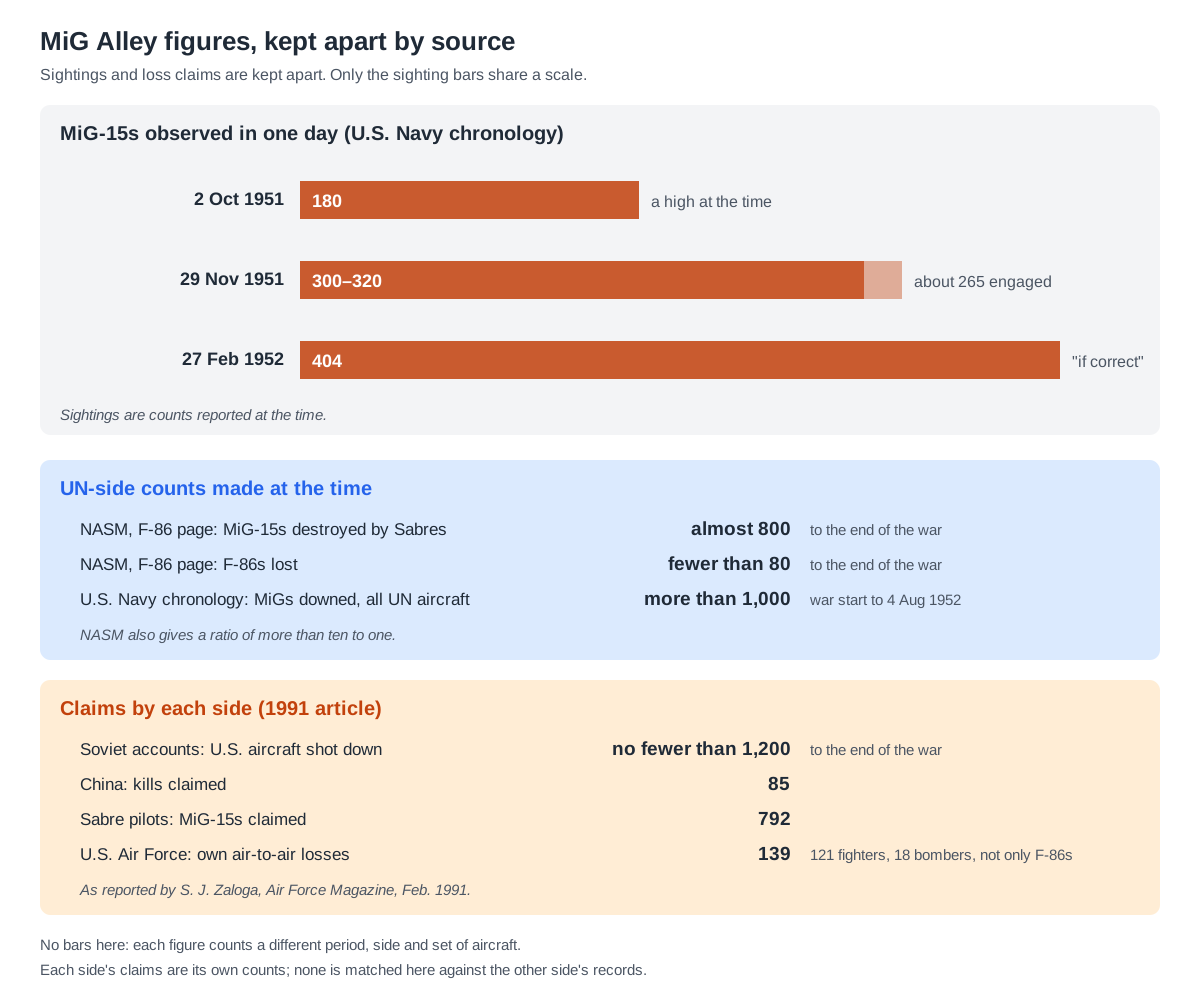
The Soviet and Chinese claims and the Sabre claims are all counts each side made for itself at the time. The public sources opened for this article did not match either side's claims against the other side's records. So this article does not pick either side's figures as the answer; it sets the figures side by side, each with who counted it. Sighting counts are also numbers reported at the time, and on at least one day the chronology itself added the caveat "if correct."
There are people behind the numbers. Most figures in this article count aircraft, but the MiG-15 and the F-86 each carried a single pilot. Like the six British pilots who died flying with the Australian squadron, some of these pilots are recorded by name at the Australian War Memorial.
What it left behind
Both aircraft lasted long after Korea. The MiG-15 was made in 17 versions, over 12,000 aircraft in all, and the type flew in some 35 countries. Lessons from the Korean fighting led to the upgraded MiG-17. A total of 8,443 Sabres were built, 554 of them F-86As, and F-86s were also license-built in Canada, Italy and Japan.
Some accounts give MiG Alley a modest place in the war as a whole. NASM's exhibition text describes air attacks in Korea and Vietnam as limited campaigns fought with conventional weapons and says air power was not decisive in either war. It adds that American strategic air power helped keep the Soviet Union and China from turning these wars into global conflicts.
The line at the border can be read in the same light. The telegrams of November 1950 show that whether to fly a few more minutes past the Yalu was a political question, argued by allied governments worried about all-out war. The narrow sky of MiG Alley was shaped by the aircraft, and also by that decision.
What to read next
- The Outbreak of the Korean War: Dawn, June 25, 1950: how the war began, before this air war.
- The Battle of Chosin Reservoir: A Withdrawal at Minus Thirty: the fighting on the ground in the same winter the MiG-15 appeared.
- Fire-control systems: linking sensors and weapons: the topic that follows from the radar-ranging A-1CM gunsight.
- Radar: measuring distance and motion with radio waves: how returning radio waves measure distance.
- Air-to-air missiles: what the missile sees: the air combat weapons of the era after guns.
- A history of laser weapons: from chemical to electric lasers: another way to stop targets in the air.