Xi'an, China, August 7, 1945. Kim Gu, chairman of the Korean Provisional Government, sat down with Major General William B. Donovan, head of the U.S. Office of Strategic Services (OSS).
On the table was a plan to send young Koreans, just out of three months of special training, back into Korea. About two days later, news came that Japan was surrendering. The operation never went ahead.
Those young men belonged to the Korean Liberation Army, known in Korean as Gwangbokgun. It was the army of the Korean Provisional Government, founded in 1940 in Chongqing, China. This article follows how a government without an army built one, where its soldiers came from, and how it dealt with China, Britain and the United States.
The main sources are Volume 50 of the New History of Korea, from the National Institute of Korean History (NIKH), and the Encyclopedia of Korean Culture.
A government without an army
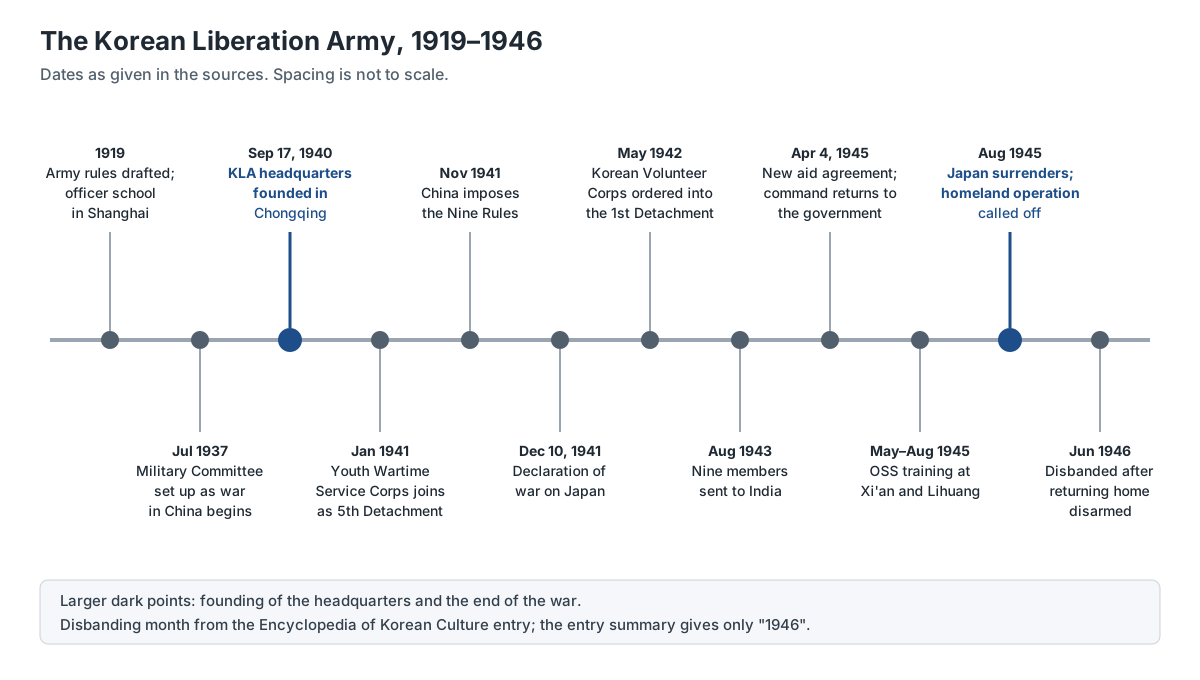
The Provisional Government wanted an army from the start. In 1919 it issued provisional army regulations that set out how a force would be organized. At the end of that year it opened an army officer school in Shanghai.
It also hoped to bring the independence armies in Manchuria under its command. Differences between the regions and money troubles, among other problems, kept these plans from coming true.
In the 1930s, a door opened a little. In 1934 Kim Gu set up a special Korean class at the Luoyang military academy to train officers. When war between Japan and China broke out in July 1937, the Provisional Government formed a Military Committee. Its plan was to train junior officers and raise a force the size of one regiment.
The budget shows how much weight the plan carried. A note in the New History of Korea says the committee set aside 370,000 won for the work, equal to 65% of the government's yearly budget.
Even so, the plan stalled. As Japanese forces took more ground, the government had to keep moving from place to place in China. The army was finally founded only after the government settled in Chongqing, China's wartime capital.
Chongqing, September 1940
Preparations went in three directions: finding soldiers, raising money, and winning approval from the Chinese government. The money came mainly from Koreans living in the United States, who gave generously when asked. Approval mattered because raising an army on Chinese soil required the consent of the Chinese government.
The heart of the plan sent to China was that the new army would act as a Korean–Chinese allied force and fight in joint operations with Chinese troops. Chiang Kai-shek approved it. A founding committee led by former Manchurian independence fighters, including Yi Cheong-cheon, Yu Dong-yeol, Yi Beom-seok and Kim Hak-gyu, drew up the details. They would first set up a headquarters and, from that base, form three divisions within a year.
On September 15, 1940, a declaration went out in Kim Gu's name. It said the army aimed to restore the independence of both Korea and China. It would defeat their common enemy, Japanese imperialism, and fight as one of the Allied forces.
Two days later, on September 17, a ceremony marking the creation of the headquarters was held at the Jialing Guesthouse in Chongqing. Chinese officials and diplomats from several countries attended. That day counts as the founding of the Korean Liberation Army.
The commander was Yi Cheong-cheon and the chief of staff was Yi Beom-seok. The encyclopedia lists the commander as Ji Cheong-cheon. His birth name was Ji Dae-hyeong, and he also went by Yi Cheong-cheon.
All the headquarters officers and detachment leaders were military men who had organized and led independence forces in Manchuria. The new army was built around veterans of those forces.
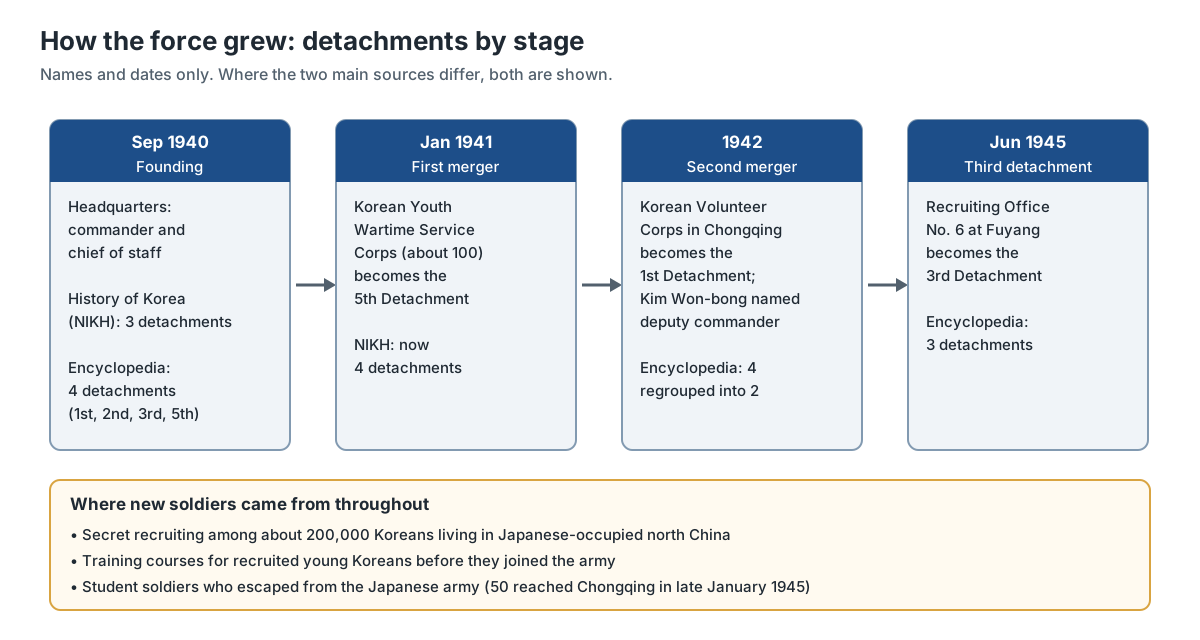
The two main sources describe the first units a little differently. The New History of Korea says the army had a headquarters and three detachments, led by Yi Jun-sik (1st), Gong Jin-won (2nd) and Kim Hak-gyu (3rd). The encyclopedia entry lists four detachments, with Kim Hak-gyu leading the 2nd, Gong Jin-won the 3rd and Na Wol-hwan the 5th.
Where the soldiers came from
Finding soldiers was a pressing problem. It had officers to lead, but no one to serve in the ranks. The leaders looked to north China, which Japan had occupied. About 200,000 Koreans had moved to that region, to cities such as Beijing, Tianjin and Shijiazhuang.
In July 1939, the government's cabinet decided to recruit young Koreans in Japanese-held areas and formed a special military mission. In November the mission went to Xi'an, a city on the front line facing north China.
Its members slipped into occupied areas, set up bases there, and brought young Koreans back. This was called chomo, or recruiting work. The New History of Korea calls it a kind of secret underground operation.
The army set up five recruiting offices. According to the encyclopedia, it had more than 300 soldiers a little over a year after its founding. Recruits went through training courses for young Koreans for a set period before joining the army.
Other armed groups joined and made the force larger. The first was the Korean Youth Wartime Service Corps. Young anarchists formed it in Chongqing on November 11, 1939, with about 30 members.
Working out of Xi'an behind Japanese lines, it grew to about 100 members by the end of 1940. In January 1941 it joined the Korean Liberation Army as the 5th Detachment. By the New History of Korea's account, the army now had four detachments.
The second was the Korean Volunteer Corps. It was formed on October 10, 1938, under Kim Won-bong, and was the first military group set up in China's interior. It began with about 100 members and reached about 330 by February 1940. Then, in March and May 1941, about 80% of its members crossed the Yellow River and moved to north China.
This move pushed the Chinese authorities to take firm control of Korean armed groups. On April 20, 1942, the Provisional Government's cabinet decided to fold the Volunteer Corps into the Liberation Army. On May 15, China's Military Committee ordered that Kim Won-bong become deputy commander and that the Volunteer Corps be reorganized as the 1st Detachment. With that, every armed Korean independence group in China's interior came under the Liberation Army.
The encyclopedia says the army's four detachments were then regrouped into two. The Volunteer Corps members who had gone to north China were expanded into a separate force, the Korean Volunteer Army, in July 1942.
Near the end of the war, young men who had escaped from the Japanese army arrived. According to the encyclopedia, Japan introduced a student volunteer system and conscription in Korea in 1944, and 4,385 young Koreans were forced into the Japanese army. Some of them escaped and came over to the Liberation Army.
Fifty of these escaped student soldiers reached Chongqing in late January 1945. In June 1945, Recruiting Office No. 6 at Fuyang in Anhui province became the 3rd Detachment, giving the army three detachments in all.
Chinese aid and the Nine Rules
The Korean Liberation Army was born with China's consent and help. The ties were close, and they came with limits. The New History of Korea says the army was in practice subordinate to China's Military Committee and operated alongside Chinese forces.
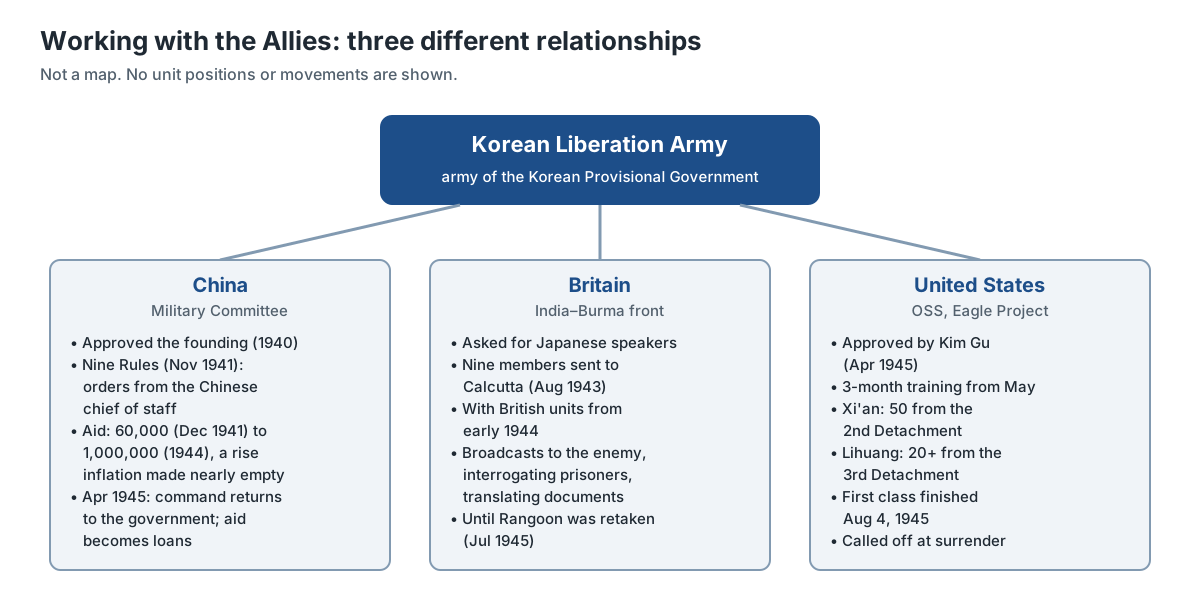
Those limits were written down in the Nine Rules for the Conduct of the Korean Liberation Army. China's Military Committee presented them to the Provisional Government on November 15, 1941. The nine articles restricted who controlled the army and what it could do.
The encyclopedia describes them as China's condition for approving the army, a way to keep its activities in check. Under Articles 1 and 2, the army took orders from the chief of the Chinese general staff, and the Provisional Government held supreme command in name only.
Money was part of the knot. Chinese aid rose from 60,000 won in December 1941 to 1,000,000 won in 1944. The encyclopedia judges the increase almost meaningless because of inflation at the time. In the Provisional Assembly, members called for the Nine Rules to be scrapped.
After long talks, a new military agreement on aid to the Korean Liberation Army was signed on April 4, 1945, to take effect on May 1. Its main points were that supreme command belonged to the Provisional Government and that financial aid would take the form of loans. The army regained control of its own command four months before liberation.
With the Allies: India–Burma and the OSS
In December 1941 Japan attacked Pearl Harbor. On December 10, the Provisional Government issued a statement declaring war on Japan in the names of Kim Gu and foreign minister Jo So-ang. From then on, the army's military course was set toward joint operations with the Allies. The New History of Korea sees the government's strategy as fighting Japan alongside the Allies in order to win a place among the Allied nations after the war.
Cooperation with Britain took place on the India–Burma front. Burma was a main route for Allied war supplies going to China, and Japan's occupation of Burma cut it. British forces fighting Japan needed people who spoke Japanese, and they asked the Liberation Army for help. The army chose nine members who could speak English and Japanese and sent them to Calcutta, India, in August 1943.
The nine studied English and broadcasting for four months. In early 1944 they were spread out among British units. Their work was intelligence: broadcasts aimed at enemy troops, questioning prisoners, and translating captured documents. It continued until July 1945, when British forces retook Rangoon (Yangon), the capital of Burma.
Cooperation with the United States ran through the OSS. The Liberation Army wanted to join the war as part of the Allies. The Americans wanted Koreans for intelligence work against Japan. These interests met in the Eagle Project.
The idea was to select Liberation Army members, give them intelligence training, and send them into the Korean Peninsula to carry out operations behind enemy lines.
Kim Gu gave final approval in April 1945, and a three-month OSS course began in May. Training took place at two sites.
At Xi'an, Captain Clyde B. Sargent was in charge, and 50 members of the 2nd Detachment, including Kim Jun-yeop and Jang Jun-ha, formed the first class. At Lihuang in Anhui province, Captain Clarence N. Weems trained more than 20 members of the 3rd Detachment, including Yun Yeong-mu and Kim Yeong-il.
The homeland operation that never launched
On August 4, 1945, the first class at Xi'an finished its training. The 2nd Detachment at once began preparing an operation to send them into Korea. On August 7, Kim Gu, Liberation Army leaders including Yi Cheong-cheon and Yi Beom-seok, and Major General Donovan of the OSS held a planning meeting in Xi'an. There Donovan said that from that day a secret operation against the common enemy, Japan, would begin between the United States and the Provisional Government of the Republic of Korea.
The members were never sent in. According to the New History of Korea, the Liberation Army heard the news of Japan's surrender around August 9. It came at the very moment the detailed plans and preparations to move out were complete. Kim Gu lamented that years of hard effort to prepare for joining the war had all come to nothing.
The army quickly formed an advance team under Yi Beom-seok. On August 18 the team flew into Korea with OSS personnel, landed at Yeouido airfield, and then returned to Xi'an.
There were other plans to enter Korea, too. Kim Gu made a proposal to Kim Du-bong, chairman of the Korean Independence League in Yan'an. The two sides' armed forces, the Liberation Army and the Korean Volunteer Army, would join up at the Yalu River and enter Korea together.
Such ideas stopped at the stage of proposals and attempts. Still, the author of the New History of Korea overview argues that the intent and vision behind them should not be underrated.
After liberation
After Japan surrendered, the Liberation Army tried to grow by taking in young Koreans in China who had been forced into the Japanese army. But the U.S. Army Military Government in Korea did not recognize the Provisional Government, and it demanded that the Liberation Army disarm. The government's leaders had to return home as private individuals.
The Liberation Army also came home disarmed. According to the encyclopedia, it was disbanded in June 1946. Some of its returning members went on to serve in the armed forces of the Republic of Korea.
Commander Ji Cheong-cheon, after returning in 1945, served in the Constitutional Assembly and as the first minister without portfolio. Chief of staff Yi Beom-seok became the first prime minister and minister of national defense.
The two sources sum up the army's legacy in their own ways. The author of the encyclopedia entry points to the homeland operation falling through just before it began. In that author's view, this cost the Provisional Government its voice on Korean independence after the war.
The New History of Korea holds that Koreans alone could not have fought an all-out war against Japan or defeated it. It describes fighting as one of the Allies, to win a place among them after the war, as the best strategy open at the time.
What to read next
- Fengwudong and Qingshanli: Records of Korean Independence Fighters: the 1920 battles of the Manchurian independence armies that the Liberation Army's officers came from
- The Burma Campaign: A War of Jungle and Air Supply: the wider story of the India–Burma front where Liberation Army members served with British forces
- Finding open sources: where to look for government reports, papers and standards: how to find and read public sources such as the New History of Korea yourself
- A history of laser weapons: from chemical to electric lasers: one branch of weapons technology that grew after World War II