On 4 March 1945, a B-29 bomber named "Dinah" set down in an emergency landing on Iwo Jima's Airfield No. 1. Fighting was still raging in the north of the island. The bomber refueled and took off again, showing that the bomber force could use this small island.
Taking it cost the lives of nearly 7,000 Americans alone. A few weeks later the last great battle of the Pacific War began on Okinawa, 340 miles from mainland Japan, and some estimates say more than 100,000 civilians died there. Why did these two islands matter so much, and who paid the price, and how?
Why these two islands
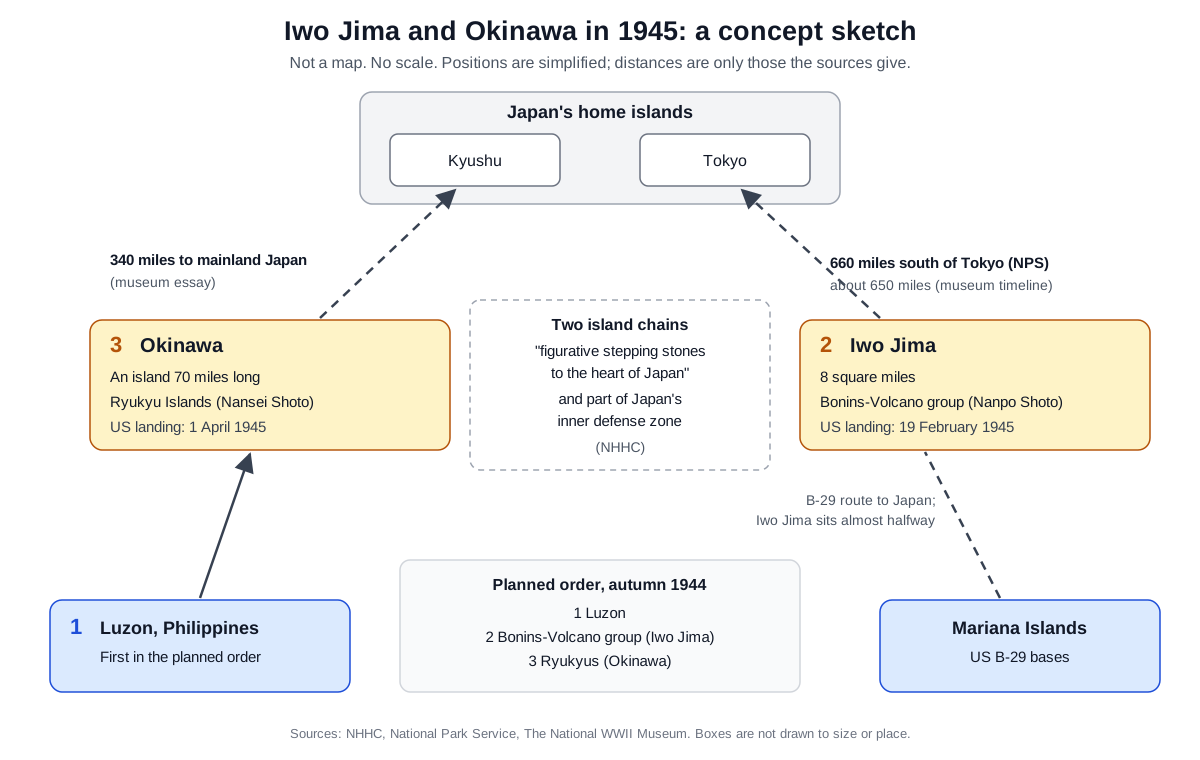
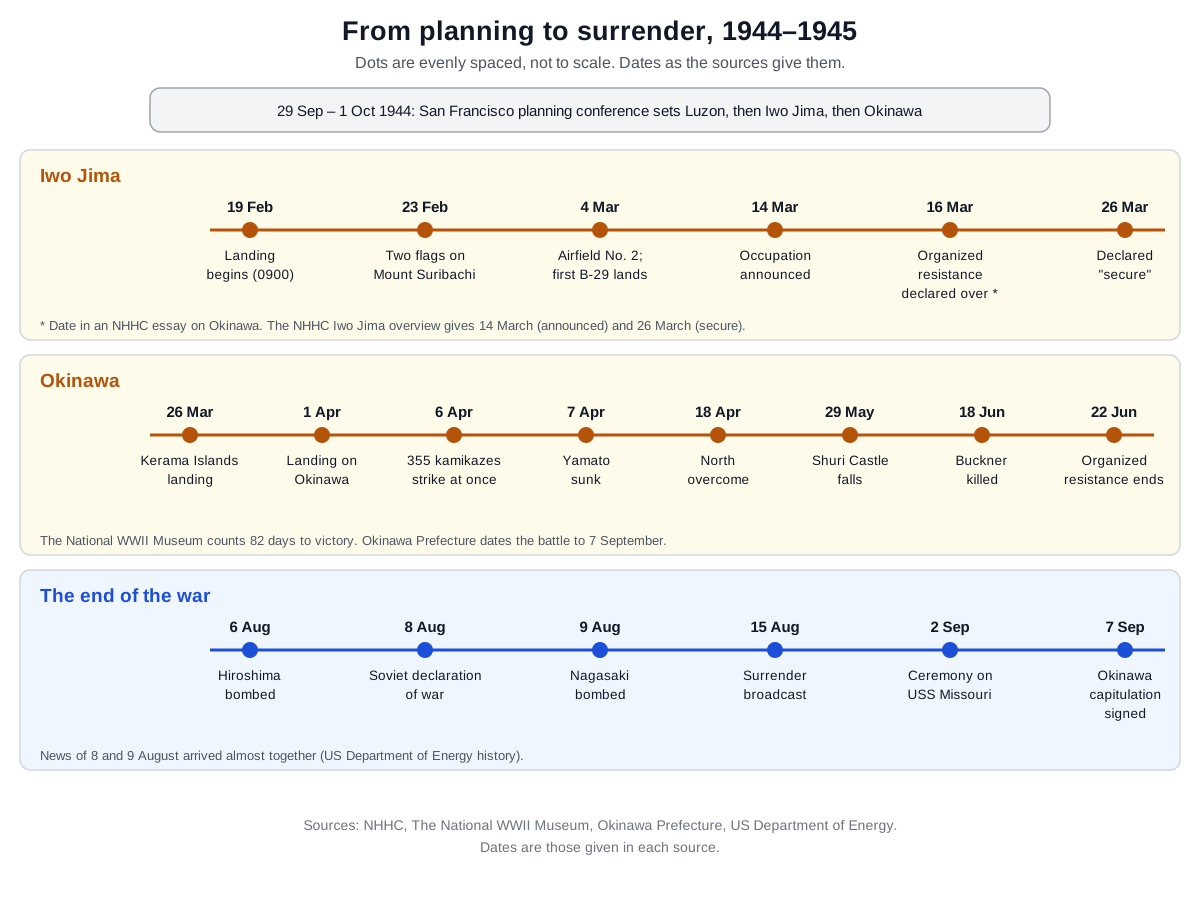
From 29 September to 1 October 1944, senior Pacific commanders met representatives of the Joint Chiefs of Staff for a strategy conference in San Francisco. Luzon in the Philippines came first, then the Bonins-Volcano group with Iwo Jima, then the Ryukyu Islands with Okinawa. The Naval History and Heritage Command (NHHC) calls these island chains figurative "stepping stones" toward the center of Japan. They were also part of its inner defense zone.
Iwo Jima is a volcanic island 660 miles south of Tokyo. Its name literally means "sulfur island," and it sits almost halfway between Tokyo and the US bomber bases in the Mariana Islands. A Japanese radar site there was thought to warn the home islands of US raids, so B-29s had to fly a longer route around it.
Holding the island seemed to offer clear uses. Its airfields could host fighters escorting the bombers and give damaged B-29s a place for emergency landings. Guarding the right flank of the coming invasion of Okinawa was another aim.
Okinawa is an island 70 miles long. Holding it would let US forces bomb the mainland freely and cut its supply lines. It would also give forward bases for Operation Olympic, the invasion of Japan planned for the fall of 1945. Taking it would remove the last barrier between US forces and Japan.
Iwo Jima: black sand and tunnels
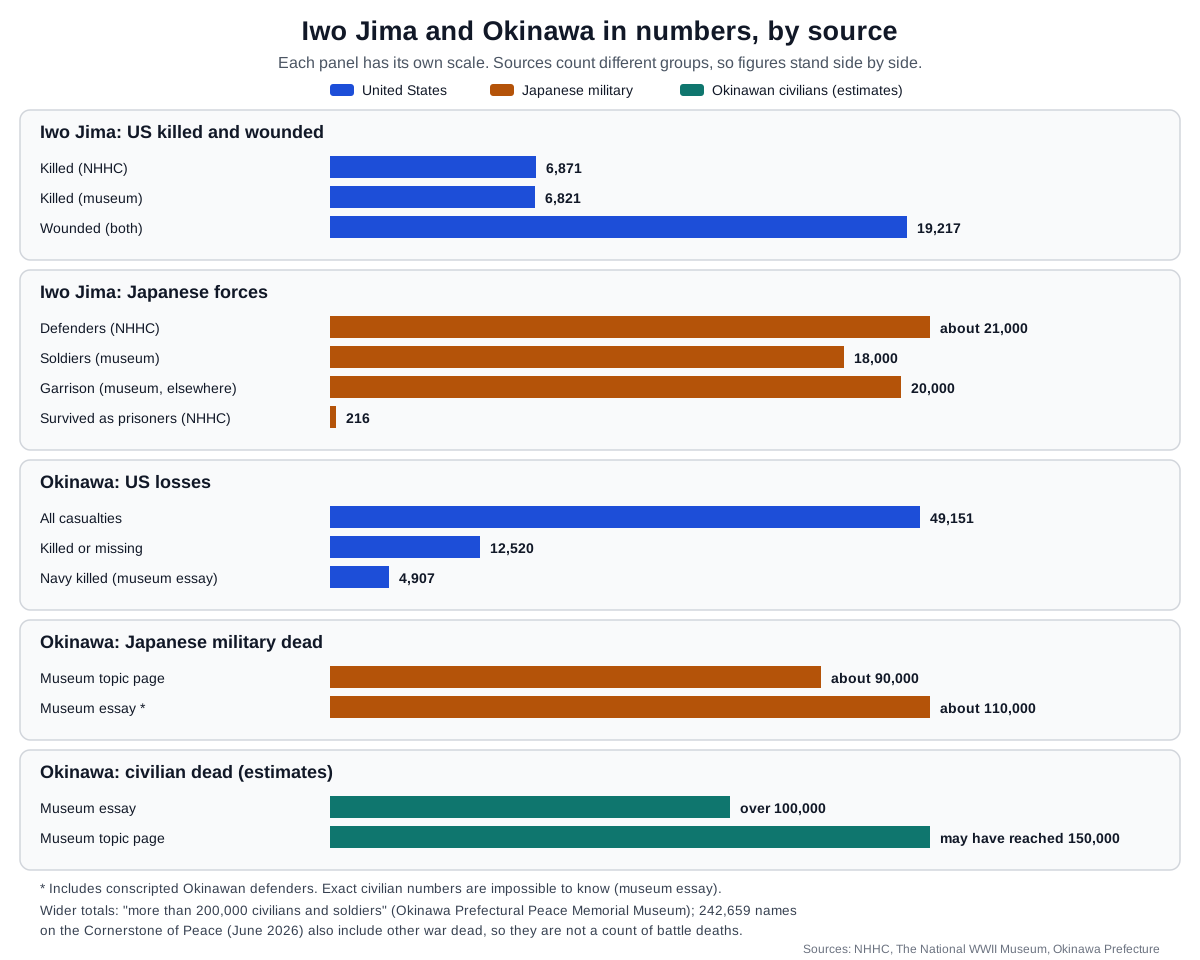
The operation was named Operation Detachment, and the landing date was 19 February 1945. The main force was V Amphibious Corps, built around the 3rd, 4th and 5th Marine Divisions. The force sizes vary by source. NHHC gives about 60,000 Americans against about 21,000 Japanese troops, while The National WWII Museum gives about 70,000 Marines and 18,000 Japanese soldiers.
The island covers eight square miles and is shaped like a pork chop. At its narrow southwestern tip rises Mount Suribachi, a dormant volcano 550 feet high. Along the island's center line lay two finished airfields and one under construction.
Japan's way of fighting had changed by mid-1944. Many senior officers had accepted that victory was impossible and chose to delay the inevitable while making the enemy pay the highest possible price. Instead of holding the beaches, they planned a battle of attrition through one defended killing zone after another.
General Tadamichi Kuribayashi arrived on the island in June 1944 and began building defenses at once. Much of the work was done at night to avoid air surveillance. Strongpoints, bunkers and gun positions were dug deep to support one another, and tunnels stocked with ammunition and food linked them. He told his officers not to treat banzai charges as a useful tactic.
By the time the US fleet began its bombardment, all Japanese civilians had already left the island. The Japanese soldiers who stayed were short of drinking water and always thirsty, and they were told their fighting positions would become their graves. Kuribayashi wrote to his wife not to expect his return.
The bombardment before the landing was short. The Marines asked for 10 days but received only three, with ammunition supply given as the reason, and only 13 hours of that fire was effective. The National Park Service (NPS) calls it "an ineffective 72-hour bombardment."
At 9:00 am on 19 February, the first wave of Marines reached the beach. The Japanese held their fire until 10:00, when the first wave was ashore and the naval guns had briefly eased. The beach was a series of steep terraces of shifting black sand and volcanic ash, and one Marine said it was like "trying to run in loose coffee grounds."
Even so, the 5th Marine Division crossed the island within 90 minutes and cut off Mount Suribachi. By the end of the first day nearly 30,000 men were ashore, and casualties that day reached 2,420.
In the end, small teams of Marines with flamethrowers, satchel charges and hand grenades destroyed the strongpoints one by one. By the end of the second day, many rifle companies had lost up to half their strength in killed and wounded. As one Marine put it, the Japanese were not on Iwo Jima but in it.
Two flags on Mount Suribachi
On the morning of 23 February, a company of Marines climbed the rough slope and reached the summit. At about 10:30 am a small American flag went up, and troops across the island watched it with excitement. That afternoon a second, bigger flag went up at the same place.
Joe Rosenthal, a photographer for the Associated Press, took the picture of that second flag. It drew little notice on the island, but the photo ran on front pages across the United States and won the 1945 Pulitzer Prize. It also became the center of a war-bond poster credited with helping bring in more than $26 billion that year.
Who was in the photo was corrected later. The Marine Corps later found that John Bradley and Rene Gagnon, long thought to be in the image, were not in it; Harold Schultz and Harold Keller were. The Marine Corps War Memorial, modeled on the photo, was dedicated on 10 November 1954 and honors every Marine who has died for the country since 1775.
The flags did not end the fight. Hidden Japanese troops still held out inside the mountain, and the drive north gained 4,000 yards in nine days at a cost of 7,000 US casualties. On 4 March US forces secured Airfield No. 2, and on the same day the B-29 from the opening landed on Airfield No. 1.
The sources give different dates for the end of the battle. In the NHHC overview of Iwo Jima, the occupation was officially announced on 14 March, but fighting went on for two more weeks. The island was declared "secure" on 26 March. An NHHC essay on Okinawa gives 16 March as the day the Marines announced that organized resistance had ended.
Of about 21,000 Japanese defenders, 216 survived as prisoners. About 3,000 hid on the island; most were killed, captured or surrendered by August, but one group held out until 1949. Kuribayashi took his own life on 23 March, inside his command post, and his remains were never found.
Okinawa: an 82-day fight
On the day the Marines announced the end of organized resistance on Iwo Jima, Admiral Raymond Spruance was already sailing toward the Ryukyus on his flagship. Within weeks more than 1,600 ships and 350,000 naval personnel gathered, making up the biggest amphibious assault force of the war. The operation was named Operation Iceberg.
On 26 March US troops landed first in the Kerama Islands, and suicide plane attacks began that same day. On Easter Sunday, 1 April, Lieutenant General Simon Bolivar Buckner Jr.'s Tenth Army landed on the western shore of Okinawa. More than 60,000 troops came ashore, led by two Army and two Marine divisions, and met no resistance on the beaches or at the first objective, two airfields.
From there the Marines moved north and the Army moved south toward Shuri. The north was overcome by 18 April, but the south was different. The Japanese built positions on high ridges around historic Shuri Castle, and defensive belts crossed the island from east to west, one behind another.
Heat and heavy rain for much of May slowed the advance even more. In the first seven weeks the Tenth Army moved only four miles. Once the rain eased at the end of May, it covered the last 10 miles to the southern tip in four weeks.
Shuri Castle fell on 29 May. The Okinawa Prefectural Peace Memorial Museum explains that the Japanese army avoided a decisive battle at Shuri and withdrew to the south to keep up a war of attrition. It was finally cornered and destroyed at the southern tip. Civilians who had fled were in the south too.
The sheer firepower is on record. Tenth Army guns fired 1.1 million rounds from 105 mm howitzers, and Navy guns poured about 600,000 rounds onto the island. One Japanese soldier wrote in his diary, "When friendly forces fire one round, at least ten rounds are guaranteed to come back."
On 18 June Buckner went to the front to watch a Marine assault and was killed. No American officer of higher rank was killed in action in the Pacific. Four days later Mitsuru Ushijima, commander of Japan's 32nd Army, took his own life, and organized resistance ended.
On 22 June the American flag rose over Tenth Army headquarters. The victory came 82 days after the battle began. Okinawa Prefecture dates the Battle of Okinawa to the signing of the capitulation document on 7 September.
Kamikazes at sea
Each day the land battle dragged on was another day the fleet stayed exposed to kamikazes. The kamikaze began on 19 October 1944. Two dozen Japanese naval pilots formed the first Special Attack Unit, or tokko, which soon became known as the kamikaze. NHHC historians write that at Okinawa Japan used aircraft not for a normal air campaign but as human-guided missiles.
Five days after the landing, 355 kamikaze aircraft from the Japanese army and navy hit the fleet at once. Between early April and mid-June there were 10 such large coordinated attacks, called kikisui, with nearly 1,500 planes in all. On average, one plane in six struck an American ship, and about 400 more flew in smaller group attacks.
The fleet's first alarm was the radar picket. Picket destroyers were placed in a ring around Okinawa to give early warning of incoming aircraft. The small picket ships were the first ships the kamikaze pilots met, so they were the first to be attacked.
The Navy blunted the kamikaze attacks but never stopped them entirely. The National WWII Museum counts 36 ships sunk and 368 damaged. Another passage in a museum essay counts 34 ships lost, 26 of them to suicide attacks.
Sailors lost were 4,907 killed and 4,824 wounded. For the first time in Navy history, the dead outnumbered the wounded in a campaign. By one estimate, nearly one in seven Navy deaths of the whole war came in these two months off Okinawa.
A British carrier force, TF 57, also fought as part of the Fifth Fleet. All four of its large carriers were hit by kamikazes, but their steel decks stood up to the fires better than the wooden decks of the US carriers.
The last big ships of the Japanese navy took the same road. Battleship Yamato, light cruiser Yahagi and eight destroyers left Tokuyama on 6 April carrying only enough fuel to get there. This Operation Ten-Go aimed to run the ships aground on Okinawa and keep fighting from the shore until all were dead.
On 7 April Yamato was hit by five bombs and ten torpedoes and sank at 2:23 pm. About 3,665 Japanese sailors died, roughly 2,500 of them aboard Yamato. US forces lost 12 aviators.
A Japanese admiral later said of this sortie, "Few people retained common sense in those days." Kamikaze pilots were on average 18 to 24 years old, and suicide attacks were offered as a way for even the rawest recruits to contribute. One surviving kamikaze pilot said he did not think the so-called suicide mindset belonged to the Japanese alone.
The war the islanders lived through
The biggest difference between the two islands was the people who lived there. Iwo Jima's civilians had all left before the fighting, but on Okinawa the islanders were in the middle of it.
The Okinawa Prefectural Peace Memorial Museum presents the battle from the Okinawan people's point of view. Its exhibit says the invading forces, with their advantage in materiel, bombed the central and southern island without discrimination from the air and sea. This "Typhoon of Steel" lasted about three months, took more than 200,000 civilian and military lives, and changed the island's landscape.
The caves of the south were both shelter and trap. Civilians and soldiers fled from cave to cave to survive, and the museum states that "in some caves, Japanese soldiers slaughtered civilians, or forced them to commit mass suicide." Some residents starved to death.
An essay at the US museum describes the same weeks somewhat differently. Waves of refugees mixed with the Japanese army as it fell back to the southern coast. Some people took their own lives after Japanese propaganda convinced them that suicide was better than the cruelty they expected from Americans. About 80,000 women, children and older men came out of caves at the southern tip in the final weeks, and between one-third and one-half of them were wounded.
Survivors' testimonies are kept in print and on video at the Peace Memorial Museum. Survivors who had long closed themselves off because of painful memories gradually began to speak, so that their accounts could pass to future generations.
Reading the numbers, and the debates
For US dead on Iwo Jima, NHHC gives 6,871 and The National WWII Museum gives 6,821, while both give 19,217 wounded. An essay at the museum puts total US casualties at over 24,000, about one in every three men who landed. The Medal of Honor went to 22 Marines and five Sailors, and Admiral Chester W. Nimitz said that "uncommon valor was a common virtue."
US casualties on Okinawa were 49,151, including 12,520 killed or missing. Non-battle casualties came on top of that, 15,613 for the Army and 10,598 for the Marines. They include men who broke down from combat fatigue.
Japanese figures vary even more. The museum's Okinawa topic page says about 90,000 Japanese combatants died and civilian deaths may have reached 150,000. Another museum essay says about 110,000 defenders were killed, counting Japanese troops and Okinawans conscripted to fight. It adds that exact numbers are unknowable, but some estimates put civilian deaths at over 100,000, or up to a third of the prewar population.
As of 23 June 2026, Okinawa Prefecture's Cornerstone of Peace carries 242,659 names. They include 149,703 people from Okinawa, 78,365 from other Japanese prefectures and 14,012 from the United States, along with 381 from South Korea and 82 from North Korea. This total is not a count of battle deaths, though. For people from Okinawa, it also includes those who died in or outside Okinawa in the 15-year conflict that began with the Manchurian Incident.
Judgments of Iwo Jima's worth still differ. In the NHHC overview, the Japanese radar could not in fact give the home islands the warning they needed. Escort fighter missions meant a 1,500-nautical-mile round trip that was very hard on P-51 pilots.
The airfields held about as much as one fleet carrier, and far fewer B-29s used the island for emergency landings than expected. The overview concludes that the 57 aviators rescued by its aircraft seem few next to the lives lost, and that whether the cost was justified is still debated.
An essay by John Curatola at the museum puts the weight on the other side. Over the following months more than 2,200 B-29 crews made emergency landings on the island's runways. With up to 11 men per bomber, he counts more than 24,000 airmen saved and sees the sacrifice of the Marines and the Navy as not in vain.
What they left
The heavy cost of the two islands left Americans and their leaders with a serious question: was invading Japan's home islands practical? The bloodshed on Iwo Jima raised fears of a far greater slaughter in an invasion. The savagery of Okinawa was read as a forecast of terrible losses on the home islands.
Some link this to President Harry Truman's choices. A museum essay says that at an early June meeting on invading Japan, Truman wanted to avoid another "Okinawa from one end of Japan to the other." NHHC historians write that, with Okinawa's lessons still vivid, Truman decided to drop atomic bombs on Hiroshima and Nagasaki, ending the war.
Other events also crowded the road to surrender. According to a Department of Energy (DOE) history page, Japan's military leaders hoped that heavy Allied losses in a ground invasion could still win a negotiated settlement. After the bombing of Hiroshima on 6 August, word of the Soviet Union entering the war on 8 August and of the Nagasaki bombing on 9 August came almost together. That night the Imperial Council vote was tied 3 to 3, and the emperor's surrender broadcast on 15 August and the ceremony aboard USS Missouri on 2 September followed.
At sea, a different lesson remained. Navy leaders began to call kamikazes a primitive guided missile. Self-guided anti-ship missiles were still years away, but kamikazes gave Navy planners a clear preview of how serious a problem that technology would be for a fleet. Spruance stressed that the suicide plane was a very effective weapon that must not be underestimated, and the later story continues in Anti-ship missiles: dealing with moving targets at sea.
The strain of joint operations is also on record. The Army's slow advance south was the Navy's biggest point of contention. Nimitz complained that he was "losing a ship and a half a day," and Spruance never voiced his criticism of the Army in public and regretted it after the war.
NHHC sums up Okinawa as a reminder for today's Navy of integrated naval power, effective joint operations, and the ability to learn in real time. Some never came home. About 10,000 sets of remains were recovered from Okinawa and nearby islands, yet around 200 soldiers and Marines, over 600 sailors and some 450 airmen are still unaccounted for.
The Defense POW/MIA Accounting Agency (DPAA) still tracks the losses from Okinawa and works with Japan's own recovery operations. Okinawa Prefecture's Cornerstone of Peace inscribes names regardless of nationality, and of military or civilian status.
What to read next
- Anti-ship missiles: dealing with moving targets at sea: see what became of the self-guided missile that the kamikaze foreshadowed.
- Turning points in military technology: a timeline of the moments, from the proximity fuze to unmanned systems, that changed military technology.
- What is a laser weapon? Film versus reality: what a laser weapon really is and how it differs from the movies.
- The Battle of Leyte Gulf: The Largest Naval Battle in History: the battle where the Japanese navy lost much of its surface fleet.
- The Manhattan Project, Hiroshima and Nagasaki: the records and differing views on the atomic bombings.