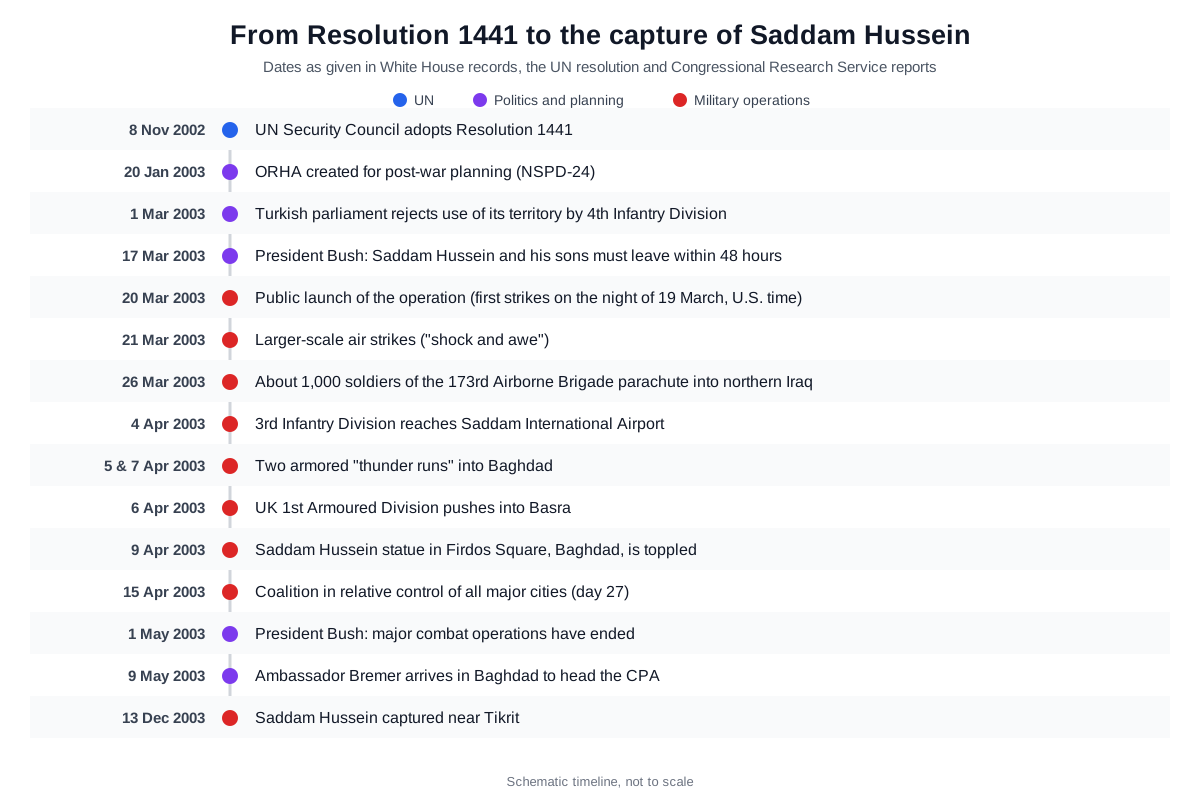
On the night of March 17, 2003, U.S. President George W. Bush gave Saddam Hussein and his two sons 48 hours to leave Iraq. A refusal, he said, would lead to military conflict. The war began three days later, and on April 9 the statue of Saddam Hussein in Baghdad's Firdos Square came down.
It is over 600 km from Kuwait to Baghdad. Coalition forces reached the end of that road less than three weeks after the war began. Yet the weapons of mass destruction put forward as a reason for the war never turned up, and the disorder after the capital fell lasted far longer.
This article follows why the war began and how fast the invasion moved. It then looks at how official U.S. and British inquiries judged the weapons question and the postwar preparations. Sources include White House archive speeches, a UN resolution, Congressional Research Service (CRS) reports, the Iraq Survey Group report, the British Iraq Inquiry, and World Health Organization (WHO) material.
Why it came to war
The Iraq question did not close when the 1991 Gulf War ended. Through the 1990s the United States and other countries worried about Iraq's programs for weapons of mass destruction (WMD). Before they left in 1998, UN inspectors found and destroyed sizable amounts of WMD in Iraq, and the United States and Britain kept no-fly zones over northern and southern Iraq.
1998 was a turning point. That December the United States and Britain carried out Operation Desert Fox, with the stated aim of reducing Iraq's ability to make or use WMD. In the same year the U.S. Congress passed the Iraq Liberation Act, which allowed support for Iraqi opposition groups.
The attacks of September 11, 2001, deepened fears that WMD could reach terrorist groups. In September 2002 the Bush administration's National Security Strategy stressed preemptive action, moving before an enemy strikes. In October, Congress gave the President authority to use force against Iraq.
On November 8, 2002, the UN Security Council adopted Resolution 1441. It decided that Iraq had been, and still was, in material breach of earlier resolutions. It gave Iraq "a final opportunity" to meet its disarmament duties under a tougher inspection regime. It also recalled the Council's warning that continued violations would bring "serious consequences."
Did the resolution authorize the use of force? A CRS report notes that the wording was strong by UN standards. Even so, most observers did not read it as "automaticity," in which noncompliance would trigger authorized force on its own. The administration judged Iraq's cooperation inadequate, yet it did not ask for a second resolution that clearly authorized military action, reportedly over concern that some permanent members would veto it.
In his March 17 speech, President Bush said intelligence left "no doubt" that the Iraqi regime still had and was hiding some of the deadliest weapons ever made. Chemical, biological, and nuclear weapons programs, long-range missile work, and support for al Qaeda were the main reasons the administration gave. These were the U.S. government's claims at the time, and the section on the weapons below shows how later inquiries judged them.
A smaller force, a faster plan
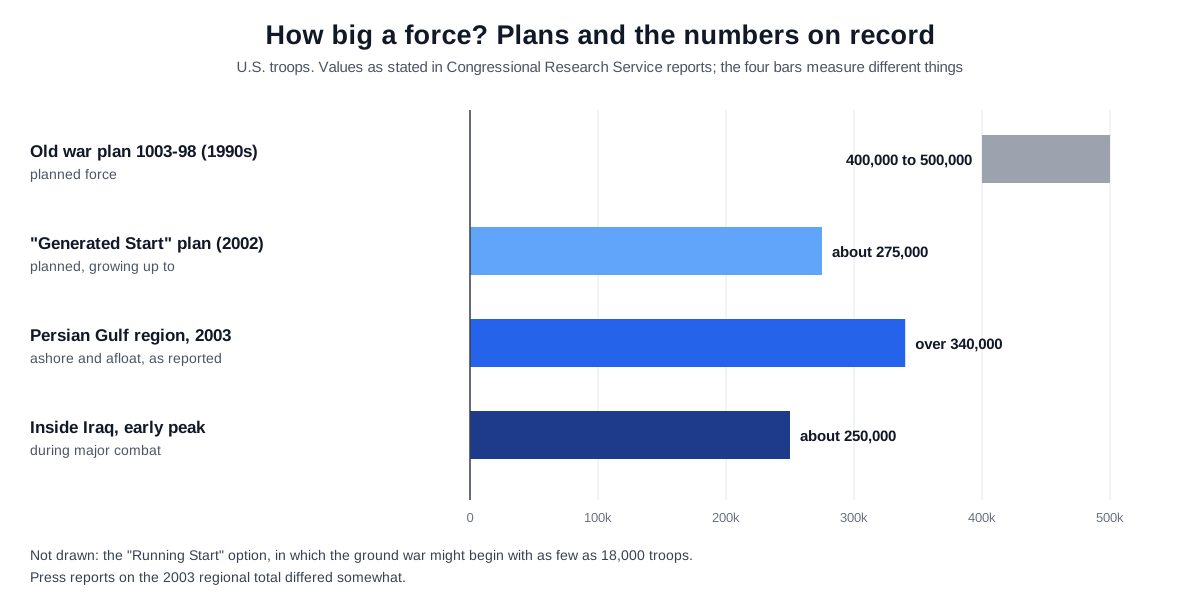
Planning started from an existing Iraq war plan, 1003-98, written in the 1990s. It called for 400,000–500,000 U.S. troops and a long buildup. According to a CRS report, Defense Secretary Donald Rumsfeld was briefed on it in late November 2001. He asked for a brand-new plan that used fewer troops and moved them faster.
The "Generated Start" plan of early 2002 began air and ground attacks at almost the same time and let the force grow to about 275,000. In the spring came "Running Start," with a smaller force and a shorter schedule, under which the ground war might start with as few as 18,000 troops. That summer a hybrid of the two was approved and became known as the "5-11-16-125" plan.
The numbers in the name are days. Five days of notice to the President, 11 days to move forces, 16 days of air campaign, and up to 125 days for the whole campaign. The name stayed even after the numbers changed.
This was a sharp break from the Powell Doctrine, which called for overwhelming force. The record shows that the air component argued for a 10–14 day air campaign first, as in the Gulf War. Sending ground forces in early, however, appears to have been meant to catch Iraqi forces by surprise.
The force kept shrinking. Army commanders found out on January 29, 2003, that only two divisions would lead them into Iraq. The northern route also closed. The 4th Infantry Division was to open a northern front from Turkey, but on March 1 the Turkish parliament turned down the request to use Turkish territory.
Ships carrying the division's equipment waited off Turkey for weeks and then went to the Persian Gulf. The division's troops began entering Iraq on April 12, after the statue in Baghdad had fallen.
How many troops took part in the end? Press reports differed somewhat, but U.S. forces in the Persian Gulf region were reported at over 340,000, ashore and afloat. Inside Iraq, U.S. forces peaked at about 250,000 during major combat.
Other countries sent forces too. A CRS report puts the British deployment at over 47,000, while the British inquiry puts the first peak near 46,000. Australia sent about 2,000 personnel, and Poland had 200 special operations troops near Basra. In his speech at the start of the war, President Bush said more than 35 countries were giving support, from bases and intelligence to logistics and combat units.
Three weeks to Baghdad
On the night of March 19, U.S. Eastern time, President Bush announced that coalition forces had begun striking targets of military importance. One CRS report dates the start of the offensive to that day, with air strikes on leadership sites. Another gives March 20, just after the ultimatum ran out, as the public launch.
The first strike followed intelligence that Saddam Hussein was at Dora Farms near Baghdad. Ship-launched Tomahawk missiles hit leadership sites in the capital, and then two F-117s struck the farm before dawn on March 20.
That night, coalition ground troops moved out of Kuwait and over the border into southern Iraq. The next day, March 21, Air Force and Navy aircraft carried out much larger strikes, the attacks called "shock and awe." Iraq lit several oil wells and launched a handful of missiles toward Kuwait, most of which Patriot missiles intercepted.
The ground war moved toward Baghdad on two routes. The Army's V Corps took the western route, west of the Euphrates, and the 1st Marine Expeditionary Force took the eastern route, nearer the Iranian border. The British 1st Armoured Division, under the Marines' command, was given Basra, Iraq's second-largest city.
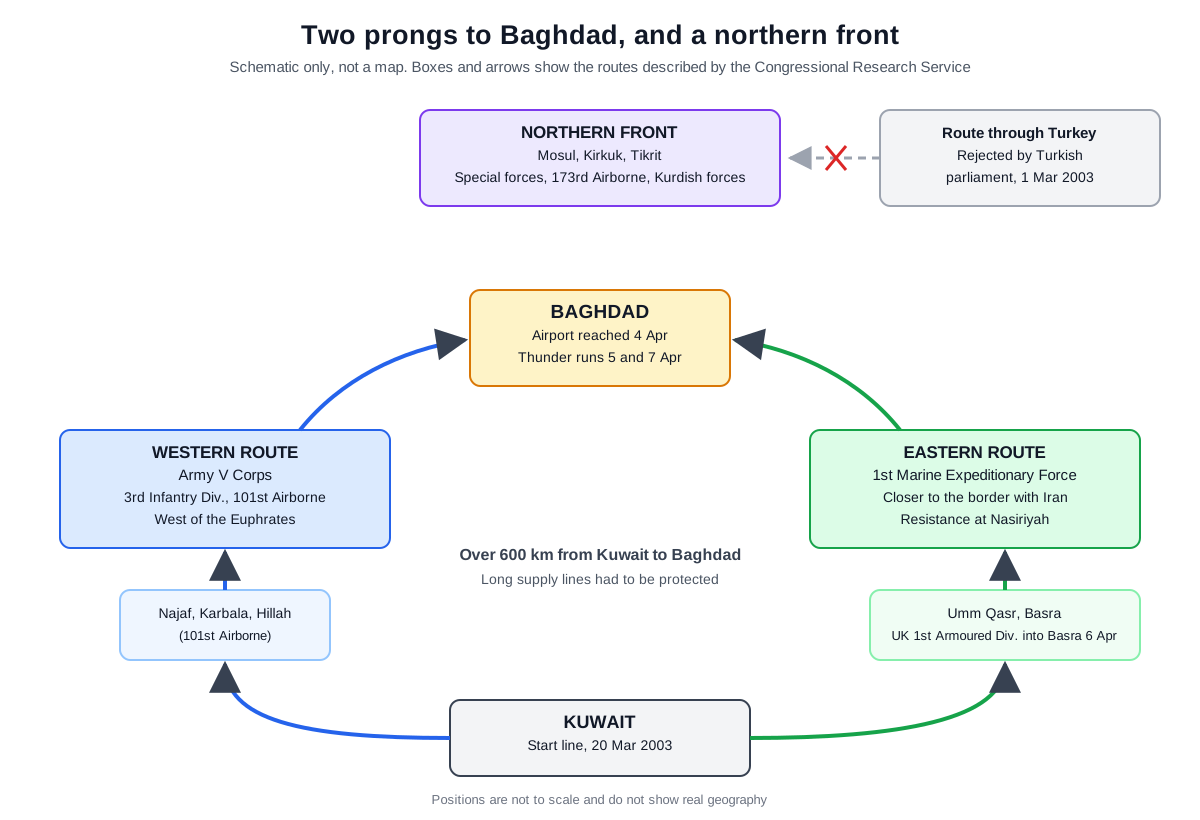
In the east, the Marines first took the port of Umm Qasr just across the border. As the main Marine force moved north it met resistance at Nasiriyah, a town that sits on a key route, and strong sandstorms made things harder. British forces did not enter Basra all at once; they wore down resistance over several weeks and pushed into the city on April 6.
In the west, the 3rd Infantry Division moved quickly through the south and reached Saddam International Airport on April 4. On April 5 and again on April 7 it made fast armored strikes into Baghdad, known as "thunder runs." The 101st Airborne Division followed and fought in cities such as Hillah, Najaf, and Karbala.
In the north, about 1,000 soldiers of the 173rd Airborne Brigade parachuted in on March 26. Special operations forces, the 173rd, and U.S. armor brought in by air worked with Kurdish irregulars to take Mosul, Kirkuk, and Tikrit.
When the statue in Firdos Square fell on April 9, many people inside and outside Iraq took it as the end of the old regime. By April 15, the 27th day, the coalition held relative control of every major Iraqi city, and Iraq's political and military leadership had fallen apart.
On May 1, aboard the aircraft carrier USS Abraham Lincoln, President Bush declared that major combat operations in Iraq had ended. He added, "Our mission continues." The old regime had not been fully taken apart, but it could no longer control Iraq's land, resources, or people.
What was different from 1991
In the 1991 Gulf War, weeks of air strikes softened Iraqi forces before ground troops moved. In 2003, air and ground attacks started together. The ground force was also smaller than in Desert Storm in 1991. That choice reflected a view that Iraq's forces were smaller and weaker than a decade before, while U.S. forces had grown far more capable.
The order of events changed twice at the last minute. Growing concern that Iraq might wreck its southern oil wells led planners to move the ground launch ahead of the scheduled air campaign. The other change was the Dora Farms strike, added just before launch on the basis of intelligence about Saddam Hussein's location.
The speed came at a price. Paramilitary forces such as the Saddam Fedayeen made guerrilla-style attacks from towns behind the front. They did little serious damage, but protecting the long supply lines took more effort than expected.
In late March, V Corps commander Lieutenant General William Scott Wallace told reporters, "The enemy we're fighting is different from the one we'd war-gamed against." There are reports that the distance of over 600 km from Kuwait to Baghdad also strained logistics and communications.
Criticism that the force was too small also surfaced at this point. Critics said the Defense Department's civilian leaders had overrated what a precision air offensive could do and had held back ground troops. In their view, a commitment to smaller ground forces and heavier reliance on high-tech weapons had driven the planning.
There were other differences from 1991. There were no mass surrenders like those of the earlier war. Even so, the Defense Department counted over 6,000 Iraqi prisoners and believed many more had simply walked away from their posts.
Special operations forces were inside Iraq before the formal launch. They secured bases in the west and sites suspected of holding WMD, and in the north they worked with Kurdish peshmerga. Defense analyst Andrew Krepinevich estimated that "nearly 10,000" special operations troops took part in major combat.
After Baghdad fell
Once the old regime lost control, looting spread through Baghdad and other cities. Looters hit government offices and the houses of former regime figures, and also some shops and cultural sites. The heads of the Iraqi National Museum reported that looters had taken or destroyed 170,000 antiquities, some thousands of years old.
Unguarded weapons stockpiles were looted as well. Some observers and coalition participants said the coalition simply lacked the troops to stop all of it.
Most observers agree that planning for postwar Iraq was far less thorough than planning for combat. Planners assumed that Iraqis, especially police, would be ready to go back to work on the day after. They also missed how badly run-down infrastructure such as the power grid already was.
The organizations in charge of the postwar period also changed. The Organization for Reconstruction and Humanitarian Assistance (ORHA), created by presidential directive on January 20, 2003, was led by retired Lieutenant General Jay Garner. On May 9, Ambassador L. Paul Bremer arrived in Baghdad to head the Coalition Provisional Authority (CPA), which would hold legal executive authority in Iraq.
Bremer later said the most important change would have been more troops from the start and all the way through. There is a counterargument. Asking how many troops are needed means little unless it is first clear what those troops are expected to do.
Saddam Hussein was captured on the evening of December 13, 2003, near a farmhouse outside his hometown of Tikrit. The next day President Bush warned that the capture would not bring the violence in Iraq to an end. The insurgency and the surge that followed are the subject of the next article.
Where were the weapons?
No chemical or biological weapons were used during the war. As of the July 2007 edition of a CRS report, no stockpiles or production facilities for chemical, biological, or nuclear weapons had been found.
The comprehensive report issued in 2004 by the U.S.-led Iraq Survey Group (ISG) painted a different picture from the prewar one. Iraq's WMD capability had been essentially destroyed in 1991, and from 1991 to 2003 Saddam Hussein's main goal was to get UN sanctions lifted. The survey group judged that he wanted to end sanctions while keeping the ability to rebuild WMD once they were lifted.
On October 7, 2004, President Bush said the report confirmed David Kay's earlier conclusion: the weapons U.S. intelligence believed Iraq had were not there. At the same event, the President stressed that the report held new findings on what Saddam Hussein intended and what he was able to do to build weapons.
The British Iraq Inquiry, published in 2016, looked at Britain's decision separately. It found that diplomatic options had not been exhausted at the time, so military action was not a last resort. Neither the intelligence assessors nor policymakers ever identified and examined the idea that Iraq might no longer have such weapons or programs. After the invasion, the inquiry adds, it soon became clear that large stockpiles were unlikely to turn up.
The government's side is recorded in the same report. Led by Prime Minister Blair, the British government chose to support military action, and Parliament endorsed that choice. When no evidence appeared, Blair defended the decision on three grounds. He cited what Saddam Hussein meant to do in the long run, Iraq's violations of Security Council resolutions, and the war's positive effect on efforts against the spread of weapons.
The inquiry notes that, unlike other uses of military force, this invasion was not set off by another country's aggression or by a humanitarian disaster under way. It also judged that Britain's decision to join came from a particular set of circumstances unlikely to recur.
Numbers and questions left behind
Counts of the war's dead differ by source. A national survey run jointly by Iraq's government and WHO, based on interviews in 9,345 households, estimated 151,000 violent Iraqi deaths from March 2003 to June 2006. Allowing for uncertainty, the range is 104,000 to 223,000, and in the first year after the invasion an average of 128 Iraqis a day died from violence.
That estimate is three times the toll Iraq Body Count reached by screening media reports. It is roughly a quarter of the figure from a smaller household survey published earlier in 2006. WHO added that results from household surveys call for caution.
There are U.S. figures as well. In December 2011, President Obama said the United States had been at war in Iraq for nearly nine years. More than 1.5 million Americans had served there, over 30,000 had been wounded counting only the wounds that show, and nearly 4,500 had died.
A war that took less than three weeks to reach Baghdad thus lasted nearly nine years. The official record leaves two big questions. Why were the weapons that intelligence believed in not there, and why were the preparations for what followed a quick victory so thin?
What to read next
- The Iraq Insurgency and the Surge: The War After the War: how the insurgency grew after May 2003, and the 2007 surge.
- The Gulf War, 1991: From Desert Shield to Desert Storm: the earlier war, where weeks of air strikes came before the ground war.
- Precision-guided bombs: what gets added to a plain bomb: the difference between kits that follow a laser spot and kits that use satellite navigation.
- Cruise missiles: how they resemble aircraft: how a missile with wings and an engine flies.
- Surface-to-air missiles: ground systems that guard the sky: systems that stop incoming threats from the ground.
- Military logistics: performance must be sustainable: why long supply lines are a burden.