On May 1, 2003, aboard the aircraft carrier USS Abraham Lincoln off San Diego, President George W. Bush said, "Major combat operations in Iraq have ended." He added, "Our mission continues." The second line held true for much longer.
The last U.S. troops left Iraq in December 2011, more than eight years later. In between, violence did not fade but spread widely in 2005 and 2006, while attacks counted by the multinational force were most frequent in mid-2007. That year the United States sent more troops in what became known as the "surge." Why did a longer war follow the announcement that the war was over?
This article looks in turn at the first year of occupation, the groups that fought, the surge and the Anbar Awakening. It then turns to the competing answers scholars give for why violence fell, and to the numbers left at the withdrawal. The sources are speeches and fact sheets in the archived White House websites, the occupation authority's own orders and Congressional Research Service (CRS) reports. A World Health Organization (WHO) survey, summaries of a journal article and a university research release fill in the rest.
Two orders in the first year of occupation
After major combat, Iraq was run by the Coalition Provisional Authority (CPA). From the fall of the regime until June 28, 2004, the coalition held the formal status of an occupier. In May 2003, the UN Security Council gave the two lead coalition members, the United States and Britain, the status of occupying powers. On June 28, 2004, sovereignty passed back to Iraqis and the CPA ceased to exist.
Two of the CPA's first orders are still widely discussed. Order Number 1, dated May 16, 2003, set out the de-Ba'athification of Iraqi society. It dismantled the party's structures and removed senior party members from their posts, banning them from future work in the public sector. In every national ministry and its affiliated bodies, such as universities and hospitals, managers in the top three layers were to be interviewed about ties to the party.
Order Number 2, dated May 23, 2003, dissolved the Ministry of Defence, the Ministry of Information and several intelligence and security bodies. The Army, Air Force, Navy, Air Defence Force and other regular services were on the list, along with the Republican Guard and the Special Republican Guard. Conscripts were released from service, and conscription was suspended indefinitely.
Employees of the dissolved bodies were treated as dismissed as of April 16, 2003, and were to receive a termination payment. Senior party members were excluded from such payments and from pensions. Anyone who had held the rank of colonel or above was deemed a senior party member unless they could show otherwise.
What did this decision lead to? A CRS report explains that prewar military planning had assumed Iraqi units could be recalled after the war and used for tasks such as guarding borders. Order Number 2 closed that path. Units could no longer be called back to help with security and reconstruction or to form the core of a new army.
Conditions in Anbar Province in the west were hard as well. Large state-owned firms closed, pensions went unpaid, de-Ba'athification cost people their jobs, and many residents felt shut out of national politics. That situation gave al Qaeda affiliates an opening to move in.
Who was fighting
The insurgency was not one organization. One strand was terrorism by Sunni Arab groups that declared Islamic extremist aims. Al Qaeda in Iraq (AQI) was the best-known name, but it may be better described as a loose network of affiliates that included both Iraqis and foreign fighters.
Another strand was Shia militias. The best known was the Jaish al-Mahdi (JAM), the militia of the young cleric Muqtada al-Sadr. In April 2004, his followers staged coordinated uprisings in cities across southern Iraq, and coalition forces put them down.
In November of the same year, the I Marine Expeditionary Force launched Operation Phantom Fury to retake the city of Fallujah in Anbar. The operation is often called "Fallujah II."
Even the name of the fight was contested. For years, the Pentagon resisted calling the enemy an "insurgency." Looking back in 2010, President Barack Obama put it this way: "A war to disarm a state became a fight against an insurgency."
A year of elections, then Samarra
2005 was a year of voting. There were elections in January and a constitutional referendum in October.
In his January 2007 address, President Bush recalled that nearly 12 million Iraqis had cast ballots. The U.S. government had expected these elections to bring Iraqis together. It had also thought that fewer American troops would be needed as Iraqi forces were trained.
Attacks rose around the votes as well. In the multinational force's count, attacks spiked sharply at political turning points such as the January 2005 elections and the October 2005 referendum.
In February 2006, the Golden Mosque in Samarra was bombed. It is one of the holiest sites in Shia Islam. On February 22, President Bush issued a statement of condolence and asked all Iraqis to exercise restraint. The bombing set off a rise in sectarian violence.
In his January 2007 address, President Bush summed up what followed. In his account, al Qaeda terrorists and Sunni insurgents had blown up the shrine to provoke Shia retaliation. Some radical Shia groups backed by Iran had formed death squads, and the violence was splitting Baghdad into sectarian enclaves. He said the violence, above all in Baghdad, had overwhelmed Iraq's political gains.
On June 8, 2006, President Bush announced that U.S. forces had killed Abu Musab al-Zarqawi, the leader of al Qaeda in Iraq, the night before. In Baghdad, an operation called Together Forward went on. In October of that year, the multinational force command admitted that it had not achieved the expected results.
A timeline, 2003–2011
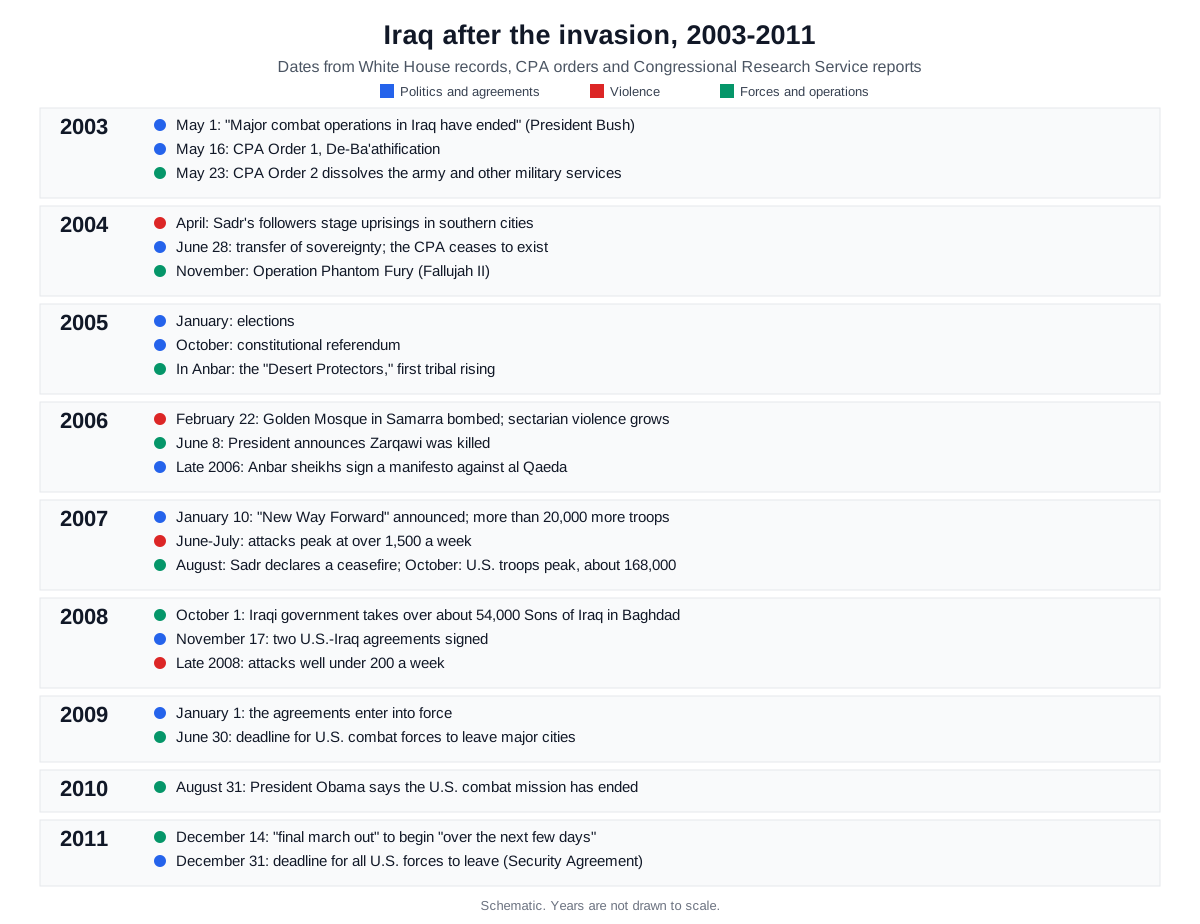
The timeline below picks up to three major events for each year and sorts them into politics and agreements, violence, and forces and operations. Comparing the rows for 2006 and 2007 shows how closely the bombing, the troop increase and the ceasefire followed one another.
The surge: more troops, a different approach
On January 10, 2007, President Bush announced the "New Way Forward" in an address to the nation. More than 20,000 additional U.S. troops would go to Iraq, and most of them, five brigades, would deploy to Baghdad. He also ordered 4,000 more troops to Anbar Province.
The speech named the reasons earlier Baghdad operations had failed. Too few Iraqi and American troops had been on hand to hold neighborhoods once they were cleared, and when forces moved on, the fighters came back. This time, he said, there would be enough troops "to hold the areas that have been cleared." The Iraqi government planned to spread its Army and National Police brigades over the nine districts of the capital, with 18 brigades in all assigned to the task.
Political conditions came with it. The United States said it would hold the Iraqi government to the benchmarks it had announced, and that America's commitment was not open-ended. A White House fact sheet released the same day added two more plans. One was more support for tribes willing to fight al Qaeda in Anbar, and the other was to expand the Iraqi Army from 10 to 13 divisions.
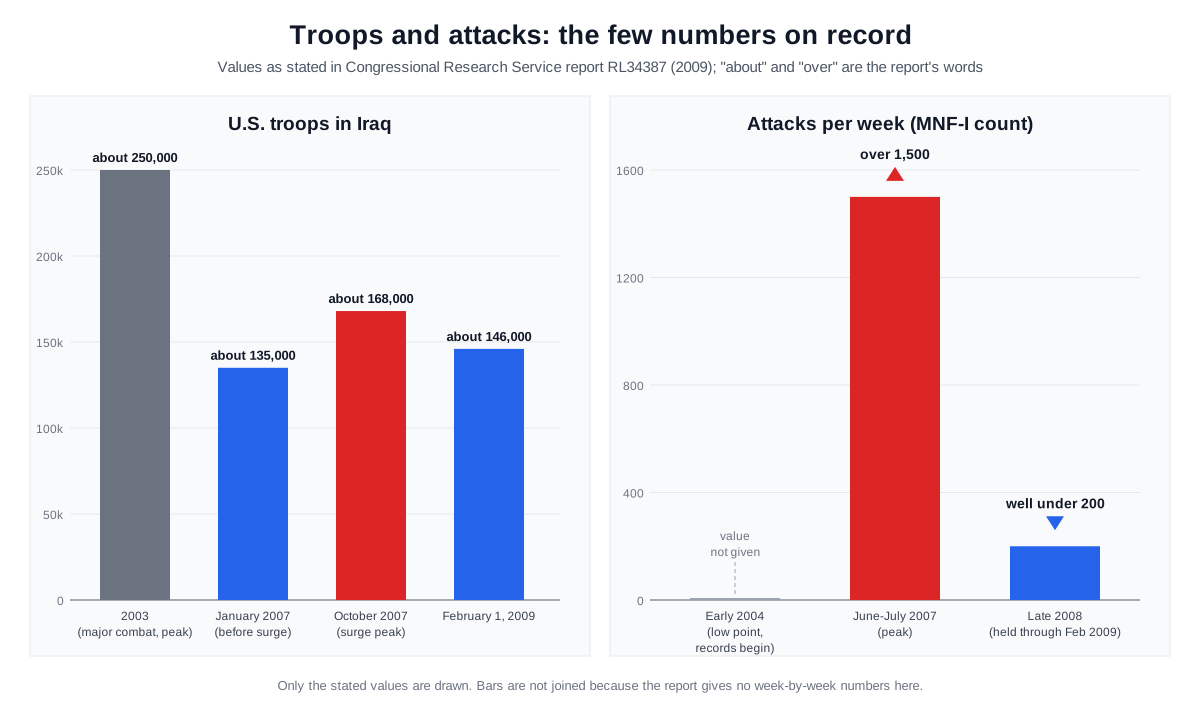
The units that went were five Army brigade combat teams, a Marine Expeditionary Unit and two Marine battalions. U.S. troop numbers rose from about 135,000 in January 2007, just before the surge forces began to arrive, to about 168,000 in October 2007. That was still below the early peak of about 250,000 during major combat in 2003.
Troop numbers were not the only change. According to CRS, most observers agree that Ambassador Crocker and General David Petraeus, commander of Multi-National Force-Iraq, built counterinsurgency approaches into the whole force and the wider U.S. effort. Those approaches stressed the safety of the population, strengthening Iraqi forces through close partnership, and building the Iraqi government's ability to govern and develop the economy. The Army and Marine Corps counterinsurgency manual, FM 3-24, came out in December 2006.
The Anbar Awakening
Around the same time, a different change was growing in Anbar. The first move came in 2005. Tribesmen in al Qaim and Haditha began working alongside some U.S. special operations units and, later, the Marines, in a movement known as the "Desert Protectors." Later, the "Awakening" grew in the provincial capital, Ramadi.
The Awakening's first leader was Sheikh Abdul Sattar of the Albu Risha tribe. In late 2006 he led the signing of a manifesto that denounced al Qaeda and pledged support to coalition forces. He was killed by a roadside bomb on September 13, 2007. By the count of the multinational force in the west, six of the eleven sheikhs who first stood up against al Qaeda were dead by January 2008.
Why did the tribes switch sides? Al Qaeda affiliates had entered Anbar promising to "rescue" the population, but in practice they were brutal. Insurgents and tribesmen who changed sides became local guard groups known as the "Sons of Iraq" (SoI). The number of SoI nationwide was capped at 103,000, and on October 1, 2008, the Iraqi government took over responsibility for about 54,000 SoI in Baghdad Province.
There was change on the Shia side too. In August 2007, Sadr declared a ceasefire, and most of JAM followed it. He repeated the call in February 2008, but some breakaway groups ignored it and kept up the violence.
Roadside bombs and concrete walls
In 2011, President Obama recalled "the grind of the insurgency – the roadside bombs, the sniper fire, the suicide attacks." The military calls such roadside bombs improvised explosive devices (IEDs). How this threat changed military vehicles is a story for a separate article.
The Awakening was tied to this threat as well. In the area of Multi-National Division-Center, the SoI handed over 668 IEDs from June 2007 to August 2008. Commanders on the ground said that, as a rule, IED attacks in an area went down after an SoI group was set up there.
Concrete walls spread across Baghdad. In April 2007, some key neighborhoods were sealed off entirely, earning the nickname "gated communities." Lieutenant General Ray Odierno, commander of Multi-National Corps-Iraq, explained that the walls were meant to protect residents by making car bombings and suicide attacks harder. The multinational force said barriers and hardened sites, together with operations against would-be attackers, had helped lower the number of vehicle attacks.
Equipment and technology played a part too. Among the factors CRS lists for the security gains are the high-end technological capabilities of special operations forces and closer integration between special operations and regular forces.
Why did the violence fall?
The numbers clearly moved. The multinational force's record starts in early 2004 at a low point, and overall attacks climbed from there. They peaked at over 1,500 a week in June and July 2007, just as the last surge units arrived.
After that they fell sharply, with one spike in March 2008 during the Basra and Sadr City operations. By late 2008, attacks were well under 200 a week, back to early 2004 levels, and they stayed there through February 2009.
Civilian deaths also fell sharply after all the surge forces had arrived in July and August 2007. The multinational force reported a decline of over 72% through January 2008. Commanders on the ground added that few attacks did not mean the enemy was gone, and in August 2008 General Petraeus said the gains were "still not self-sustaining."
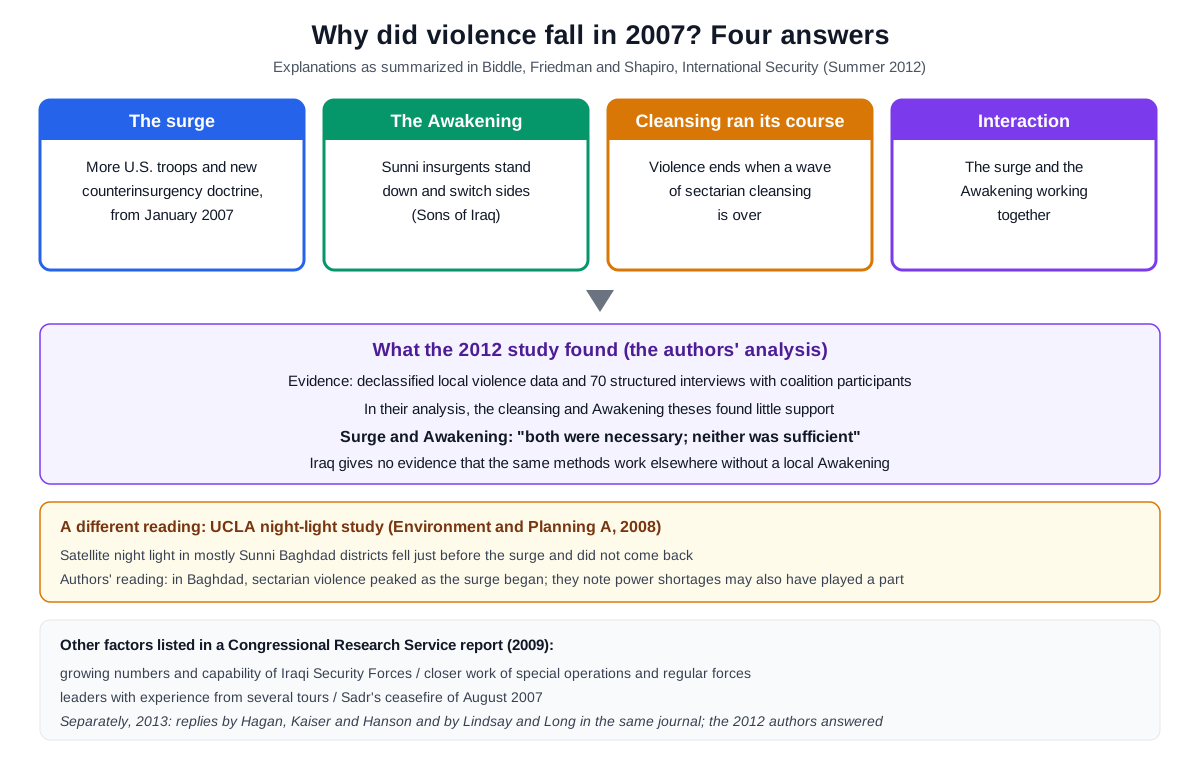
So what brought the violence down? The answers do not agree. The summary of a 2012 article by Stephen Biddle, Jeffrey Friedman and Jacob Shapiro in the journal International Security lays out four claims side by side.
One credits the extra U.S. troops and new doctrine that started in January 2007. One credits the Awakening, in which Sunni insurgents stood down on their own. One says the violence simply ran its course after a wave of sectarian cleansing. The last credits the surge and the Awakening acting together.
Some research supports the cleansing thesis. In 2008, a UCLA team led by the geographers John Agnew and Thomas Gillespie used publicly available weather-satellite images to measure how night light changed in each Baghdad neighborhood. Comparing four clear nights between March 2006 and December 2007, they found that light in mostly Sunni neighborhoods dropped sharply just before the February 2007 surge and never came back. In Kirkuk, Mosul, Tikrit and Karbala, which were not surge targets, light held steady or grew.
Agnew read this to mean that violence in Baghdad fell because fighting between communities had reached its peak as the surge was beginning. By the time the surge started, he said, many of the people targeted had been killed or had fled the country. The researchers acknowledged that Baghdad's long-running power shortages may also have played a part in the loss of light in some districts. The study appeared in the journal Environment and Planning A in October 2008.
Biddle and his co-authors tested the four claims with declassified data on violence at the local level and 70 structured interviews with coalition participants. In their analysis, the cleansing and Awakening theses found little support. They concluded that the surge and the Awakening had to work together for violence to fall as fast and as widely as it did. In their words, "both were necessary; neither was sufficient."
Against the cleansing thesis, they pointed out that for much of the war the most violent province was Anbar, which is almost entirely Sunni. Against the Awakening thesis, they noted at least four similar attempts between early 2004 and late 2005 that did not get the kind of protection the surge offered. They added that Iraq gives no evidence that the same methods will produce the same results elsewhere without a local equivalent of the Awakening.
The section above holds field records of the Awakening's part. The SoI handed over 668 IEDs, and commanders said IED attacks fell where SoI groups were set up.
The debate went on. In spring 2013, the same journal ran responses to the 2012 article by John Hagan, Joshua Kaiser and Anna Hanson, and by Jon Lindsay and Austin Long. The three authors replied.
CRS did not name a single cause either. Alongside the extra surge troops, it listed the growing number and capability of Iraqi forces and the experience of leaders on repeat tours. It also named many Sunni Arabs' rejection of violence and Sadr's ceasefire.
Withdrawal and the numbers left behind
On November 17, 2008, after months of negotiations, the United States and Iraq signed a Strategic Framework Agreement and a Security Agreement. The Iraqi Cabinet and parliament approved them on November 27, 2008, and they entered into force on January 1, 2009. The Security Agreement set two deadlines. U.S. combat forces would leave major populated areas by June 30, 2009, and all U.S. forces would leave Iraq by December 31, 2011.
On August 31, 2010, President Obama announced that the U.S. combat mission had ended. Nearly 100,000 U.S. troops had already been withdrawn, and a transitional force stayed on to advise and assist Iraqi forces, support counterterrorism missions and protect U.S. civilians. At Fort Bragg on December 14, 2011, he said nearly 150,000 U.S. troops had left Iraq over the previous three years. The final march out, he said, would begin within days.
The American numbers were heavy as well. More than 1.5 million Americans had served in Iraq, over 30,000 had been wounded and nearly 4,500 had died. The president added that the wounded count covered "only the wounds that show."
Iraqi losses differ widely by source. The Iraq Family Health Survey was run by the Iraqi government and WHO, with interviews in 9,345 households. It put the number of violent Iraqi deaths from March 2003 through June 2006 at 151,000, with a range of 104,000 to 223,000 once uncertainty is allowed for. That period does not include the second half of 2006 or 2007, when attacks peaked.
The WHO representative in Iraq said this estimate was three times the count of the Iraq Body Count project, which screens media reports. It was also about four times lower than a smaller household survey from earlier in 2006. A WHO statistician who worked on the survey said death tolls in conflict are extremely difficult to assess and the results must be read with caution. Without full death registration and hospital reporting, he added, household surveys are the best that can be done.
By the survey's estimate, an average of 128 Iraqis a day died from violence in the first year, 115 in the second and 126 in the third. More than half of the deaths were in Baghdad. Iraq's health minister noted that some homes were too unsafe to visit. Even so, he said, the results showed a massive death toll since the conflict began.
Many people also fled their homes. The UN refugee agency (UNHCR) estimated nearly 2.8 million internally displaced people in Iraq as of late 2008.
The war was declared over twice: "major combat operations" ended in May 2003, and "the end of the war" came in December 2011. The eight years in between cannot be summed up in one number, or in one cause.
What to read next
- ISR drones: why endurance matters: the principles of watching from the air for long periods.
- Military logistics: performance must be sustainable: what it takes to keep troops and equipment going over time.
- Turning points in military technology: where technologies such as precision guidance and drones came from, in date order.
- "The Iraq War, 2003: Three Weeks to Baghdad": the invasion and the fall of Baghdad, which came before this story.
- "IEDs and the MRAP: How a Roadside Threat Reshaped Vehicles": how roadside bombs changed the shape of military vehicles.
- "The War in Afghanistan, 2001–2021: Twenty Years in Outline": the other war fought over the same years.