The news says the war is over, yet the land does not come back right away. Mines and explosives that never went off may still lie under fields, roads and the shortcut to school. Someone has to make that ground safe to walk on again.
That work is called humanitarian demining. This article looks at how it differs from soldiers clearing mines during a fight, and at the order in which land is handed back. It then follows how the work grew with international rules from the late 1980s, and what is still left to do.
Opening a path versus giving land back
There is one phrase, "mine clearance," but two purposes behind it. The UN Mine Action Service (UNMAS) splits mine clearance into a military kind and a humanitarian kind.
Military clearance is how soldiers open a safe path to move forward during a conflict. Only the mines that block a route needed for an advance or a retreat are removed. Mines left on either side of the path fall outside the goal of that moment.
Humanitarian clearance starts from a different place. Its purpose is to clear land so that civilians can go back to their homes and daily routines without fear of explosive hazards. What it seeks is peace and security restored at the level of the local community.
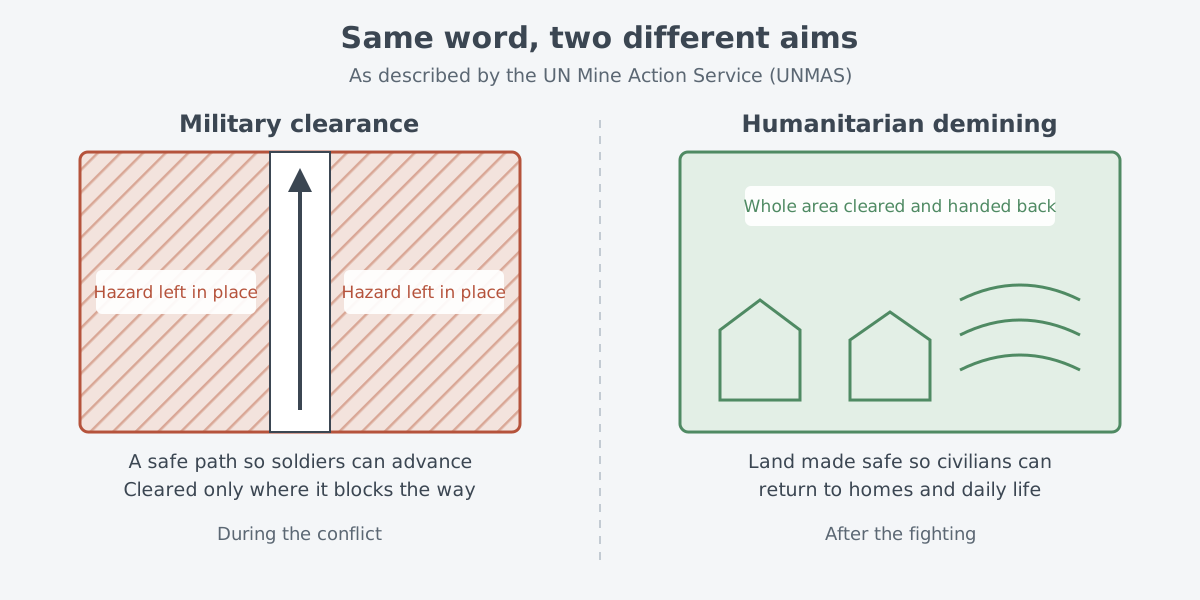
Think of a snowy morning. Military clearance is shoveling a single path to the front door; humanitarian demining is making the whole yard safe for children to play in again. The real thing is different. Mines do not melt when spring comes, and you first have to find out where they are.
The five pillars of mine action
Lifting mines out of the ground is one piece of a larger picture. The United Nations groups the work against landmines and explosive remnants of war under the name mine action, and divides it into five pillars.
- Clearance: removing or destroying all explosive ordnance in a set area or down to a set depth. Surveys, mapping and minefield marking are part of it.
- Risk education: lowering the chance that people are hurt by explosive ordnance, through public information, education and training, and contact with communities.
- Victim assistance: caring for the needs and rights of victims through medical care, physical rehabilitation, psychosocial support and social inclusion.
- Advocacy: encouraging every country to join the international agreements that ban or limit landmines.
- Stockpile destruction: helping to destroy explosives held in storage, and to store and inspect the rest properly.
The goal of risk education shows the direction of the whole effort. It aims to bring risk down to a level where people can live safely. It also aims to rebuild conditions in which economic and social life can move again, free of the hold of explosive contamination. Victim assistance is also more than goodwill: it is a duty of the countries that have joined the Anti-Personnel Mine Ban Convention.
The storage side involves large numbers too. UNMAS notes that more mines sit in stockpiles than have actually been laid in the ground. Depending on the source, the stockpiled anti-personnel mines destroyed so far by treaty members number more than 53 million or more than 55 million.
How land is given back
Why not dig up every square meter of suspect ground? It would take endless time and money. The International Mine Action Standard (IMAS) 07.11 treats the resources for dealing with explosive contamination as scarce and valuable. It makes land release the main way to get the most out of them.
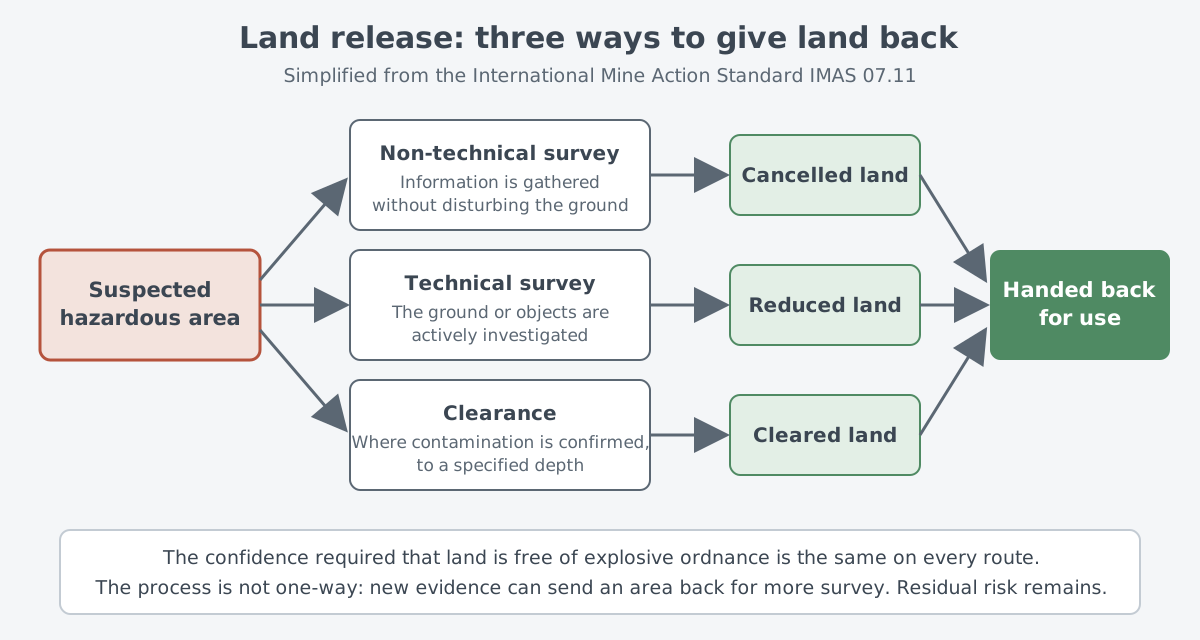
Land release is a process of deciding by evidence. First, areas suspected of being dangerous are identified. Then three routes open.
- Non-technical survey: data are gathered and analyzed without disturbing the ground. If it shows no evidence of explosive ordnance, the land is "cancelled."
- Technical survey: the ground or objects are investigated directly to gather data. Parts confirmed to hold no evidence are "reduced."
- Clearance: on land where contamination is confirmed, the specified explosive hazards are all removed or destroyed down to a specified depth.
The standard gives an example. An area may be listed as suspect because of indirect evidence, such as visible craters or old reports. It can later be cancelled if there is evidence that people have used it safely over time, such as farming it for several years. Looking down from a drone fitted with a camera does not count as a survey that disturbs the ground.
None of the three routes is the easy one. The confidence needed that land is free of explosive ordnance is the same whether the land is cancelled, reduced or cleared. Nor does the process run in one direction only: when new evidence turns up, survey and clearance are repeated.
Even so, risk never reaches zero. The standard calls the risk left after all reasonable effort has been applied residual risk. For that reason, steady contact with local people runs through the whole process.
Many kinds of groups do this work. Nongovernmental organizations, companies and national mine action teams take part, and so do military units when they carry out humanitarian demining.
Where it began: Afghanistan, 1988
Until the 1980s, tens of thousands of people around the world were killed or maimed every year by mines and explosive remnants of war left behind after conflicts. That is how the 20th-anniversary book of the Geneva International Centre for Humanitarian Demining (GICHD) describes those years. These weapons also held back relief work and recovery after the fighting.
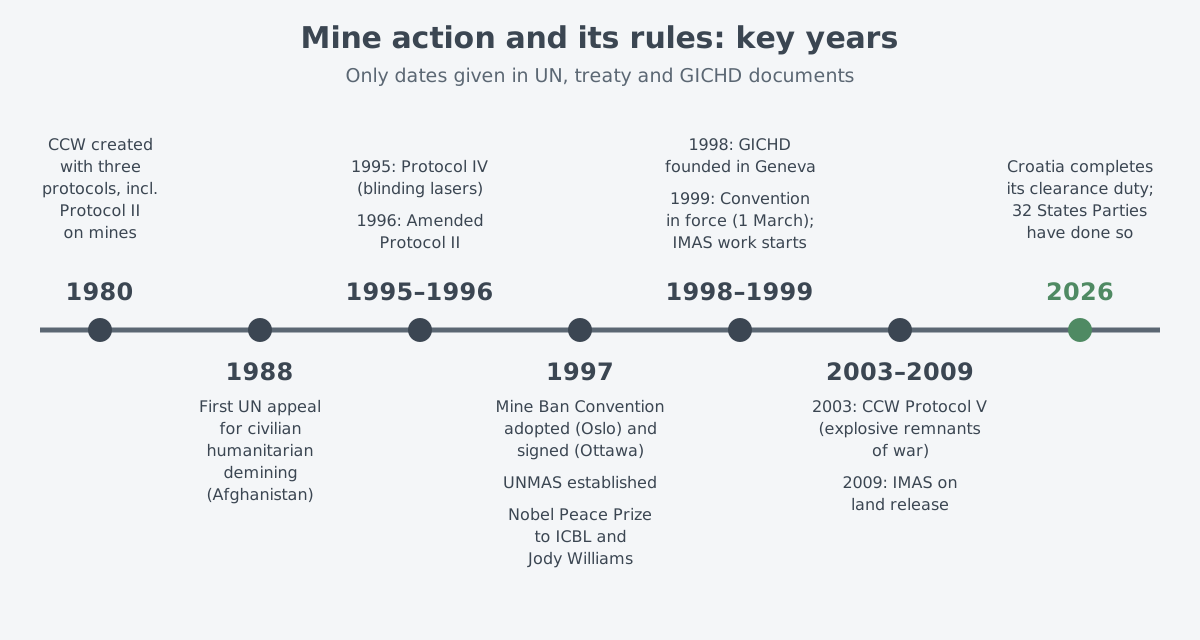
Change came in 1988. For the first time, the UN office coordinating assistance to Afghanistan appealed for money for humanitarian demining to be carried out by civilians. UN agencies then took on demining support in countries such as Angola, Cambodia and Mozambique.
In the late 1990s, institutions arrived to support the work. UNMAS gives 1997 as the year it was established. Switzerland announced plans for a center when the Mine Ban Convention was signed in Ottawa in December 1997. The GICHD opened in Geneva four months later, on 28 April 1998.
Standards followed, so that everyone could describe the work in the same terms. Development of the International Mine Action Standards began in 1999, and the standard on land release was adopted in 2009.
Rules arrive: the Ottawa Convention and the CCW
The rules grew along two lines. One is the Convention on Certain Conventional Weapons (CCW). When it was first created in 1980, it had three protocols, and Protocol II covered mines, booby traps and other devices.
Amended Protocol II was adopted in 1996. A party to a conflict that used these weapons must remove mines and similar devices after the conflict ends, and must keep records of where they were placed. Anti-personnel mines that cannot be detected are banned.
Protocol V was added in 2003. Its aim is not one type of weapon but to reduce the threat from all explosive remnants of war. After a conflict, each party must mark and clear such remnants on its own territory. It must also record data on the explosive ordnance its forces used, and share it with whoever controls the area and with groups doing clearance or risk education.
The other line is the Anti-Personnel Mine Ban Convention, often called the Ottawa Convention. It was adopted in Oslo, Norway, on 18 September 1997, opened for signature in Ottawa, Canada, on 3–4 December the same year, and entered into force on 1 March 1999. It defines an anti-personnel mine as one designed to explode because a person is present, close by or touches it, and to incapacitate, injure or kill one or more people.
The clearance promise sits in Article 5. Each member must destroy the anti-personnel mines in the mined areas it controls as soon as possible. The outer limit is 10 years from the date the treaty takes effect for that country. A member that cannot finish in time may ask for an extension of up to 10 years.
Under Article 4, mines held in storage must be destroyed within 4 years of joining.
In 1997, the year the treaty was adopted, the Nobel Peace Prize went jointly to the International Campaign to Ban Landmines (ICBL) and Jody Williams. The prize recognized their work to ban and clear anti-personnel mines.
The work that remains
Some countries have reached the end. In March 2026, Croatia announced that it had met its Article 5 obligation. By Croatia's account, over almost 30 years it found and destroyed close to 107,000 mines, along with 470,000 items of unexploded ordnance. With Croatia, 32 treaty members have now completed this obligation.
For many others the end is still far off. Some members with extended deadlines have been clearing for decades and need several more years. Many members that had declared their clearance finished have since found mined areas they did not know about, or face newly laid mines.
The human toll has not fallen either. In December 2025, UN News reported that the Landmine Monitor 2025 recorded 6,279 casualties from mines and explosive remnants of war in 2024, the highest in four years. Civilians made up 90% of them, and almost half were children.
At least 57 states, plus some other areas, still have anti-personnel mines in their ground, and 32 of them are treaty members. There was progress as well. Oman finished clearance in 2025; no member had done so since 2020. Through survey and clearance, over half of the affected members also shrank their contaminated areas last year.
Still, the report's authors say the aim of completing clearance by 2025 is a long way off.
Money is another obstacle. The field has relied heavily on a few large donors, and when the United States froze funding across the whole sector in 2025, some programs stalled and others ended. International support for victim assistance fell 23%.
Where this meets lasers: two rules under one convention
Mines and lasers seem far apart. In international rules, they are neighbors. Amended Protocol II on mines, Protocol V on explosive remnants of war, and Protocol IV on blinding laser weapons, adopted in 1995, all sit under the same CCW.
What Protocol IV bans and what it leaves outside its scope is explained from the treaty text in Eye safety and international rules: the protocol on blinding laser weapons. Reading the two articles side by side, one thing stands out: the rules on mines also cover what comes after use. They require parties to clear up after a conflict, keep records, and share those records.
What to read next
- Eye safety and international rules: the protocol on blinding laser weapons: the rule on laser weapons under the same CCW.
- Unmanned ground vehicles: robots for dangerous places: ground robots that take on dangerous jobs such as explosive ordnance disposal.
- Autonomous weapons and human control: why mines come up as an old example of weapons with autonomous functions.