People call the war that began in 1337 and ended in 1453 the Hundred Years' War. Count the years and you get 116. Yet England and France did not fight for all of that time. War and truce took turns, and there were long stretches with no major battle.
What ties those years into one war is what the two sides were fighting over: the French crown, and the land that English kings held inside France. This article follows the war on a single timeline. It runs from the quarrel over the throne through three phases, changing weapons and armies, numbers that differ by source, and the war's legacy.
Even the name is not from the period. This series of conflicts between England and France was only "later known" as the Hundred Years' War. Fordham University's Internet Medieval Sourcebook, which carries extracts from Froissart's chronicle, introduces it in the same spirit. It calls the war an episodic struggle that lasted well over a hundred years, mostly without any fighting.
One crown and one stretch of land
In 1328 King Charles IV of France died without a direct heir. The crown passed to Philip VI of Valois, the nearest heir through the male line. King Edward III of England was also related by blood. His mother was Charles IV's sister, so Edward was the late king's nephew and a grandson of Philip IV through his mother.
According to the French National Library (Bibliothèque nationale de France, BnF), Edward did not object to the succession in 1328. The trouble started over land. Edward had inherited Guyenne in south-west France, and in 1337 Philip VI confiscated it. The Royal Armouries, a UK national museum, describes the same event as Philip invading Edward's French lands and starting a territorial war.
In 1340 Edward claimed the French throne. A quarrel over land had become a quarrel over a crown. Other kingdoms were drawn in, too. Philip had already been backing the Scots against England.
116 years in three phases
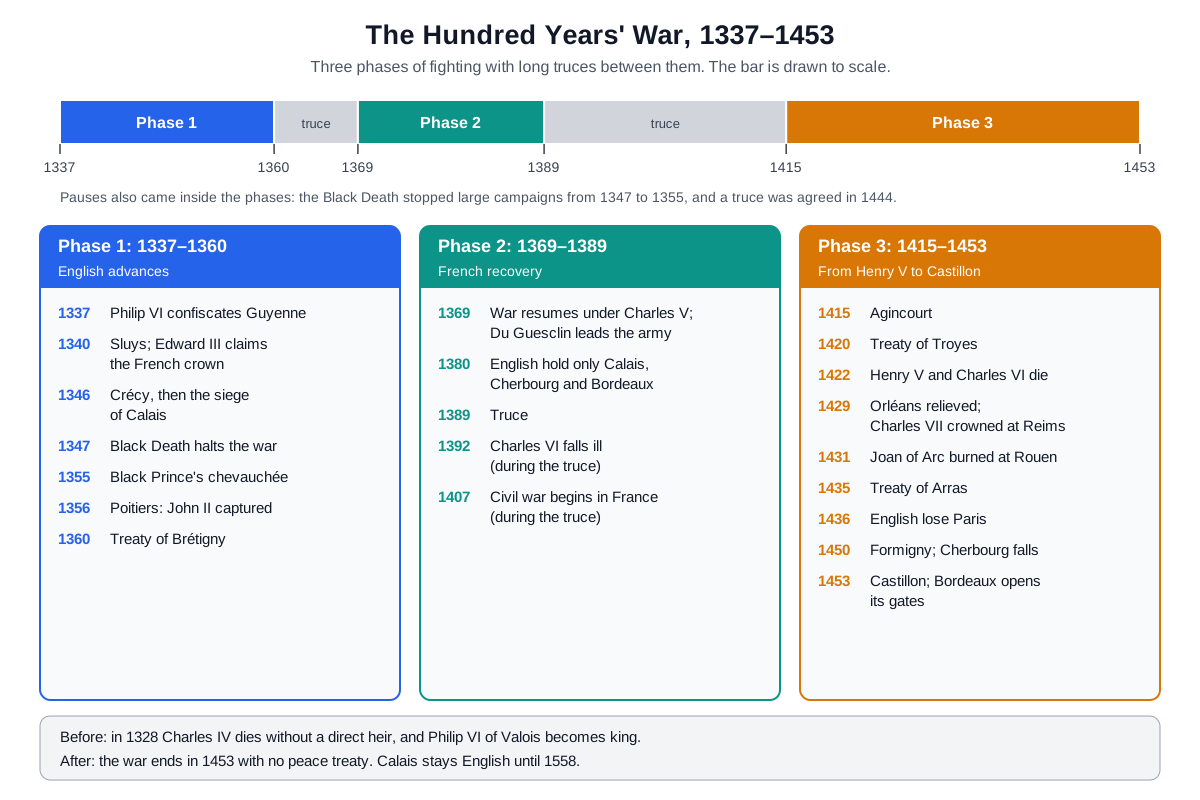
The first phase (1337–1360) was a time of English advances. On 24 June 1340, at the harbor of Sluys in Flanders, a French fleet of more than 200 ships was almost wiped out.
In 1346 Edward III invaded Normandy and took up a position on a ridge near Crécy. The French cavalry, though more numerous, were crushed by English foot soldiers and archers. After the siege that followed, Calais stayed English for almost two centuries.
In 1347 the Black Death brought the war to a halt. There were no large campaigns or battles until 1355, and estimates put the plague's European death toll in the millions.
In 1355 Edward III's son, Edward the Black Prince, set out on a raid. He swept through the country between Bordeaux and Narbonne, covering some 402 km in just over a month. A mounted raid like this is called a chevauchée. It spread fear among the people, damaged the standing of the French king and his army, and destroyed useful resources.
In September 1356, King John II of France caught up with him near Poitiers, but John surrendered and was taken prisoner.
The king's capture did much to bring about the Treaty of Brétigny, signed in 1360. Edward III gave up his claim to the French throne. In return he received large territories in the south-west, along with Calais. John II was released only for a heavy ransom.
The second phase (1369–1389) was a time of French recovery. John II's son, Charles V, introduced the salt tax (the gabelle), reorganized the government and the army, and put Bertrand du Guesclin in command. When the war resumed in 1369, Edward III again called himself king of France. Through a string of small victories, France steadily won back the occupied land, and by 1380 the English held only Calais, Cherbourg and Bordeaux.
A truce followed in 1389, and for decades afterward each country seemed more absorbed in its own affairs than in the enemy. In France, Charles VI had a fit of madness in the forest of Le Mans in 1392. After the Duke of Orléans was assassinated in 1407, the Armagnacs and the Burgundians fought a civil war. In England, Henry of Lancaster took the throne in 1399, and his son Henry V succeeded him in 1413.
The third phase (1415–1453) opened with Henry V. He landed in Normandy in August 1415 and won a crushing victory over the French knights at Agincourt on 25 October. He later returned to Normandy and took Caen and Falaise, and Rouen fell after a six-month siege.
In September 1419, John the Fearless, Duke of Burgundy, was killed by the Dauphin's men. The new duke, Philip, then sided with Henry. Under the Treaty of Troyes of 21 May 1420, Henry married Charles VI's daughter Catherine and was to inherit the French throne in place of the Dauphin. The Dauphin's supporters, who held central France, refused to accept it.
In 1422 Henry V died shortly before Charles VI. The infant Henry VI became king of both realms, while the Dauphin, who had taken refuge in Bourges, proclaimed himself Charles VII. France now had two kings.
On 12 October 1428 the English laid siege to Orléans. On 29 April the next year, Joan of Arc reached Orléans with about 200 men-at-arms, and on 8 May the English withdrew. On 17 July 1429 the Dauphin was crowned Charles VII at Reims. The Royal Armouries calls the siege of Orléans a turning point in the war.
The Burgundians captured Joan in 1430 and handed her over to the English. After a church trial she was put to death by burning at Rouen in May 1431. The BnF gives 30 May as the date of her sentence to the stake. A retrial in 1456 annulled the verdict.
In 1435 the Treaty of Arras reconciled Burgundy with Charles VII. Having lost their main ally, the English gave up Paris the following year. After a truce in 1444, they lost at Formigny in 1450, and that August they lost Cherbourg, their last stronghold in Normandy. On 17 July 1453 the English commander John Talbot was killed at the Battle of Castillon, and in October Bordeaux opened its gates.
Bows, armor and cannon: a war of changing weapons
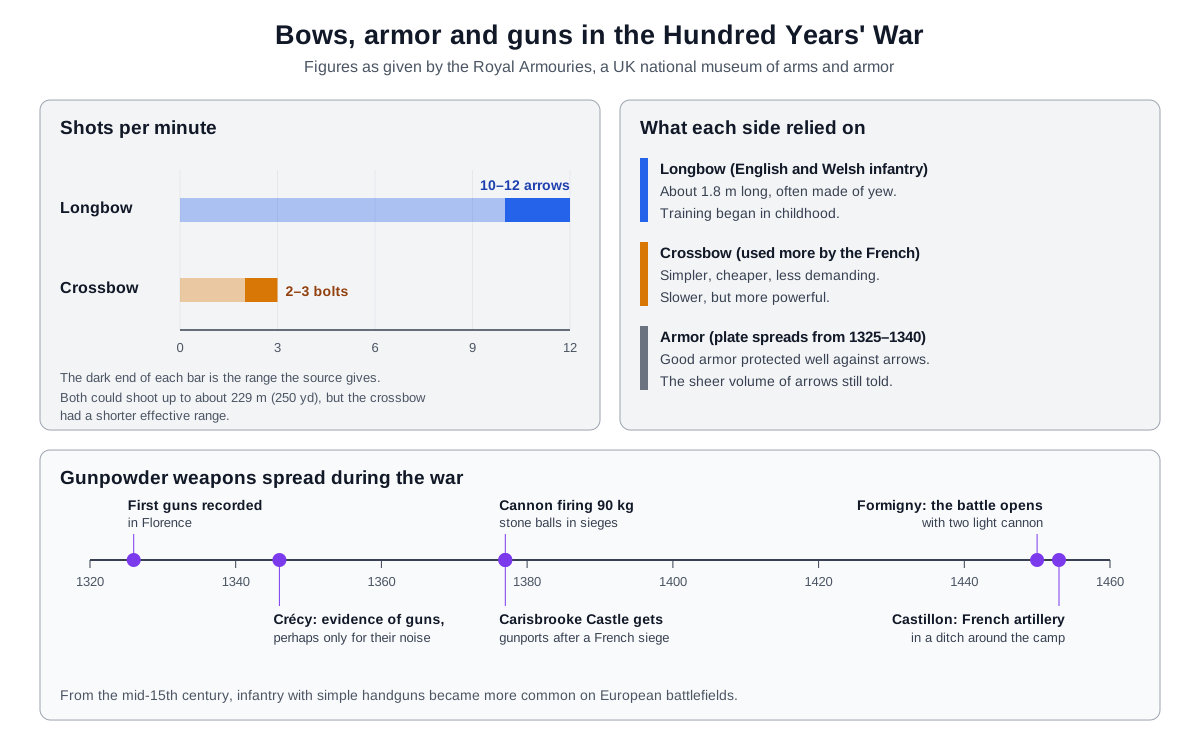
The weapon that comes up most often in stories of this war is the English longbow. It was a wooden bow about 1.8 m long, often made of yew. English and Welsh foot soldiers favored it, and training began in childhood. After the victories at Crécy and Poitiers, Edward III ordered in 1363 that every able-bodied man own a bow and practice on Sundays and holidays instead of playing football.
The French relied more on the crossbow, and many crossbowmen came from towns. A crossbow is a mechanical bow that was simpler, cheaper and less demanding to learn than a longbow. It was more powerful but slower. The Royal Armouries puts the crossbow at 2–3 bolts a minute, against 10–12 arrows for a longbow archer.
So did arrows simply punch through a knight's armor? Not often, in the Royal Armouries' view. Good armor protected men and horses quite well, probably only a small share of arrows got through, and mostly at thin spots, like the side of a helmet.
What made archery work was less the force of one arrow than the sheer number of them, often described as a "cloud" or "storm." English Heritage calls the longbow the most decisive weapon of the war and adds that at shorter ranges its arrows could pierce armor.
Armor itself changed a great deal. Between 1325 and 1340, mail made of linked iron rings was replaced or reinforced with plates of iron or steel. A full suit of plate weighed about 60–70 pounds, but the weight was spread over the whole body, so the wearer could still move with surprising agility.
Gunpowder weapons gained ground throughout the war. In Western Europe, guns first appear in a record from Florence in 1326. Some evidence points to guns at Crécy, though perhaps only to frighten with their noise. By 1377, large cannon firing 90 kg stone balls were being used in sieges.
Castles changed to match. Carisbrooke Castle on the Isle of Wight raised its gatehouse towers after a French siege in 1377 and added gunports, openings made for firing cannon. In 15th-century England, gunports became almost standard on castles.
At Formigny in 1450, the French opened the battle by firing two light cannon. At Castillon, French guns, commanded by the brothers Jean and Gaspard Bureau, had an important role. As the Musée de l'Armée, France's army museum, describes it, the guns sat in a ditch around the French camp, hidden from the English. Talbot attacked the camp with 6,000 men, and his army was shattered by the gunfire.
A new way to raise armies
Medieval armies were traditionally raised through feudal duties owed by lords and their tenants. In the 14th century, England found this system less and less able to supply enough men for long campaigns overseas. So English kings signed paid contracts with captains, who hired archers and men-at-arms. Professional armies raised this way fought the long campaigns in France.
The French crown paid soldiers too, but it still leaned on older feudal powers. Foreign soldiers were common: Genoese crossbowmen fought for France at Crécy, and many Scots served with French armies during the 1400s. In the gaps between campaigns, some soldiers from both sides signed on with the Great Companies, mercenary bands that would fight anyone for money.
Late in the war, Charles VII won the États généraux over to a permanent land tax. An ordinance of 26 May 1445 then laid the foundations of a standing army of 15 companies serving only the king. The Musée de l'Armée puts this army at 9,000 men, paid in war and peace alike. In 1448 Charles also created the Franc-archers, a militia of commoners who were exempt from tax for their service and formed the army's reserve.
The numbers differ by source
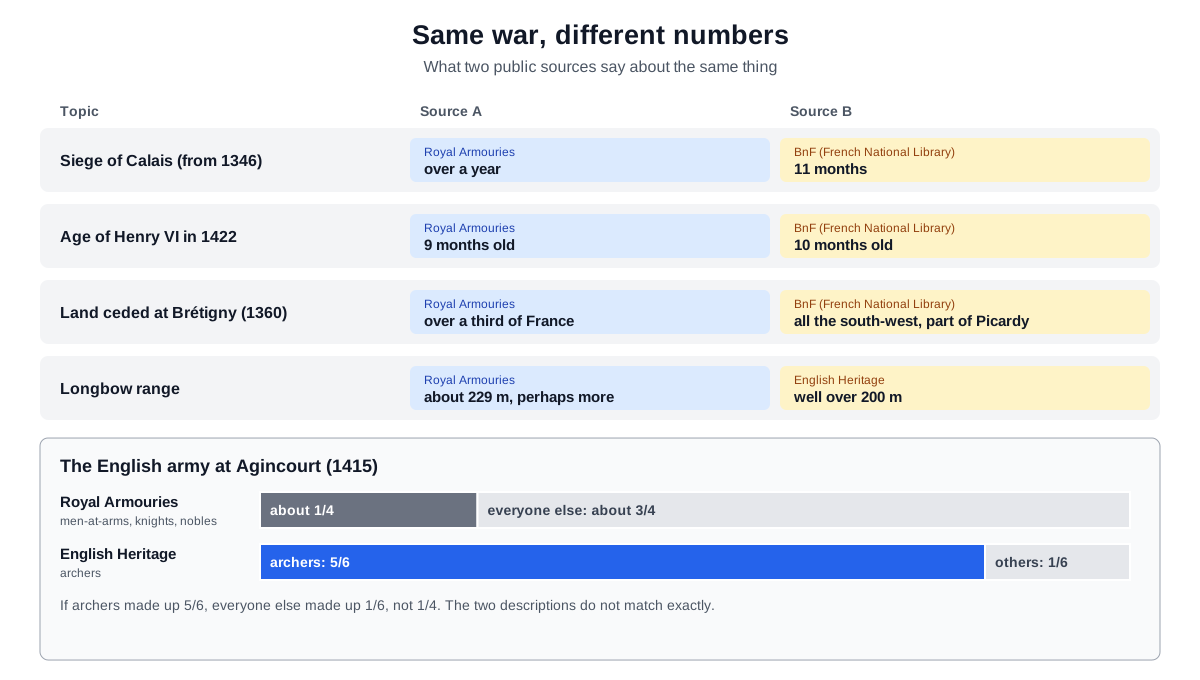
The same event can come with different numbers. The siege of Calais lasted "over a year" in the Royal Armouries' account and "11 months" in the BnF's. Henry VI was 9 months old when he became king in 1422, or 10 months, depending on which you read. The land ceded at Brétigny is "over a third of France" in one account and "all the south-west of the kingdom and part of Picardy" in the other.
What about the English army at Agincourt? In the Royal Armouries' account, men-at-arms, knights and nobles were roughly one quarter of the English force, but more than three quarters of the French one. English Heritage writes that five out of six men in Henry V's army were archers. If archers were five-sixths, everyone else was one-sixth, so the two descriptions do not quite match.
The longbow's range is also put differently: "about 229 m, perhaps more" in one, "well over 200 m" in the other. With numbers like these, it is safer to note which institution gave them.
What the war left behind
The Hundred Years' War ended without a peace treaty. England kept only Calais, and gave that back to France in 1558. English Heritage describes the end of the war as a complete English defeat.
Nearly all the fighting happened in France. Except for raids on its southern coast, England saw little direct harm, and many English people grew rich from ransoms and plunder. France's experience was different. Mounted raids swept the countryside and destroyed resources, and at home the country fell into civil war.
England's final defeats coincided with a breakdown of order at home, and the Wars of the Roses (1455–1485) soon followed. France, by the end of the war, had a standing army that was paid even in peacetime. The Order of the Garter, which Edward III founded after Crécy, also came out of this war.
Many stories remain, too. Joan of Arc, Henry V and the Black Prince are names that still resonate, and Joan was made a saint in 1920. Agincourt became the best-known battle of the war partly thanks to Shakespeare's play Henry V. But a play is not a record, so it helps to keep the stage version and the chronicles apart.
What to read next
- Crécy and the Longbow: The Real Story Behind Bows Beating Knights — a closer look at the first phase's great battle and the longbow story.
- The Battle of Agincourt: Arguments About Mud and Numbers — the battle that opened the third phase, and the arguments over its numbers.
- Joan of Arc and the Siege of Orléans: The Turn of 1429 — the siege that became the war's turning point.
- Self-propelled howitzers: guns that move themselves — what artillery looks like and how it moves today.
- Turning points in military technology — moments since the 20th century when new technology changed war.
- A history of laser weapons: from chemical to electric lasers — how laser weapons, another branch of weapons technology, developed.