Some armored vehicles on the road ride on large rubber tires. A tank crossing a muddy field wears belts of steel instead. Both are heavy armored vehicles, so why have armies never settled on just one?
Wheeled and tracked vehicles are not a contest that one side always wins. Gaining one thing means giving up another. This article starts with the physics of contact area. It then turns to one U.S. government report comparing the two, to missions that use both, and to why the trade-off is still hard to predict.
How much touches the ground
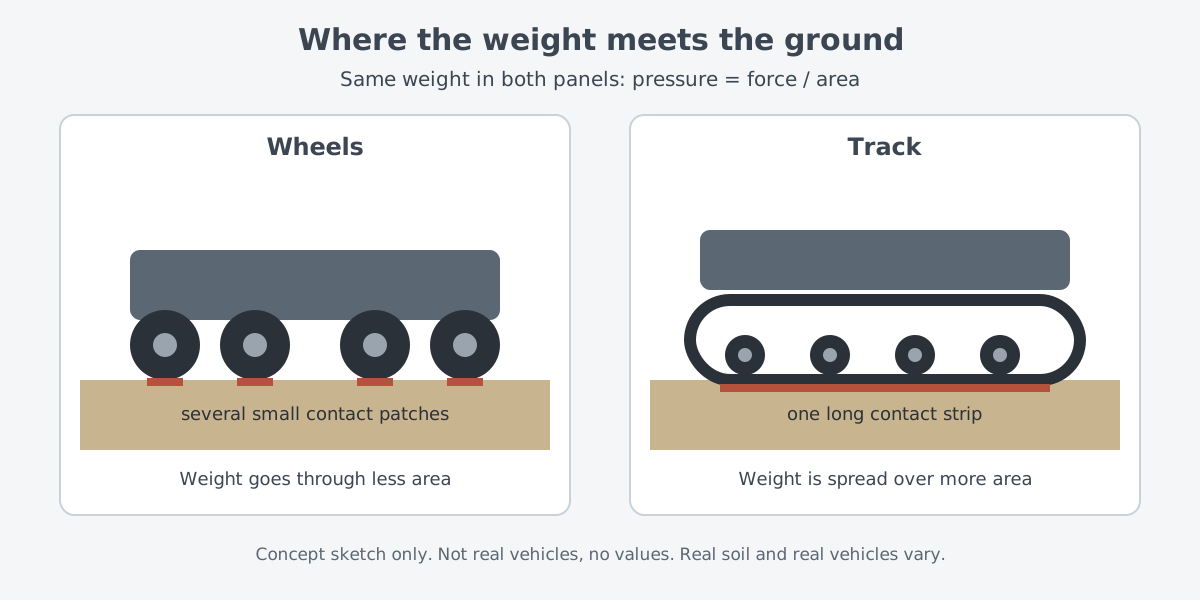
Pressure is a force divided by the area it acts on.
P = F / A
The same force can have very different effects depending on that area. For a vehicle of fixed weight, the larger the area touching the ground, the lower the pressure on the ground.
As a concept only, a wheeled vehicle sends its weight down through the small patches where a few tires meet the ground. On a tracked vehicle, the long underside of a belt wrapped around the wheels carries the weight.
The sketch is simple, but real vehicles do not split so neatly. Tire size and number, track width and vehicle weight differ from one vehicle to the next. This one picture cannot settle which side sinks less. How a track spreads weight and how soil holds up are covered in more detail in Tracks and Suspension: How Heavy Vehicles Cross Mud.
When tracks went onto a wheeled tractor
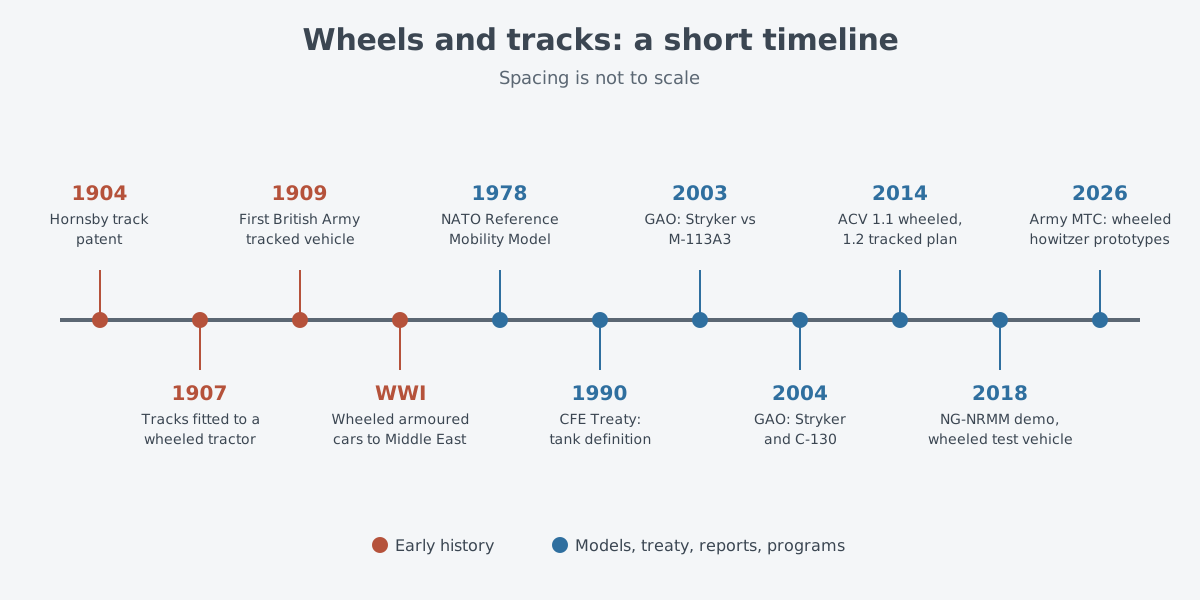
The choice between wheels and tracks is older than the tank. A 1905 military tractor from the British firm Hornsby did well in War Office trials as a wheeled vehicle. In 1907, Hornsby fitted that very wheeled tractor with the crawler track that the firm's David Roberts had patented in 1904.
That machine was ordered for military use in 1909 and became the first tracked vehicle to enter service with the British Army. Wheels did not vanish right away, though. Four tractors went to the War Office on May 5, 1910. The tracked one is the machine now at the Tank Museum in Bovington, and the other three were wheeled.
Wheeled armored cars also fought in the First World War. The Rolls-Royce armored cars began when wealthy gentlemen took their family cars to the front, and weapons and armor soon followed. Once trench warfare began, the cars did not suit the Western Front, so the British Army sent them to the Middle East. Once the battlefield turned to trenches, the wheeled cars were sent to fight somewhere else.
One public comparison: Stryker and M113A3
There is a public record of a government comparing wheels and tracks head to head. The U.S. Army picked the Stryker, an armored wheeled vehicle, as its primary combat platform. The National Defense Authorization Act for fiscal year 2001 required a comparison with a medium armored vehicle the Army already had. The Army chose the M113A3 armored personnel carrier (APC).
The M113A3 is a tracked vehicle. Even today, CRS material lists the M113 family as roughly 30% of the tracked vehicles in the Army's armored brigades. The U.S. Government Accountability Office (GAO) reviewed the evaluation in report GAO-03-671, published in May 2003. In effect, one wheeled vehicle and one tracked vehicle were measured under the same plan.
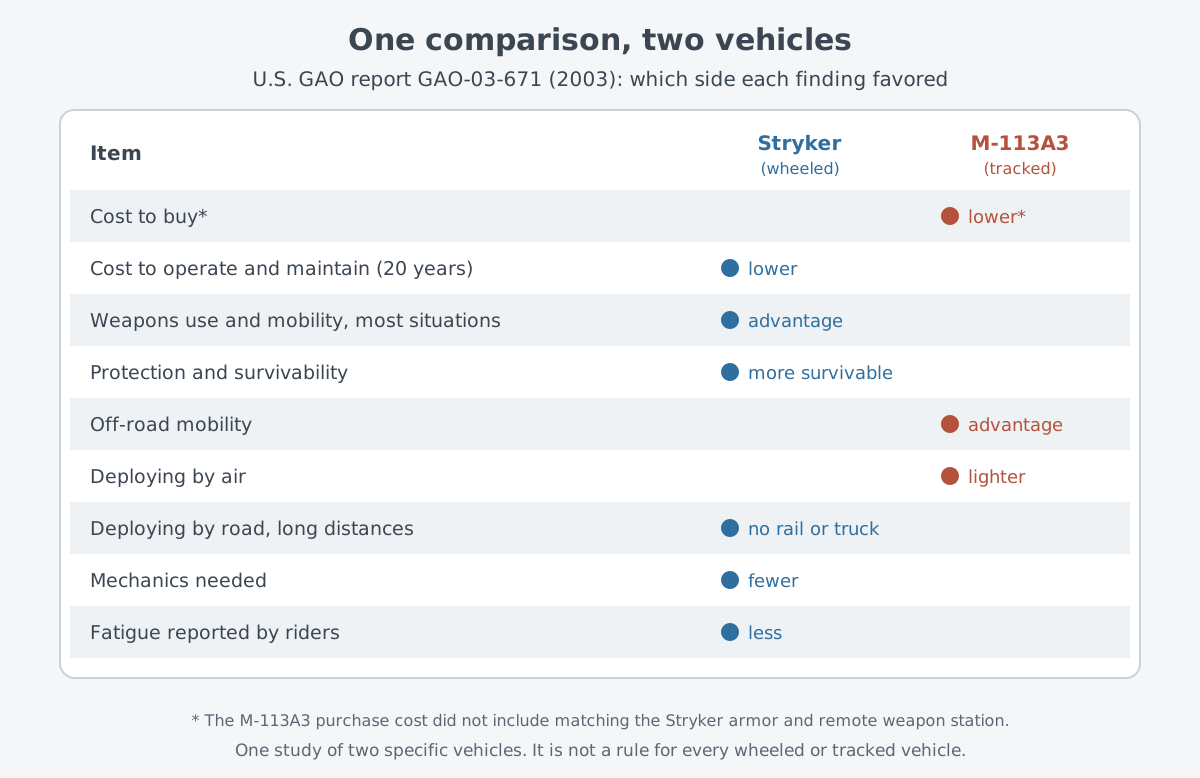
Start with what they shared: both vehicles let infantry squads complete platoon missions. The differences came next. The Stryker had the edge in using its weapons and in mobility during most situations, while the M113A3 had the edge in off-road mobility. The Test and Evaluation Command also concluded that the Stryker was better on protection and survivability. To look harder at mobility, the Army modeled travel at Aberdeen Proving Ground over terrain from Korea, Europe and Southwest Asia in wet and dry weather.
On money, the results pointed in two directions. The Stryker cost more to buy but less to run and maintain. The M113A3's purchase cost, however, left out what it would take to give it armor and a remote weapon station like the Stryker's, and to integrate and test that equipment. Over 20 years, operating and maintenance cost per vehicle was estimated at $2.9 million for the Stryker and $3.1 million for the M113A3. The gap came from fuel efficiency, replacement parts and training costs.
Maintenance and ride comfort were compared too. The Stryker family shares a common chassis and so needs fewer kinds of parts, and as a wheeled vehicle it was judged to need fewer mechanics. Soldiers riding in a Stryker reported less fatigue, lower stress and better communication than soldiers riding in an M113A3.
Reading this as "wheels win" or "tracks win" would be a mistake. It is one evaluation of two vehicles at one point in time. On top of that, the Stryker had not yet logged many miles, so a statistically reliable forecast of its reliability was not possible, and the Army relied partly on projections.
Weight and the long road
The same report also covers moving the vehicles. Both could be transported. The lighter M113A3 was easier to send by air, but over long distances it needed rail or truck support, which made it harder to send by road.
For the Stryker, weight became the problem on the aircraft side. The Army required it to weigh no more than 38,000 lb and to be carried within a theater by C-130 aircraft, arriving ready to fight at once. In August 2004, GAO noted that the Army had shown this transport during training. In a real operating environment, though, GAO found the C-130 could carry the Stryker only to a limited degree unless conditions were favorable.
So wheels or tracks is not decided on the ground alone. How far a vehicle must travel, and by what means, sits on the same scale. The way size and weight come first when a laser weapon goes onto a vehicle is covered in Weight and platforms: fitting on a vehicle, ship or aircraft.
One job, two answers
Self-propelled howitzers are a good example. In the definition used by the Congressional Research Service (CRS), a self-propelled howitzer is a howitzer mounted on a tracked or wheeled vehicle. Both approaches are built into the definition itself. The difference between towed and self-propelled guns is covered in Self-propelled howitzers: guns that move themselves.
In August 2026, the U.S. Army announced a Mobile Tactical Cannon (MTC) agreement for up to 18 wheeled self-propelled howitzer systems for prototyping, testing and soldier experiments. If fielding is approved, the MTC will replace M777 towed howitzers in some units. The Army said this would greatly raise mobility and other qualities, but future fielding will be decided using data from soldiers' operational experiments. The naming of the prototype is covered in the XM1776 news item.
The U.S. Marine Corps also looked down both roads for its amphibious vehicle. The Marines named the first step of the Amphibious Combat Vehicle (ACV) program 1.1 in March 2014 and planned a tracked, fully amphibious ACV 1.2 as well. ACV 1.1 was planned as a vehicle that could swim but still needed another ship or aircraft to get from ship to shore. The 2015 request for proposals pictured ACV 1.1 as an eight-wheeled vehicle.
A 2026 CRS product quotes the Marines calling the ACV an eight-wheeled vehicle of the next generation, built to carry Marines from ships to the shore. Under one program name, wheels and tracks were weighed side by side.
Treaty language holds both as well. The 1990 Treaty on Conventional Armed Forces in Europe (CFE) defines a main battle tank as a tracked armored fighting vehicle. It then adds that a wheeled armored fighting vehicle entering service that meets all the other criteria also counts as a battle tank. The definition looks at what a vehicle does more than at what it rolls on.
Why it is hard to predict
To compare a wheeled and a tracked vehicle on the same ground before either one drives there, you need a model of how a vehicle gets across that ground. The NATO Reference Mobility Model (NRMM), which appeared in 1978, is such a tool. It takes in vehicle data, terrain maps of soil, topography, vegetation, roads and obstacles, and scenario and weather data.
NRMM is a set of empirical formulas drawn from tests in the late 1960s and 1970s. Because many of its formulas come from observation, stretching them beyond the test conditions can give wrong answers. A technical memo from Michigan Technological University and others therefore says NRMM results are useful for comparing existing vehicles, or new ones similar to them. It also says the model should not be used for vehicles with mobility technology very different from today's, such as active suspension. The same condition applies when this model is used to weigh wheels against tracks.
A next-generation, physics-based model (NG-NRMM) aims to handle both current and emerging mobility technology. At its demonstration at Michigan Technological University in the United States in September 2018, the vehicle whose performance the developers predicted was a wheeled test vehicle called FED-Alpha. It was chosen because its physical traits resemble those of the HMMWV, while avoiding the sensitive data tied to a vehicle already in service.
The trade between wheels and tracks ties together cost, maintenance, transport and ground. One public comparison and a set of older empirical formulas do not give a single right answer. Change the mission, the ground or the distance, and the balance tips again.
What to read next
- Tracks and Suspension: How Heavy Vehicles Cross Mud: how a track spreads weight and what springs and dampers do.
- Infantry fighting vehicles and APCs: how they differ from tanks: how tracked armored vehicles split by the jobs they do.
- Self-propelled howitzers: guns that move themselves: the definition and programs of a weapon that uses both wheels and tracks.
- Weight and platforms: fitting on a vehicle, ship or aircraft: how a vehicle's size and weight shape the task of carrying a laser weapon.