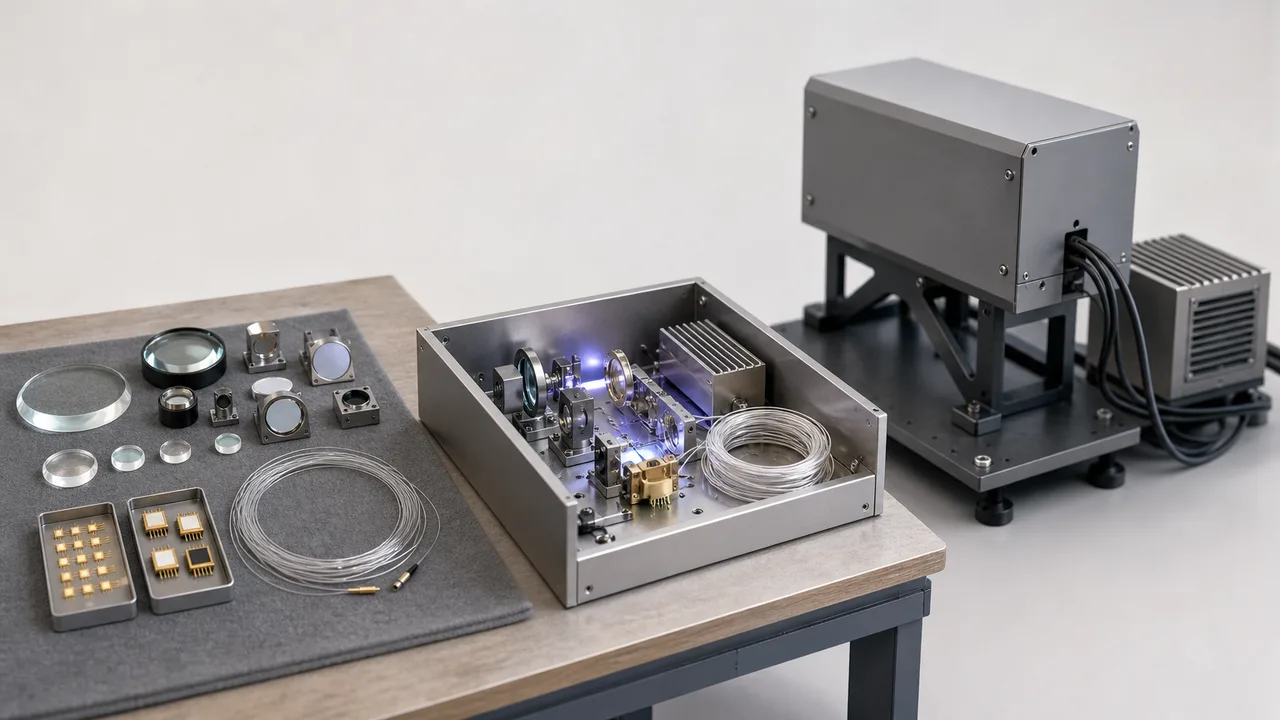
Take apart one piece of laser equipment and you may find several name tags. The lenses may come from one company, the semiconductor chip that makes the light from another, and the boxed laser that holds them from a third. A weapon adds one more layer on top.
So the words "laser company" alone say little about what a company sells. A lens maker, a maker of factory lasers and a company that puts a laser weapon on a vehicle do quite different work.
Below, the laser business is split into three layers: components, lasers and systems. What moves through each layer is checked against what companies state on their official sites and against public US government documents.
What goes into one laser
A laser has three basic elements: the gain medium that amplifies light, a power source that puts energy into it, and a way to feed light back. In many lasers the feedback comes from reflection, and this part is called the optical resonator. Putting energy into the medium is called pumping.
Each of these elements is also sold on its own. Lenses and mirrors that gather and steer light, semiconductor light sources used for pumping, and fibers that hold the gain medium are all separate products. Put them together in a box that emits light and you have a laser. Add a pointing device, a power supply and cooling, mount the whole thing on a vehicle or a ship, and you have a system.
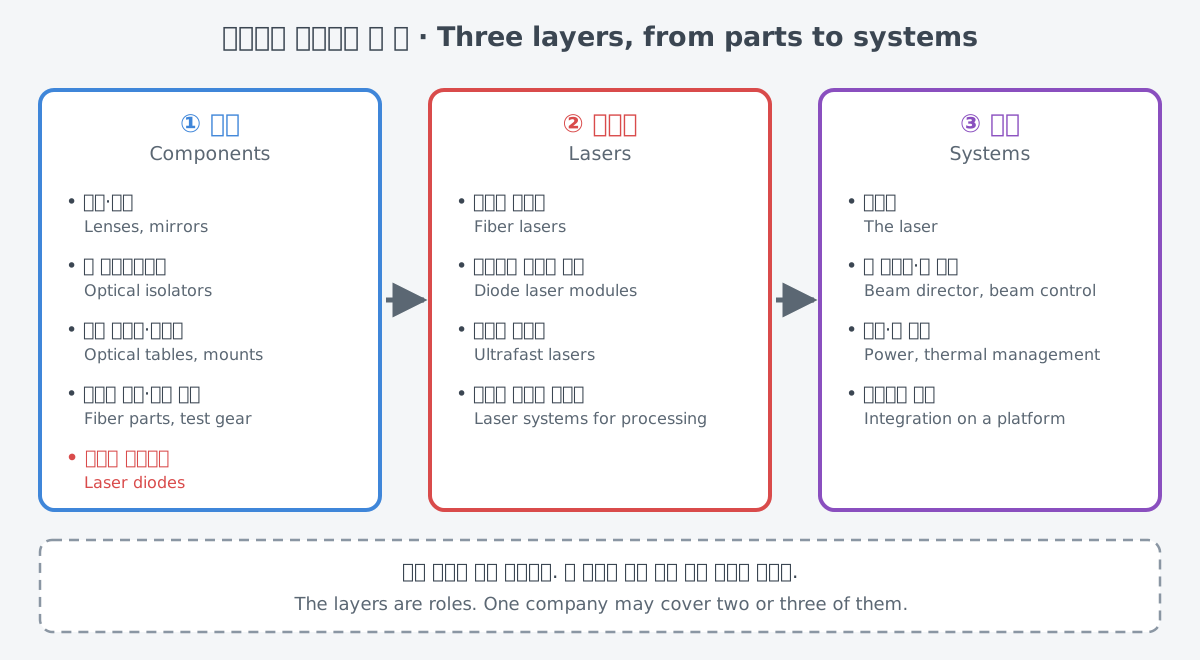
Compare it with a car. Component makers are like the bulb and tire companies, laser makers like the engine company, and system makers like the company that finishes the car. In practice the lines are much less clear. One company may make both parts and lasers, and the same product can be a finished item for one customer and a part for another.
Component makers: optics, mounts and test gear
Picture the optical table in a research lab and you can see what component makers sell. On it sit lenses and mirrors, the mounts that hold them, a table that damps vibration, and instruments that measure the light.
Thorlabs designs and manufactures photonics components, instruments and systems of this kind. It started in 1989 in Newton, New Jersey, with the goal of making lab equipment easier to get for graduate students and junior professors. The company states that it has more than 24,000 products.
The product menu of Newport (MKS) looks similar. Lenses, mirrors, optical tables, Faraday optical isolators and light analysis equipment sit in one menu. The same menu also carries Spectra-Physics lasers and drivers for semiconductor lasers, so the label "component maker" does not cover everything it sells.
Companies like these also publish material on how their products are used. Among Newport's application notes is one on printed circuit board (PCB) manufacturing, where lasers are routinely used for drilling, cutting boards apart, marking and other steps.
The laser diode: a part and a laser at once
The laser diode (LD) sits on the line between parts and lasers. It is a laser made of semiconductor, and the basic device is a highly refined diode. Current driven through a PN junction creates a population inversion between energy bands, and the resonator that feeds light back is part of the semiconductor itself.
On the outside it looks more like a small electronic part. It is packaged like one, with an internal sensor to regulate its output power.
A laser diode is used in two ways. In the first, its own light is used directly. Diode lasers are the most numerous lasers in use today, and CD players and optical telecommunications are typical uses.
In the second, it becomes the energy source for another laser. Solid-state lasers such as Nd:YAG are often pumped by a flashtube or by laser diodes. High-power fiber lasers are mainly ytterbium-doped silica fiber lasers, and they too are pumped by diodes. According to IPG Photonics, a fiber laser must couple and collect the light from laser diodes to create a collimated (nearly parallel) laser output.
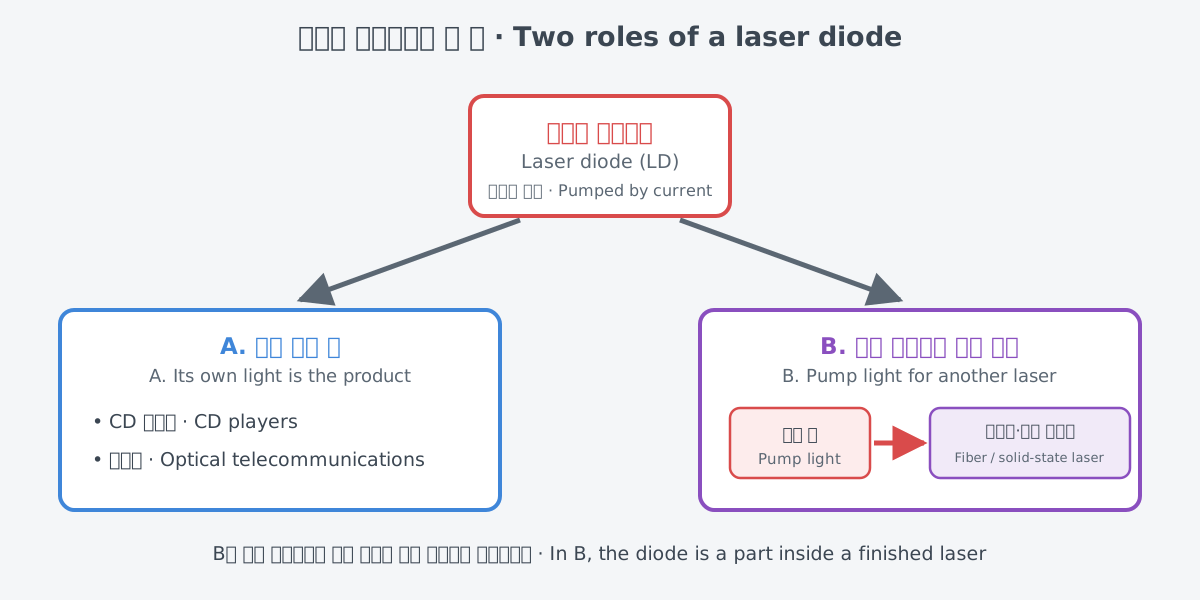
In the second role, the same diode becomes a part inside a finished laser. A diode used this way is also called a pump diode. The product list of BWT includes diode laser modules labeled "for laser pumping," which shows this use.
Laser makers: a finished light source
Laser makers gather parts such as diodes, fibers and mirrors and build a finished product that emits light. The buyer may be a factory that cuts metal, an operating room or a research lab.
IPG Photonics dates its work to 1990. Today it offers lasers and laser systems used in material processing, medical procedures and advanced applications. Its site menu holds more than lasers. It also carries packaged diodes and beam delivery equipment, along with finished machines such as laser systems for cutting.
BWT offers diode laser, fiber laser and ultrafast laser products. In other words, diode laser modules and fiber lasers sit side by side in one company's product list.
The amplifier that raises output power is a product too. FiberBridge Photonics, based in Hannover, Germany, lists high-power fiber amplifiers along with fiber laser components such as pump combiners, fiber end caps and cladding light strippers. Here a company that lists fiber laser parts also lists a large block of a laser, the amplifier.
System makers: from a laser to a weapon system
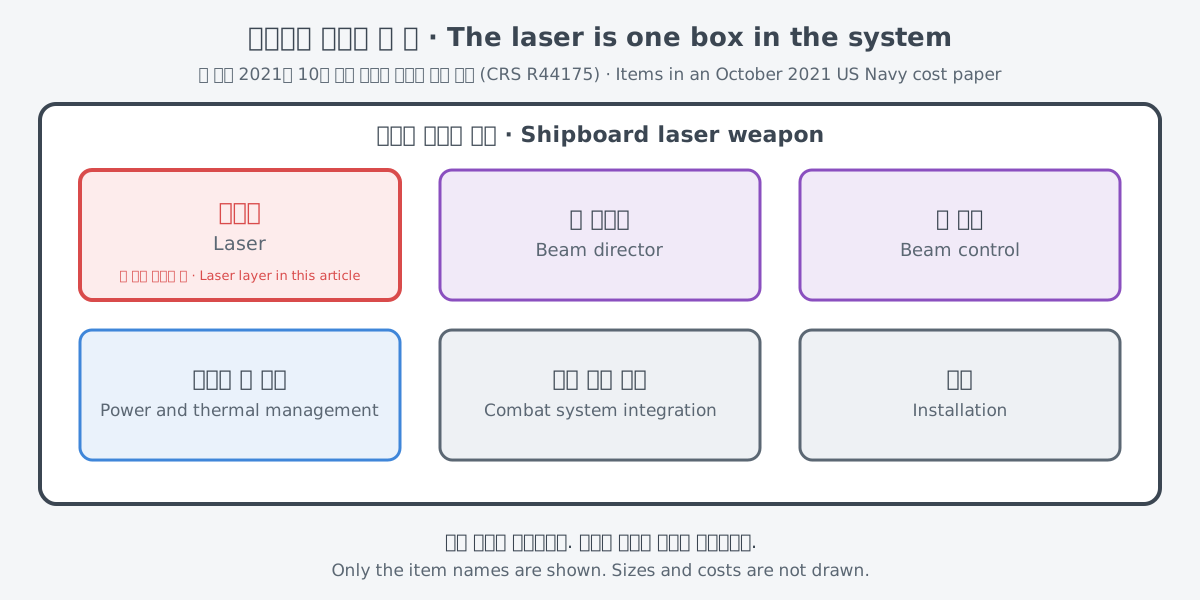
In a laser weapon, the laser is one box in the system. A report from the Congressional Research Service (CRS), R44175, carries an October 2021 US Navy information paper. When it estimates the cost of shipboard lasers, the paper counts the laser, the beam director, beam control, power and thermal management, combat system integration and installation as one bundle.
US Army sources show the same picture. Army budget documents quoted in CRS report R46925 name a vehicle, a laser subsystem, a power and thermal subsystem and a beam control subsystem. These are integrated with battle management, command, control and communication software.
A 2014 article from the Technical Center of the US Army Space and Missile Defense Command (SMDC) quotes an Army research official. He pointed to recent demonstrations in which a commercial laser and supporting beam control, power and thermal subsystems were all integrated on one military truck. He added that the technology still needed to mature.
Completing this bundle and putting it on a platform is the work of the system layer. Some laser makers extend their work into this layer.
FiberBridge Photonics has a page on high-energy laser (HEL) systems. There it names "manufacturing and installation of the complete laser system" as work it can do. It also names integration of the HEL on platforms for land, sea, space and air.
Parts aimed at this market appear too. On its directed energy laser page, Exail offers phase modulators, doped fibers and variable optical delay lines as parts suited to developing high-power laser architectures. Exail is an industrial group working in robotics, maritime, navigation, aerospace, photonics and quantum technologies. It was formed in 2022 when ECA Group and iXblue joined forces.
One company can cover several layers
The three layers are roles, not companies. Several companies point to vertical integration, which means making everything from early stages to the finished product inside one company.
Can one company make everything from the chip to the finished machine? According to nLIGHT, it has built a vertically integrated technology stack running from semiconductor chips to full laser systems. Its business areas are directed energy, sensing and advanced manufacturing. The range FiberBridge Photonics claims is the entire value chain, from fiber components to high-power laser systems.
The same idea appears on the research equipment side. Thorlabs calls its ability to design, prototype, test and manufacture both catalog products and custom solutions vertically integrated.
For laser weapons, this supply chain also shows up in official documents. The same October 2021 Navy paper states that the industrial base for major subsystems and components of laser weapon systems is not yet mature in production capacity. The Navy listed this as one of the factors that limit the accuracy of cost analysis for future laser weapons.
Reading company material
For what a company makes, its official site is the most direct source. A company site is also written to promote its products. Words such as "world leader" or "most efficient" are the company's claims, not a comparison of several companies measured the same way.
The site alone often does not tell you whether the company makes every item on its menu itself. The power and wavelength numbers in a product name are the specifications of that one product. They do not describe the performance of the system the laser goes into.
Read weapon-related company text the same way. The uses and performance a company describes are its own description, and they should be read apart from test results that a government or military has released.
What to read next
- "Where industrial lasers are used: cutting, welding, marking, cleaning": what lasers do in the factories that buy from laser makers.
- "A laser weapon is more than a laser: the system at a glance": each box of the system layer, one at a time.
The official websites of the companies are collected on the Makers page.