On 25 October 1854, in a valley near Balaklava in the Crimea, the 673 men of the British Light Brigade rode toward a Russian battery. The order was short, and it did not make clear which guns it meant. Within weeks the charge became a poem by Tennyson. It is still the first image many people have of the Crimean War.
The charge is not the only thing this war left behind. News from the front began to reach home by telegram, in newspaper reports and in photographs. In a hospital, a nurse counted the dead and turned the count into a picture. This article follows why the war began and how it unfolded, and what the telegraph, the camera and statistics changed along the way.
Why the Crimea?
In the 1850s, Tsar Nicholas I of Russia called the Ottoman Empire the "sick man." The familiar words "of Europe" were tacked on a few years later. Early in 1853 he sent Prince Menshikov to the Ottoman government with a demand: Russia wanted sovereignty over the empire's 12 million Orthodox Christians.
Russia soon mobilized and marched into the two Danubian Principalities, Moldavia and Wallachia, the land that is Romania today. The Ottomans answered with a declaration of war in October 1853. On 30 November a Russian fleet destroyed an Ottoman one at Sinop, on the southern shore of the Black Sea. The British official gazette ranks it among the most lopsided sea battles ever fought.
Britain and France declared war on the Sultan's side on 28 March 1854. Both hoped to keep the weakening Ottoman state standing and to check Russian expansion in the Near East. A French voice survives too. On 2 March 1854, Napoleon III told French deputies that France had as much interest as Britain, or more, in keeping Russian influence from spreading without limit over Constantinople.
The fighting did not start in the Crimea, though. In June 1854 the two allied armies assembled at Varna, on the western shore of the Black Sea. That summer the Russians lost to the Ottomans at Silistria and, under pressure from Austria, pulled out of the principalities. The allies at Varna were left with little to do.
Swayed by opinion at home, the British government chose a new target, Sevastopol, Russia's naval base in the Crimea, and France went along. The Kingdom of Sardinia joined the allies in 1855 to win favor with France.
The Crimea was not the only theater. In Armenia, Russia did well for the most part against the Ottomans, and allied warships were also active in the Baltic. Still, for Britain, the Crimea mattered most.
From 1853 to 1856 on one timeline
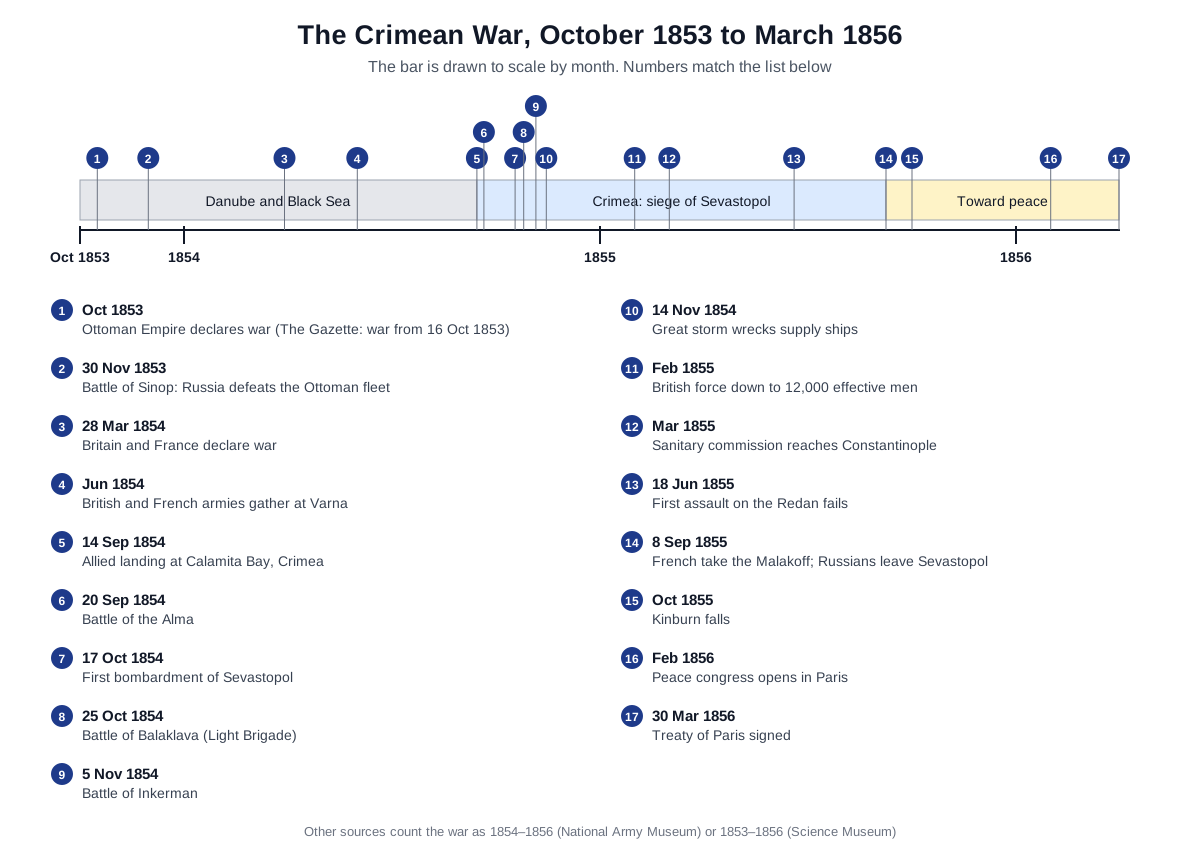
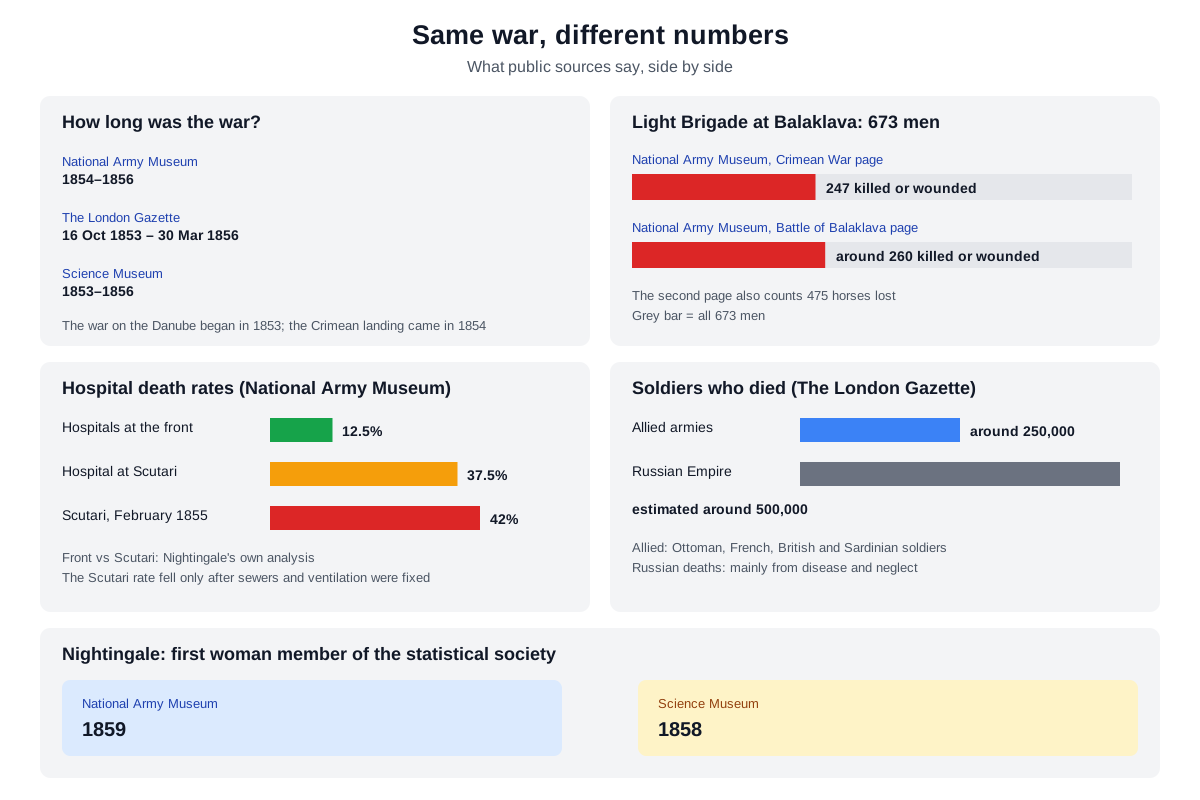
Institutions count the war differently. The London Gazette, Britain's official gazette, gives 16 October 1853 as the start and 30 March 1856 as the end, and the Science Museum gives 1853–1856. The National Army Museum (NAM) in London counts 1854–56. The Russo-Ottoman war on the Danube began in 1853, and Britain and France joined in 1854, so the start year depends on which event you take as the beginning.
On 14 September 1854 the allies came ashore at Calamita Bay on the Crimea's northwest coast. By the 18th, 30,000 French, 26,000 British and 4,500 Turkish troops had landed. On 20 September they stormed the Russian lines on the high ground over the Alma River. The Russians fell back after losing 5,000 men, and the allies lost 3,000.
The road to Sevastopol was open, but the allies did not know how weak its defenses were. So they swung around the city to lay siege from the south, with the harbors at Balaklava and Kamiech as their bases. That bought the Russians time to build up the fortifications, which held up well against the first bombardment on 17 October. The siege lasted until the following September.
On 5 November the Russians struck the British lines at Inkerman by surprise at dawn. The fight was confused and fought in thick fog, and the allies won as British infantry held on and French reinforcements came up. NAM puts British dead at 2,500, French at 1,700 and Russian losses at 12,000.
On 18 June 1855 British troops attacked a strongpoint called the Redan. They had to cross 250 yards of open ground under heavy fire and fell back after more than 1,500 casualties. A second attempt on 8 September also failed to win the Redan. This time, though, French troops seized the Malakoff redoubt, and the Russians gave up Sevastopol.
A column by Yves Bruley published by the Fondation Napoléon describes that day from the French side. Heavy bombardment began on 5 September. At noon on the 8th the guns fell silent and the charge sounded.
A long, uncertain day ended when General Mac-Mahon took the Malakoff tower, and the Russian general Gorchakov ordered Sevastopol evacuated to the north. In October 1855 the fort at Kinburn was taken as well.
Balaklava and the Light Brigade
On 25 October 1854, about 25,000 Russian troops pushed toward Balaklava, the British supply port, and took several redoubts held by Turkish troops. When Russian cavalry pressed on toward the harbor, the 93rd Highlanders under Sir Colin Campbell blocked the way. Infantry meeting a cavalry charge would normally form a square of four ranks, yet these men stood in just two. Two disciplined volleys turned the Russians back, and the moment became known as the "thin red line."
Next, the 800 men of the British Heavy Brigade charged uphill at 3,000 Russian cavalry. They moved at barely more than a trot and the charge lasted only about 10 minutes, but it threw the Russian horsemen into disorder.
Then came the trouble. Lord Raglan, the British commander, watched from high ground and wanted to stop the Russians from hauling away the guns they had captured. His order read: the cavalry should "advance rapidly to the front, follow the enemy and try to prevent the enemy carrying away the guns." NAM describes it as loosely worded.
The cavalry commanders in the valley below could not see what Raglan saw, so they did not know which guns he meant. In front of them was only a Russian battery at the far end of the valley.
The Light Brigade charged the wrong battery. The riders galloped through cannon fire coming at them from three directions, and some reached the guns at the far end. A charge by the French Chasseurs d'Afrique helped the survivors withdraw.
Even within one museum, the losses are given slightly differently. NAM's Crimean War page counts 247 of the 673 men killed or wounded, while its Battle of Balaklava page says around 260, and adds that 475 horses were lost. Neither side gained a strategic win. Balaklava stayed in allied hands, but the Russians held the heights and the road, which made supplying the siege lines through the coming winter much harder.
The defeat is remembered largely because of Alfred Tennyson's poem "The Charge of the Light Brigade," which appeared only weeks later. Some years after that he wrote "The Charge of the Heavy Brigade" too, to raise funds for Crimean veterans, a good number of them poor. A poem is a poem, and the order and the casualty records are worth reading on their own.
Winter, a road and supplies: what broke and what was fixed
On 14 November 1854 a violent storm hit the Crimea. Tents in the camp outside Sevastopol were destroyed, and the steamship Prince went down with its load of winter clothing and horse fodder. In all, 30 ships loaded with medicine, food and clothes suffered damage.
With their fodder gone, the transport animals died of cold and hunger. Winter turned the dirt road from Balaklava up to Sevastopol into deep mud that carts on wheels could not get through. At the worst point, soldiers walked a 19 km round trip to Balaklava to fetch supplies. Men in the trenches lacked food, warm clothes, tents, medicine and fuel to cook with, and by February 1855 only 12,000 British soldiers were still fit for duty.
Moving the wounded broke down as well. Short of space on the ships, the army had shipped out just a handful of ambulances, and the animals to pull them were dying. Patients were carried on mules borrowed from the French or on cavalry horses. Some men who reached the hospital at Scutari, across the Black Sea, lay untreated for weeks.
None of this was new. NAM notes that almost every British overseas expedition had suffered similar problems. What changed was that this time a war correspondent sent the picture home.
Lord Palmerston's new government set up commissions of inquiry, and their reports named the lack of a paved road as one factor. They also blamed the government for failing to supply proper equipment, and senior officers for slow handling of stores. The government reorganized military administration, planned a new transport corps for the army and began laying rails at Balaklava. Those steps, and the coming of spring, slowly eased the supply crisis.
The second winter was different. This time disease hit the French army hard. The British, by then properly clothed, sheltered and equipped, escaped the misery of the previous year.
Telegraph and newspapers: when news got faster
The Science Museum calls the Crimean War the first high-tech conflict of the modern era, fought in a time of railways, telegraph lines, photography and explosive shells. That does not mean a single wire joined the front and London from the first day.
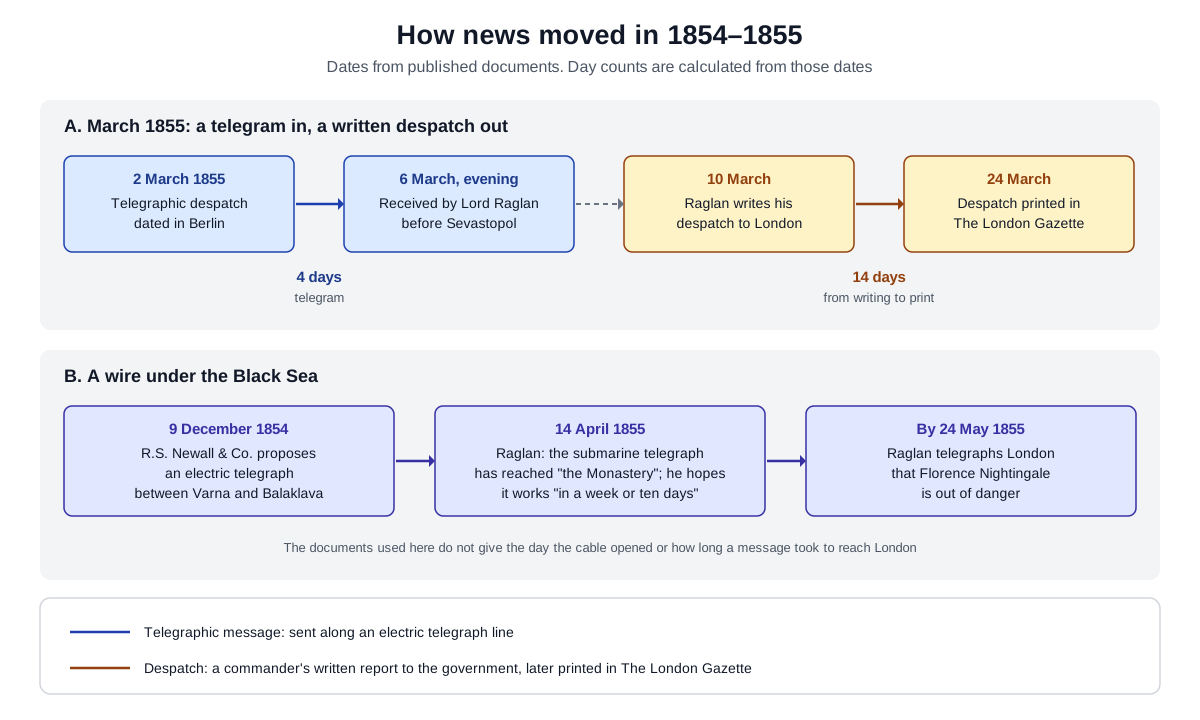
News reached Britain in two ways: by telegram and by handwritten official despatch. A despatch could include lists of the killed and wounded, and a trusted officer carried it to the War Office or the Admiralty in London. Both kinds were printed in the Gazette.
One despatch from March 1855 shows the pace of the time. In a despatch dated 10 March, Raglan wrote that a telegram from Berlin, sent on the 2nd, had reached him late on 6 March. It reported that the Russian emperor had died at noon on the 2nd.
Counting by the dates, the news took four days to get from Berlin to headquarters in the Crimea. Raglan's despatch was printed in the Gazette on 24 March, 14 days after he wrote it.
A cable under the Black Sea was being laid in the same months. The archive of Royal Museums Greenwich holds a proposal by R.S. Newall & Co., dated 9 December 1854, for a telegraph line linking Varna and Balaklava.
On 14 April 1855, Raglan reported that the submarine telegraph had been safely brought from Cape Kelegra to "the Monastery." The engineers would carry it on to the neighborhood of Varna. He hoped the line could be used within a week or ten days.
By May the telegraph was carrying news about one person's health. Nightingale went to Balaklava in May 1855 and fell ill with "Crimean fever." By 24 May, Raglan could send word to London by telegraph that she had pulled through.
Newspapers changed too. In February 1854, John Delane, who edited The Times, sent William Howard Russell out with the Brigade of Guards. NAM regards men like Russell as the first true war correspondents in the world. Russell's reports on the army's failings caused a public outcry, and that outcry brought down the government of Lord Aberdeen.
The audience grew as well. As literacy spread and more people gained the vote, more of them wanted news, and new technology such as the telegraph raised the demand for accurate, current reports. The Illustrated London News doubled its weekly sales during the war, from 100,000 to 200,000, and by November 1854 no British paper was more popular. When the newspaper duty, the "tax on knowledge," was abolished in 1855, cheap newspapers multiplied.
The official gazette was part of this flow. Thanks to the despatches it printed and to other media, the Crimean War is counted among the earliest modern wars. The general public could follow it with timely and accurate news.
A camera on a cart
Photography was still young. In 1851 the wet-plate process of Frederick Scott Archer pushed aside the earlier methods, but a photographer still had to haul a darkroom everywhere. Cameras were large and heavy, and long exposures made action shots impossible.
A photograph from 1855 in NAM's collection shows the van Roger Fenton (1819–69) used for his photography, with his assistant Marcus Sparling sitting on it. Fenton helped found the Royal Photographic Society and is known above all for his photographs of the Crimean War.
His Crimean work was limited by the wishes of the businesses and officials who backed him, and by harsh conditions in the field. Even so, NAM rates the record highly for its quality and range. It includes portraits and landscapes, as well as "tableau vivant," or living picture, scenes in which people were posed like actors on a stage.
James Robertson, chief engraver to the Ottoman Imperial Mint, also photographed the Crimean War. He mostly shot landscapes, and he was on hand as the siege of Sevastopol ended, photographing the ruined forts.
Photographs did not fill the newspapers right away. During the war, papers sent artists as well as reporters to the front, and they printed drawings. After the war, better printing let photographs gradually replace drawn illustrations.
Nightingale and a picture made of numbers
Florence Nightingale read newspaper accounts of the soldiers' suffering and answered a government call for nurses. She left London with her party on 21 October 1854 and reached Constantinople on 3 November; the Science Museum gives the team as 38 strong. The hospital at Scutari was dirty and lacked basic equipment. The male army doctors did not want the nurses at first, but when casualties poured in from Inkerman in November, they accepted the help.
The nurses improved medical and sanitary care on the wards, set up kitchens and washed bedding and clothes. They also wrote letters home for the soldiers and opened reading rooms.
Even so, the death rate did not fall at once. In February 1855 it rose to 42% at the hospital. NAM writes that Nightingale wrongly blamed the deaths on poor nutrition rather than poor sanitation. The airless building sat over a broken sewer, and deaths fell only once the sanitary commission had fixed the drains and let in fresh air.
The commission, made up of Dr John Sutherland, Dr Gavin and the sanitary engineer Robert Rawlinson, reached Constantinople in March 1855. Its work, together with that of Nightingale's nurses, helped cut the death rate at Scutari by half within weeks. The change in the hospital came from both groups' work.
Nightingale's other legacy was numbers. When she arrived, deaths at Scutari were not even being recorded properly. She gathered and analyzed data. Soldiers treated in hospitals near the front (a 12.5% death rate) had a better chance of surviving than those sent on to Scutari (37.5%).
After returning to England in August 1856, she told this story with a single picture. In the diagram, now known as a polar area diagram, each wedge stands for one month, and the wedge's area shows how many soldiers died that month. Blue is preventable disease, red is battle wounds and black is other causes. The right side of the diagram shows 1854–5, after her arrival, and the left side shows 1855–6, after reforms to the hospital and to nursing.
Two things stand out at a glance. Deaths fell sharply after the reforms, and more soldiers died during the war from preventable disease than from wounds. Most statisticians of the day published tables of numbers. Nightingale chose a picture so that MPs, officials and officers with no training in statistics could see the size of the problem right away.
She became the first woman elected to the Statistical Society, known today as the Royal Statistical Society; NAM gives the year as 1859, the Science Museum as 1858. On 9 July 1860 the Nightingale Fund paid for a school to train nurses, which she opened at St Thomas's Hospital.
Mary Seacole, who was born in Jamaica, was at the war as well. Late in 1854 she volunteered in London as an army nurse, and when the War Office and Nightingale turned her down, she paid her own fare to reach the front. She often rode out to bring medicine and food to those who needed them.
The Treaty of Paris and what remained
After losing Sevastopol, Russia agreed to peace terms when Austria threatened to join the war on the allied side. A peace congress opened at the Quai d'Orsay in Paris in February 1856, and the treaty was signed there on 30 March. It promised Turkey its independence and turned the Black Sea into neutral water, closed to every warship. Russia handed over Bessarabia, where the Danube meets the sea.
NAM sees the neutral status of the Black Sea and the Dardanelles as a setback for Russia's hope of a warm-water naval base in the south. Ratification by all parties took less than a month.
The cost was heavy. The British official gazette says the four allied nations lost around 250,000 soldiers, and that an estimated 500,000 died on the Russian side. The Russian deaths came mainly from disease and neglect.
The war also created something new. To honor the courage shown by Crimean War soldiers, Queen Victoria instituted the Victoria Cross. It rewards bravery against the enemy no matter what a soldier's rank, and the Gazette announced it on 5 February 1856.
Views of the war have shifted over time. Bruley writes that French historians under the Third Republic often saw it as an indefensible war fought for trivial reasons. Today, he adds, research has made it better known and better understood. On the British side, the campaign is remembered both for failures of command and supply and for the courage and stamina of ordinary soldiers.
Seen across a longer stretch of European history, the Crimean War sits inside a long peace. NAM writes that Waterloo opened a general European peace that lasted until 1914, broken briefly by the Crimean War. For the British Army, it was the only large war in Europe between 1816 and 1914.
What to read next
- The Napoleonic Wars at a Glance: Corps and Conscription — the war that shook Europe before the Crimea, and how the peace after Waterloo began.
- The American Civil War at a Glance: 1861 to 1865 — the great war fought across the Atlantic a few years after the Crimea.
- Military logistics: performance must be sustainable — supply and maintenance laid out as modern military logistics.
- Turning points in military technology — the moments since the 20th century when new technology changed warfare.
- A history of laser weapons: from chemical to electric lasers — how laser weapons, another branch of weapons technology, developed.