On the afternoon of 24 December 1950, explosives brought down the piers and cranes of the port of Hungnam. The ships carrying the last troops were pulling out of the harbor at the time. For roughly two weeks before that, more than 100,000 soldiers, their vehicles and their supplies had been loaded aboard ships there. More than 90,000 refugees who had left their homes boarded too.
Why did an army leave by sea instead of over land? And how did refugees end up on warships and merchant ships? The answers lie in records of the U.S. Naval History and Heritage Command (NHHC) and in an entry of the Encyclopedia of Korean Culture. The two agree on the main story, but their numbers and dates differ a little.
The NHHC material comes in two kinds. One is an overview page on the battle. The other is the H-Gram, a series of historical notes written by the command's director (here issue 056 and its attachment, H-056-1). The H-Gram mixes in its author's interpretation, and the encyclopedia entry also carries a notice that it gives the writer's scholarly view.
Why the way out was by sea
After the Inchon landings in September 1950, UN forces moved north quickly. MacArthur believed the war would be over by Christmas, and a "home before Christmas" mood spread among U.S. troops. Yet from 19 October, Chinese troops had been crossing into North Korea at night without being detected.
By late November, as the size of the Chinese offensive became clear, the U.S. X Corps on the eastern front was in danger. On 30 November its commander, Major General Almond, told all his forces to pull back and gather at Hamhung, a large city just inland of Hungnam. The units at the Chosin Reservoir had to fight their way down a single supply road toward the port.
Could they not have gone south over land? The Eighth Army in the west could withdraw by road. In the east, X Corps lost its road south when the Wonsan area fell to the Chinese. The way left open was the sea.
At first MacArthur thought a force gathered at Hamhung and Hungnam could hold out through the winter, and the senior commanders there agreed. On 1 December, however, the U.S. Joint Chiefs of Staff directed him to withdraw X Corps. A meeting in Tokyo on 7 December discussed shipping X Corps around to the west coast of South Korea to help defend Seoul, and the Joint Chiefs approved the plan. In the Korean encyclopedia's account, MacArthur's withdrawal order came on 9 December.
A landing run in reverse
Hungnam was a huge logistics operation carried out on short notice, in effect an amphibious landing run in reverse. A landing puts people and cargo from the sea onto a beach. Here the people and cargo on the shore had to be gathered back into ships. Another difference was that troops who had come in through three ports, plus others who had come overland, all had to leave through one harbor.
The plan called for loading 110,000 to 120,000 people, 15,000 vehicles and over 400,000 tons of supplies. That included large stocks of ammunition and aviation fuel built up for the winter offensive. There were not enough ships, or enough pier space, to move it all at once. So the cargo ships made repeated trips between Hungnam and Pusan.
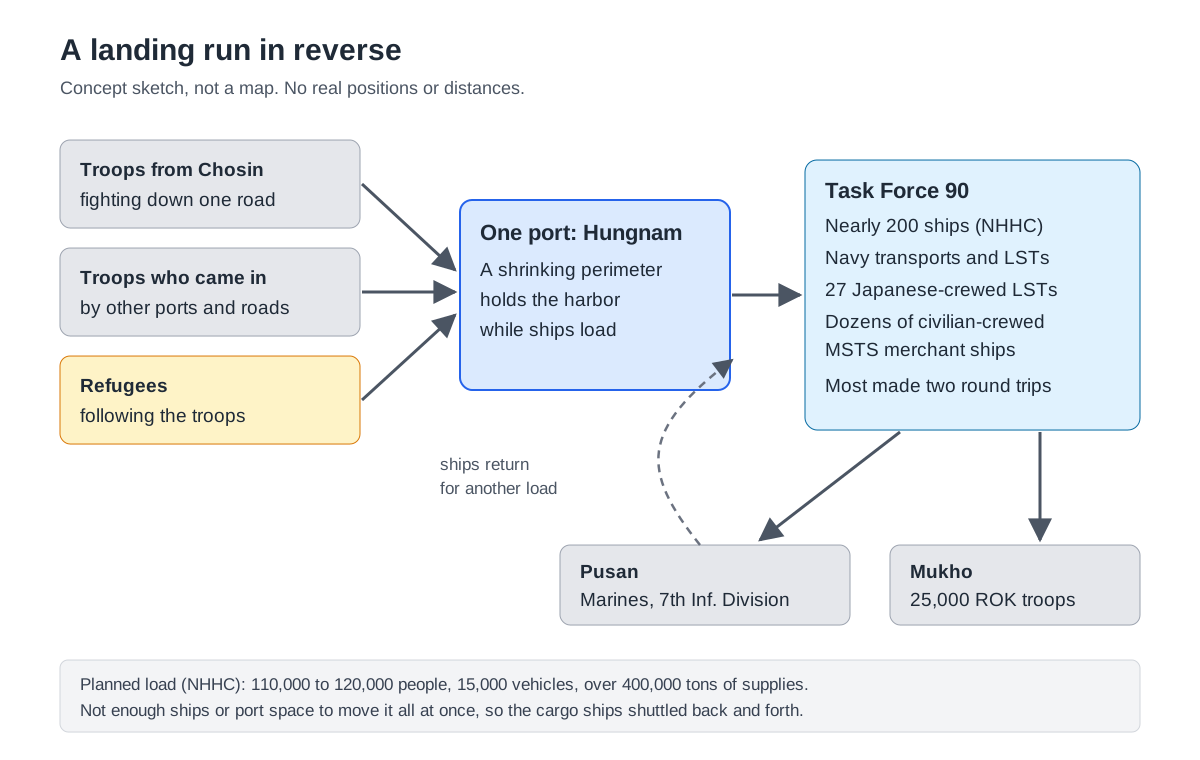
The ships were gathered by the U.S. Navy's Task Force 90. Besides Navy transports and tank landing ships (LSTs), the force included 27 LSTs crewed by Japanese sailors and dozens of Military Sea Transportation Service (MSTS) merchant ships with civilian crews. In all there were close to 200 ships.
The first to board was the 1st Marine Division, back from the Chosin Reservoir. The Marines reached Hungnam on 11 December, were loaded by the 14th and sailed for Pusan on the 15th. The Korean record gives the same dates. On the 17th, 25,000 South Korean troops and 700 vehicles were shipped to Mukho, a port on the east coast south of the 38th Parallel.
As much cargo as possible went aboard. Even broken-down vehicles filled three Liberty ships so the Chinese could not salvage them. Of the fuel, 29,500 drums were loaded and only 200 left behind, and 9,000 tons of ammunition were loaded. What stayed behind was about 1,000 tons of frozen dynamite, too dangerous to move.
Navy leaders worried about Soviet submarines and about jets from bases in Manchuria. The submarine threat produced only several false alarms, and no air attack came.
The people on the docks
The army was not the only crowd at Hungnam. During the Chosin battle, local people who had hidden in valleys and caves near Hagaru-ri gathered around the Americans once they arrived. Thousands of refugees followed the Marines down. They made their way to Hamhung and Hungnam in cold of minus 27 degrees.
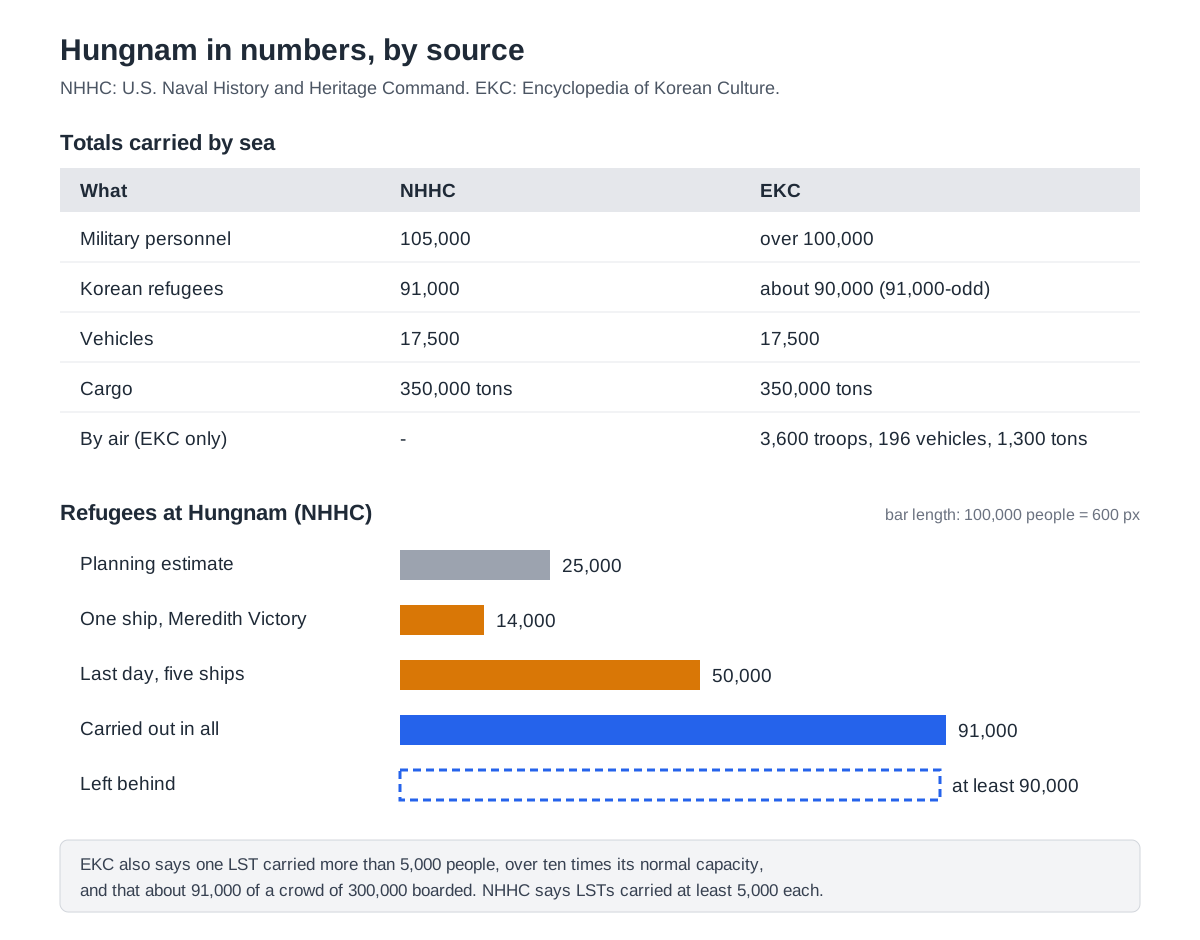
Something similar had already happened at Wonsan. There the Navy took 7,000 refugees, as many as the ships could carry, but more than 20,000 civilians were left at the barbed wire. Hungnam was worse. The first planning estimate of 25,000 refugees proved far too low, and 50,000 people tried to get on the last train from Hamhung to Hungnam alone.
The Korean record keeps an account of how boarding came to be allowed. Almond first said the refugees would be hard to carry because there were so many weapons and so much equipment to move. Persuaded by General Kim Baek-il, commander of the South Korean I Corps, and the interpreter Hyun Bong-hak, he finally allowed refugees into the space left over.
The ships were packed. A single LST carried at least 5,000 people, and in one case more than 10,000. The Korean encyclopedia says one LST carried 5,000-odd people, more than ten times its normal capacity. The chartered freighter Meredith Victory sailed with 14,000 refugees aboard.
Not every ship got away smoothly. A Korean LST carrying 7,400 refugees fouled a shaft and could not get off the beach, and food and water ran short on board. Only after help from repair parties and divers did it put to sea on 19 December.
The last ships on Christmas Eve
Chinese troops moving at night reached the edge of Hungnam, but in the H-056-1 account they made no significant attack on the perimeter. The NHHC overview says the units on the perimeter fought off Chinese probing attacks. On 18 December the perimeter shrank to a radius of about 5,000 yards. That day Almond and his staff moved to the flagship, and responsibility for defending Hungnam passed to Rear Admiral Doyle, commander of Task Force 90.
The 7th Infantry Division finished boarding by the 19th and sailed for Pusan on the 21st. On the last day of the evacuation, three Victory ships and two LSTs no longer needed for U.S. troops were filled with 50,000 refugees.
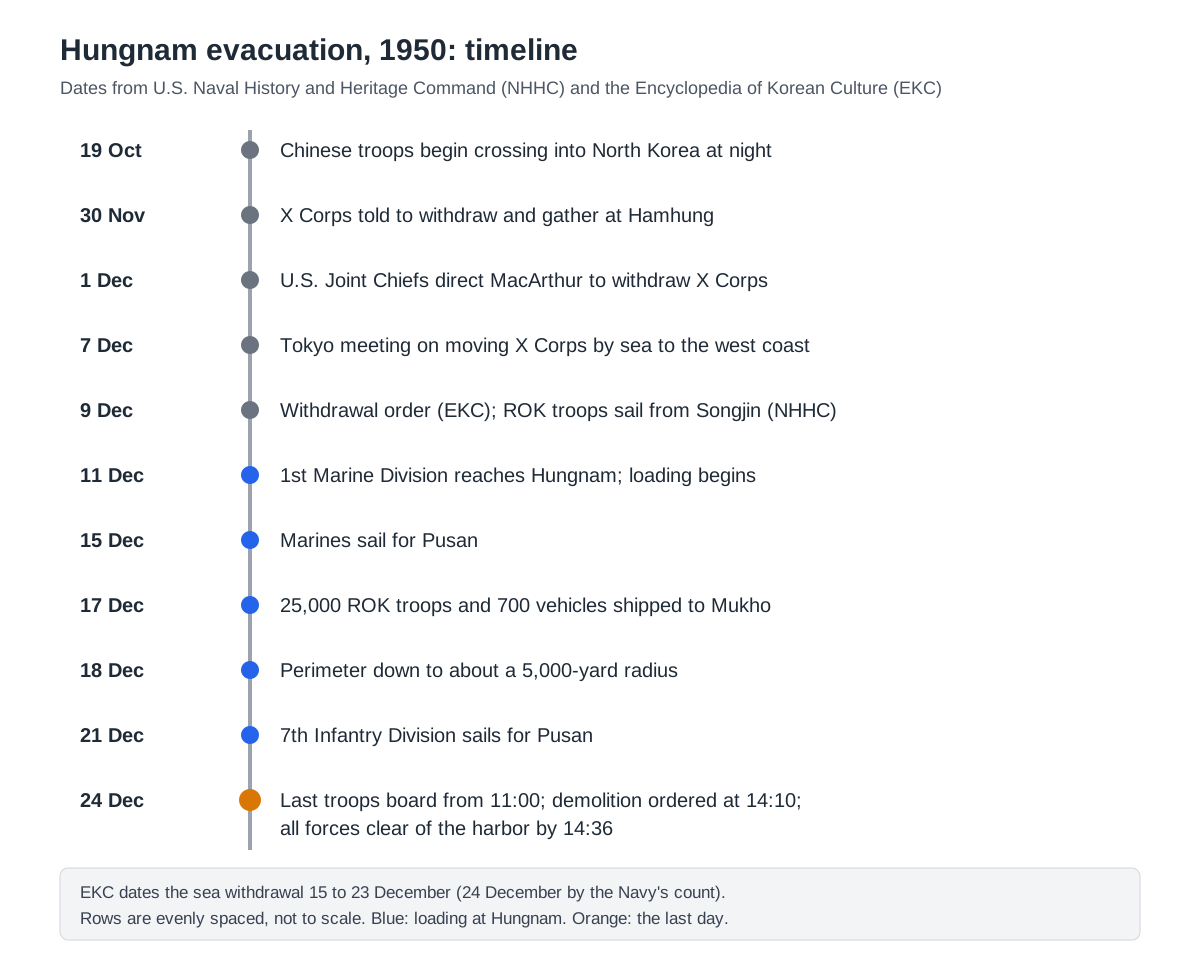
At 11:00 on 24 December, the last troops ashore began to board, and by 14:05 every beach was clear. At 14:10 Rear Admiral Doyle ordered the port facilities destroyed. Charges set in advance by Underwater Demolition Teams brought down the cranes, the piers and the walls of the inner harbor. By 14:36 all forces had left the harbor area.
That day an ammunition stockpile blew up by accident, wrecking several landing craft and causing casualties. The Korean encyclopedia says that after boarding ended, concentrated fire from the fleet and bombers destroyed what was left.
The numbers differ a little by source
NHHC's H-056-1 says 105,000 U.S. and Korean personnel, 91,000 Korean refugees, 17,500 vehicles and 350,000 tons of cargo left Hungnam. Most of the ships made two round trips, and some made more.
The Korean encyclopedia puts the force gathered at Hungnam at more than 105,000. It lists what went by ship as more than 100,000 troops, 17,500 vehicles and 350,000 tons of supplies. Within the same entry, the refugee count appears both as about 90,000 and as 91,000-odd out of a crowd of 300,000. The encyclopedia also covers air transport, which the NHHC pages do not: 3,600 troops, 196 vehicles and 1,300 tons of supplies.
The dates differ a little too. In the Korean record, the sea withdrawal runs from the sailing on 15 December to the 23rd, ending on the 24th by the Navy's count.
The sources also differ on who left last. The NHHC overview says 7th Infantry Division units were the last to embark, but H-056-1 says the 7th Division finished boarding on the 19th. It adds that the last of the 3rd Infantry Division was loading on the 23rd. It does not name the units that boarded on the 24th.
Whichever source you follow, more than 90,000 refugees got out by ship. Even so, NHHC says at least 90,000 more were left behind, and the encyclopedia says only 91,000-odd of a crowd of 300,000 made it aboard.
What it left and where views differ
NHHC's H-Gram summary says the evacuation was dubbed the "Christmas Miracle." It writes that nothing of military value was left behind and nothing was lost to the enemy. It also records with regret that there was no room for many thousands more refugees. The ammunition accident described earlier did, however, cause casualties.
The Korean encyclopedia judges that the evacuation was possible because it was a large joint land, sea and air operation. In its view, it let South Korean and UN forces keep much of their fighting strength for the next stage of the war.
The decision to withdraw was debated for years. The NHHC director who wrote H-056-1 thinks Hamhung and Hungnam could probably have been held, and that Seoul fell to the Chinese in January anyway. The director also holds that an evacuation this large is not possible without control of the sea and the air above it.
What to read next
- Military logistics: performance must be sustainable. Why moving people and cargo sits at the center of war.