On the morning of July 1, 1863, rifle fire broke out on a ridge west of Gettysburg, a small town in southern Pennsylvania. Neither the Confederate Army of Northern Virginia nor the Union Army of the Potomac had picked this place for a battle. The leading troops of the two armies ran into each other here as much by chance as by plan.
When the fighting ended three days later, more than 51,000 soldiers from the two armies had been killed, wounded or gone missing. No other battle of the Civil War cost so much blood, and people still often call it the war's "turning point."
Why did Lee march this far north? How did the three days unfold, and what rifles and cannon did the soldiers carry? This article also looks at how to read numbers that change from record to record, and at exactly how much the phrase "turning point" covers.
Why Lee marched north
The war had already gone on for more than two years. By May 1863, out west, the Union general Grant had the Mississippi River city of Vicksburg under siege, and only in the East did the Confederates seem to be winning. There, Lee's Army of Northern Virginia won at Chancellorsville that May.
Lee chose to ride that success into the North. The move was meant to lift Southern morale and ease the pressure on Vicksburg. Lee hoped for more as well. He wanted European support, a stronger peace movement in the North, Union armies drawn away from Southern soil, and food for his army.
On why the war began, the National Park Service (NPS), which looks after the Gettysburg battlefield, is clear. Slavery, in its words, was the chief cause of the war. It adds that ordinary soldiers fought for their own, very personal reasons, and that descendants on both sides still argue about what moved their ancestors.
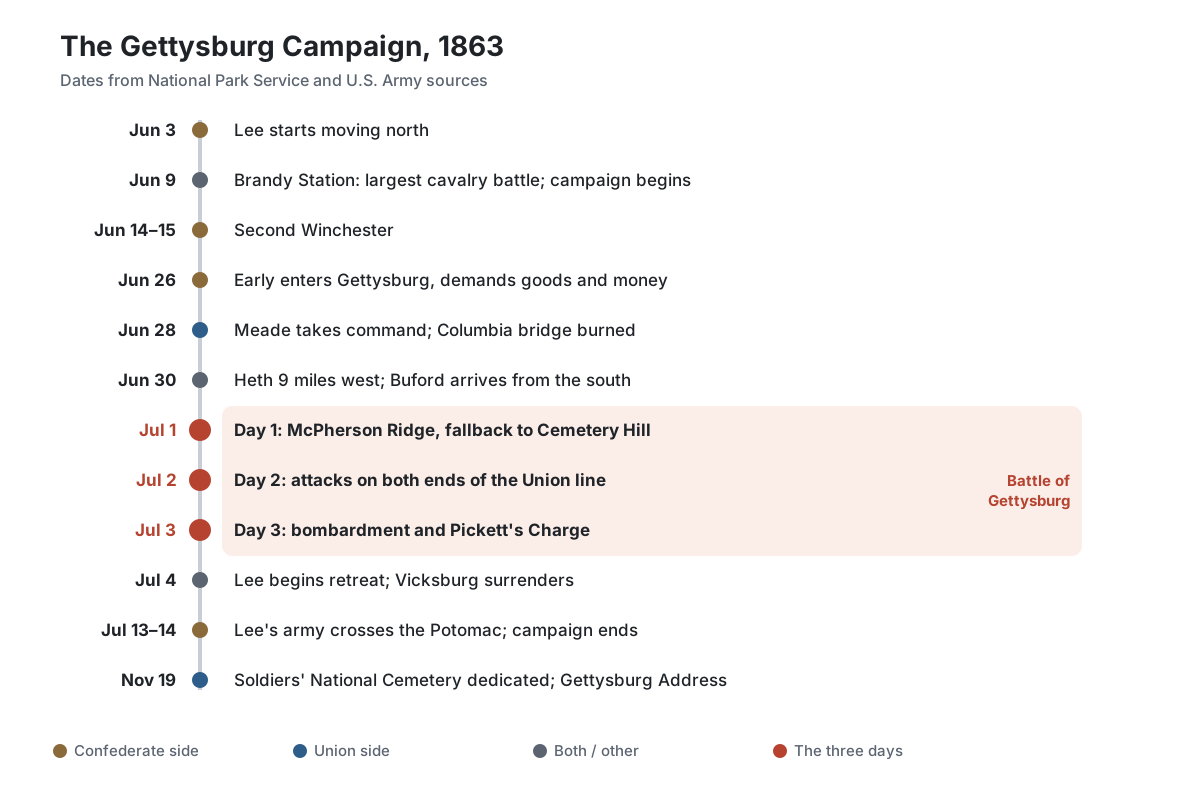
Lee's army began moving on June 3. Lee went west from Fredericksburg, Virginia, into the Shenandoah Valley and kept the mountains between his columns and the enemy. On June 9, Brandy Station saw the largest cavalry battle of the war, and that clash also opened the Gettysburg Campaign.
On the Union side, the Army of the Potomac followed on the east side of the mountains. Because it had orders to protect Washington, it always had to stay between Lee and the capital. That left Lee fairly free to move once he reached Maryland and Pennsylvania.
On June 14–15, at Second Winchester, Richard S. Ewell's Confederates drove the Union troops out of the valley. On June 26, Confederate Major General Jubal Early rode into Gettysburg and asked the town government for goods and money. On June 28, Confederates passed York and reached the Susquehanna bridge at Columbia, but militia set the bridge on fire and cut off the way across.
On that same June 28, before dawn, the Army of the Potomac got a new commander. The army was camped around Frederick, Maryland, about 35 miles south of Gettysburg, when word of the appointment reached George Gordon Meade's tent. Meade was surprised and objected at first, but he took the job.
By June 30, Henry Heth's division of Lee's army stood 9 miles west of Gettysburg on the Chambersburg Pike. From the south, John Buford's cavalry division of the Army of the Potomac was riding toward the town. Lee had meant to fight on the defensive, but this chance meeting changed his plans.
July 1: the first clash west of town
The fighting began on the morning of July 1 at McPherson Ridge, west of town. Confederates struck the Union troops there, and the outnumbered Union side held on until afternoon. The ground of the first day is a broad, open stretch north and west of town.
More troops from both armies kept arriving all day, and the fight grew. Around 4 p.m. the Union troops finally gave way and fell back through the town, and many were captured on the way. South of town, the survivors gathered on Cemetery Hill and Culp's Hill.
The Confederates did not press their advantage to the end. Overnight, the bulk of the Union army arrived and settled into position. Some townspeople joined in, such as John Burns, an old veteran of the War of 1812, who took his musket and fought beside the Union troops.
July 2: the fishhook line
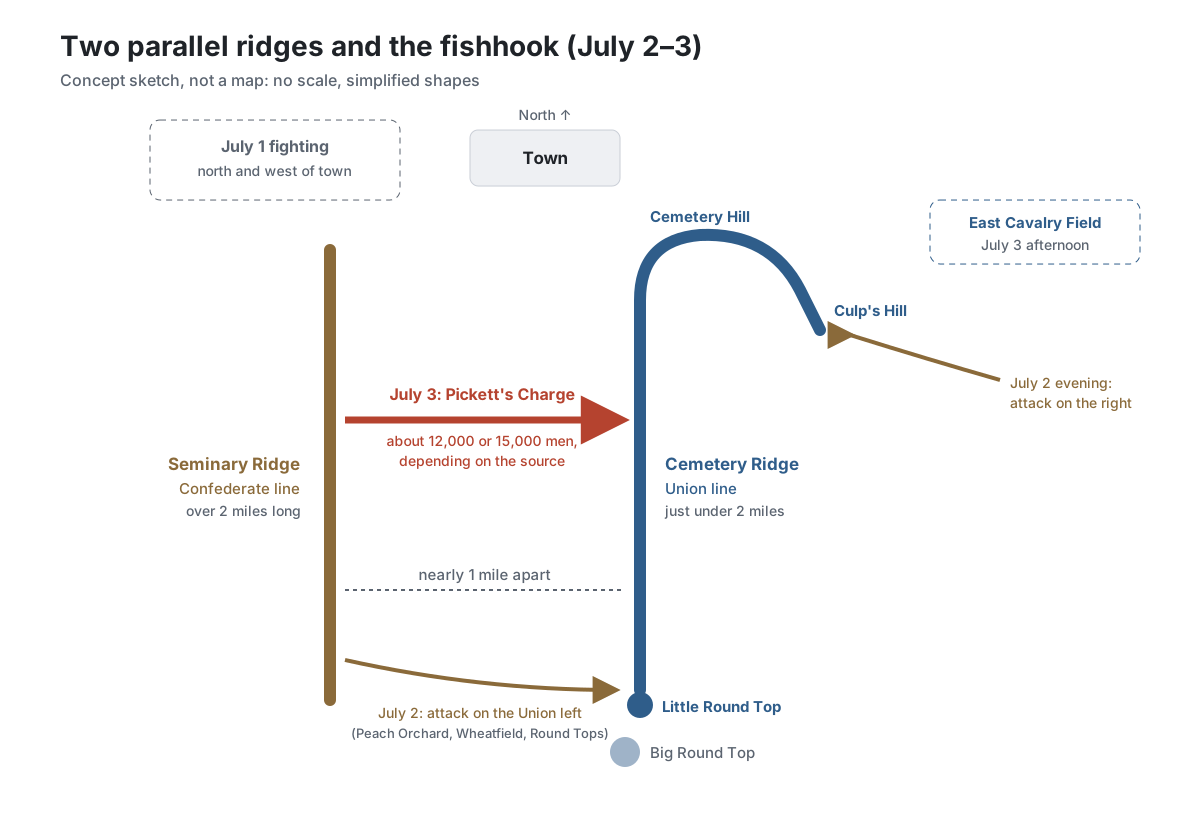
When July 2 dawned, the bulk of both armies had reached the field. They faced each other from two parallel ridges nearly 1 mile apart. The Union held Cemetery Ridge, and the Confederates held Seminary Ridge to the west.
The Union line is often compared to a fishhook. Cemetery Ridge, just under 2 miles long, grows lower toward Little Round Top and Big Round Top in the south. Its north end curls around Cemetery Hill to reach Culp's Hill. Across the way, the wooded slopes of Seminary Ridge ran on to Warfield Ridge for over 2 miles.
Lee ordered attacks on both ends of the Union line. James Longstreet's assault overran the Peach Orchard at the south end, wrecked the ground at the foot of Little Round Top, and left the Wheatfield covered with dead and wounded. In the evening Ewell struck the north end at East Cemetery Hill and Culp's Hill and gained ground for a moment, but the Confederates could not make use of it.
At Little Round Top, Brigadier General Gouverneur K. Warren, Meade's chief engineer, saw the Confederate threat, raised the alarm and brought up reinforcements. By evening the Union still held Little Round Top and had pushed back most of Ewell's men. The second day settled nothing for either army.
July 3: the bombardment and Pickett's Charge
Early on July 3, Union troops took back the last foothold on Culp's Hill that the Confederates had seized the evening before. Having tried both ends of the line the day before, Lee now aimed at the Union center. The staff ride guide from the U.S. Army Center of Military History (CMH) says Longstreet gathered 159 guns facing that center.
At 1 p.m., the Confederate guns opened fire. Union batteries fired back until about 2 p.m. and then stopped to save ammunition. For two hours the guns on both sides traded fire, yet the Union defenses were hardly weakened.
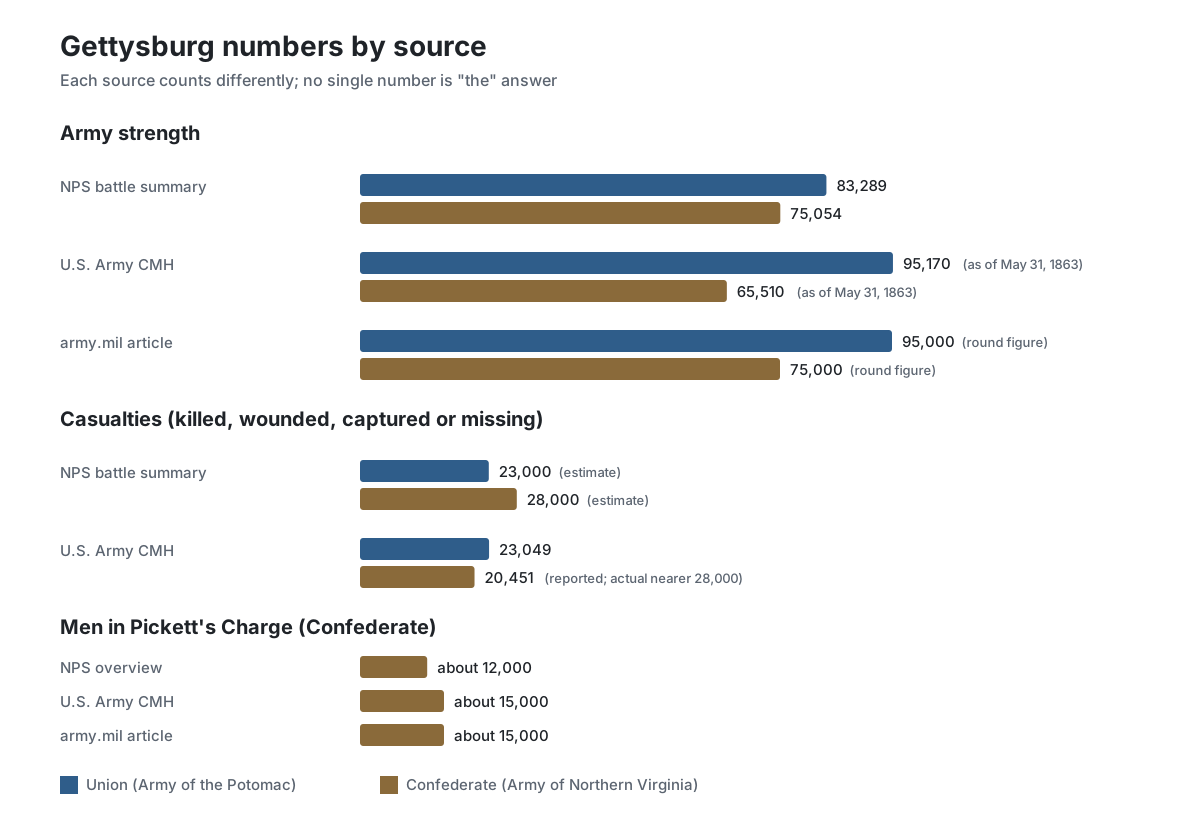
Then Confederate infantry came out of the woods along Seminary Ridge and crossed 1 mile of open fields. The attack is best known as Pickett's Charge, and it is also called the Pickett-Pettigrew assault or Longstreet's assault. The NPS gives about 12,000 men for it, while CMH and the Army article give about 15,000.
The center of the attack broke into the Union line for a moment, then was thrown back with heavy losses. In that one hour Lee lost more than 5,000 soldiers. Lee took the blame for the failure himself.
That same afternoon, east of town, Union cavalry under David Gregg blocked Jeb Stuart's Confederate horsemen. Stuart had tried to get around the Union flank and threaten Meade's rear. The place is now called East Cavalry Field.
On July 4, Lee began to pull back toward Virginia. His wagons of wounded stretched for more than 14 miles. On the night of July 13–14, Lee's army got back across the Potomac, which closed the campaign.
Rifled muskets and cannon
The main weapon of the infantry at Gettysburg was the rifled musket. In 1855 the U.S. Army replaced its .69 caliber smooth-bore musket with a .58 caliber rifled musket, a gun with rifling cut into its barrel. It was still loaded from the muzzle, as before.
Union infantry mostly used the Springfield, and Confederates mostly used the Enfield imported from Britain. A soldier was expected to fire three aimed shots a minute, and his basic load was 40 rounds in the cartridge box. No other infantry weapon killed as many people in battle.
How far could it hit a target? That depends on the source and the conditions.
The CMH table gives an effective range of 200–500 yards for the rifled musket and the Enfield, and 50–80 yards for the smooth-bore. The NPS guide says the rifle was accurate at 200–300 yards. The maximum range could pass 1,000 yards, but real firing distances were often short, and volume of fire at close range counted for more than accuracy far away.
CMH concludes that the move from smooth-bores to rifled muskets made defense stronger in the Civil War and raised losses among attackers. Even so, officers still had to lead by sight and voice, so tight formations stayed in use to some degree until the war ended.
Artillery was grouped into batteries of four or six guns. At Gettysburg the Union had 360 field guns and the Confederates had 241. The Union relied mostly on 10-pounder Parrott and 3-inch Ordnance rifles, and the Confederates mostly on 12-pounder Napoleons plus the same two rifled guns.
The 12-pounder Napoleon, a bronze smooth-bore, had an effective range of 1,600 yards, and the iron 10-pounder Parrott and 3-inch Ordnance rifle reached 1,800 yards. Cannon fired four basic kinds of ammunition: solid shot, case shot, shell and canister. Canister, a can packed with 28–32 iron balls, worked only within about 350 yards.
Numbers that differ by source
How many men fought at Gettysburg, and how many fell, depends on which record you read. The CMH guide itself says up front that estimates of strength vary and that casualty figures are incomplete. So it is better to set the numbers side by side than to pick one.
Start with strength. The NPS battle summary lists 83,289 Union and 75,054 Confederate soldiers, 158,343 in all. The CMH table shows 95,170 for the Union and 65,510 for the Confederates, but both counts date from May 31, 1863, about a month before the battle. The Army article uses round figures of 95,000 and 75,000.
Casualties count more than the dead: they include the wounded and those captured or missing. The NPS summary estimates 23,000 Union and 28,000 Confederate casualties, 51,000 in total. In the CMH table, Union losses come to 23,049 (3,155 killed, 14,529 wounded and 5,365 captured or missing), roughly one man in every four.
The Confederate side is harder. The Confederates reported losses of 20,451, but CMH says their returns are incomplete and that the real total seems closer to 28,000, or one-third of the army. That matches the size of the NPS figure of 28,000.
The force in Pickett's Charge also ranges from about 12,000 to about 15,000, depending on the source. The Army article describes it as three Confederate divisions. Using figures printed in the NPS teachers' guide, Pickett's own division had 5,848 men in three brigades.
The gap between paper and reality shows up in smaller units too. The guide sets an ideal regiment at 1,000 men, yet two Virginia regiments it uses as examples had 376 and 505 men at Gettysburg.
The town, the cemetery and 272 words
Before the battle, Gettysburg looked like many other farm towns in south-central Pennsylvania. After the armies left, wounded men filled nearly every building, and churches, public buildings and even homes became hospitals. More than 20,000 wounded soldiers from both sides passed through the large tent wards of Camp Letterman General Hospital, east of town. The last patients left in January 1864.
One civilian died. Jennie Wade was mixing bread dough in her sister's kitchen when a bullet came through two doors and struck her. Other townspeople, like Sallie Myers, a 21-year-old teacher, cared for wounded soldiers of both armies in her father's house and in the Catholic church.
On November 19, 1863, the new Soldiers' National Cemetery was dedicated. The orator Edward Everett spoke, and President Abraham Lincoln gave a short address about two minutes long. It came to 272 words. Moving the Union dead into the cemetery began that fall and went on long after the dedication.
The address opens with the words "Four score and seven years ago." Its first sentence speaks of a new nation "conceived in Liberty, and dedicated to the proposition that all men are created equal." It closes with a pledge of "a new birth of freedom," so that government of the people, by the people, for the people will not vanish from the earth. Today the cemetery holds more than 6,000 U.S. soldiers and veterans, and more than 3,500 of them died at Gettysburg.
Work to protect the battlefield started soon. In 1864 local citizens founded the Gettysburg Battlefield Memorial Association, and when it handed its land to the federal government in 1895, the site became a National Military Park. A commission of veterans located and marked the lines of both armies, and since 1933 the National Park Service has run the park. From 1870, Confederate remains were moved to Southern cemeteries with help from grave records kept by a town doctor, O'Neal.
What "turning point" means
When people call Gettysburg a "turning point," the agencies draw the line in slightly different places. An NPS lesson sees it as the last time the South tried to invade the North in full force. In that reading, the defeat there made Gettysburg the turning point of the war in the East. After that campaign, Confederate forces could no longer keep up an offensive.
The NPS teachers' guide widens the frame. Paired with the fall of Vicksburg on July 4, Gettysburg is often named as the turning point of the whole war. With Vicksburg's surrender, the Union gained full control of the Mississippi River. In the two years of war that remained, no Confederate army came as far north as Gettysburg again.
Still, the war did not end at Gettysburg. Lee surrendered to Grant at Appomattox Court House on April 9, 1865. People also still argue about what Lincoln meant by "a new birth of freedom" and "the unfinished work."
What to read next
- The American Civil War at a Glance: 1861 to 1865: the four years before and after Gettysburg in one view.
- The Rifled Musket and the Minié Ball in the Civil War: a closer look at the rifled musket covered briefly here.
- Vicksburg and the Anaconda Plan: The Fight for the Mississippi: the western fight that ended in the same week as Gettysburg.
- Military logistics: performance must be sustainable: problems behind the fighting, like guns saving ammunition and long trains of wounded, in today's terms.
- Turning points in military technology: the technologies that changed war after rifling and cannon.
- A history of laser weapons: from chemical to electric lasers: how a new kind of weapon grew, long after the age of gunpowder.