In East Sussex, in the south-east of England, there is a small town called Battle. The name means exactly what it says.
On 14 October 1066, on a low ridge where the town now stands, two armies faced each other all day. One belonged to King Harold of England, the other to William, Duke of Normandy. Toward evening Harold fell, and at Christmas that year William was crowned at Westminster.
This fight is the Battle of Hastings. The sections below follow why three men wanted the same crown in one year, how the day on the ridge went, and what it left behind in England.
Some sources are old chronicles. Others come from the museum that keeps the Bayeux Tapestry and from English Heritage, which looks after the battlefield. Read side by side, they show where the numbers and the stories split apart.
One crown, three claimants
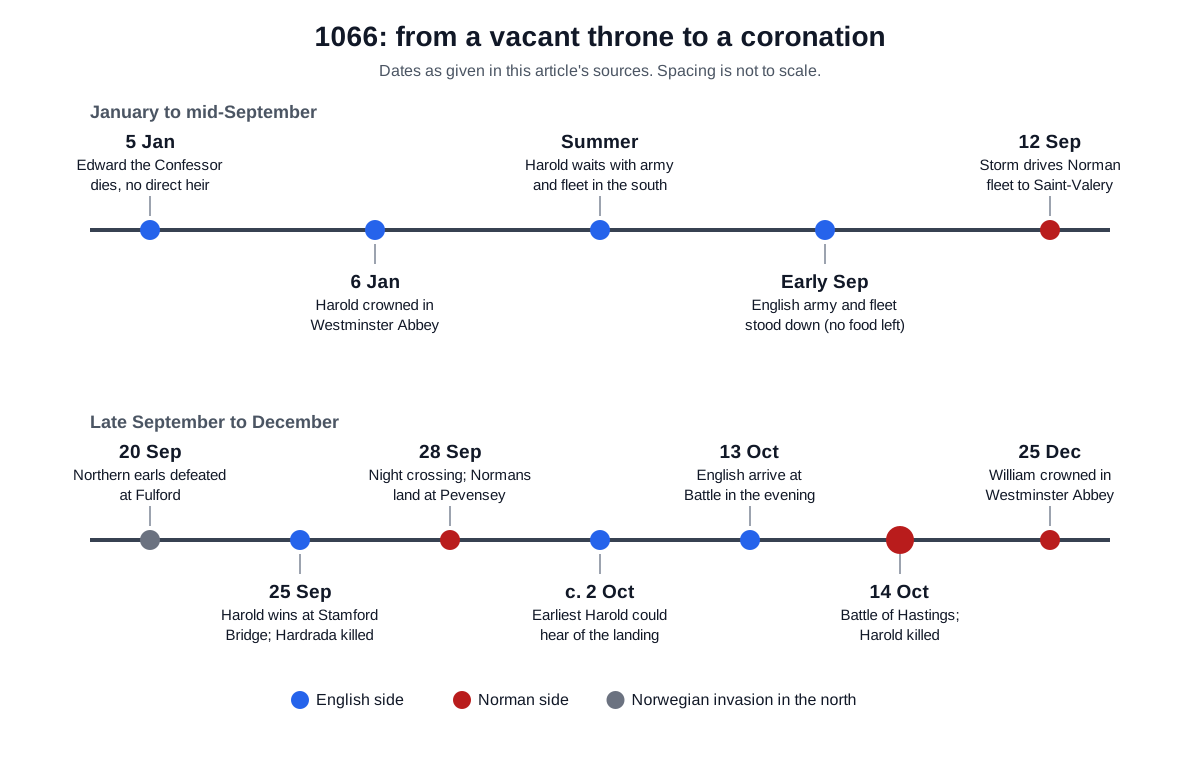
On 5 January 1066, Edward the Confessor died with no direct heir. The very next day, Harold, Earl of Wessex, was made king in Westminster Abbey. He was Edward's brother-in-law and the leader of the royal army.
Harold's case rested on Edward's last words. A life of Edward, written soon after his death, says the king placed "this woman and all the kingdom" under Harold's protection. Yet the Anglo-Saxon Chronicle uses different verbs in different versions: in one, Edward "granted" Harold the kingdom; in others, he "entrusted" it to him. The scene is the same, but the weight of the words is not.
Two more men across the sea wanted the crown: Harald Hardrada, King of Norway, and William of Normandy, Edward's second cousin. In Norman sources, Edward promised William the throne in 1051, and Harold swore him an oath during a visit to Normandy in 1064 or 1065. English records written before 1066 say nothing about that oath.
By blood alone, there was one more candidate: Edward's great-nephew, Edgar Ætheling. By descent his claim was the strongest, but in 1066 he was probably around 14. Harold, at around 40 and with long military experience, stood in a very different position.
Two invasions, north and south
In spring a strange star appeared over England. Some people called it a comet. Soon after, Harold's brother Tostig arrived with ships and raided the coast as far as Sandwich.
Harold called up a land and sea force larger than any king there had gathered before. Reliable word had reached him that William of Normandy was coming. He stayed on the Isle of Wight through the summer and autumn. In early September, with the food gone, the army and fleet were sent home.
The invasion came from the other end of the country. According to the Chronicle, Hardrada arrived with 300 ships, and Tostig joined him. On 20 September, the northern earls Edwin and Morcar were beaten at Fulford, south of York. Five days later, on 25 September, Harold rode north and won at Stamford Bridge, 5 miles east of York, where Hardrada and Tostig were both killed.
The earliest Harold could have heard that the Normans had landed in the south was around 2 October. Within two weeks he stood before Hastings. For a long time, historians took this as a "long march" south with tired troops. English Heritage points out that no source from the time mentions such a march.
The distances show how tight it was. Even if the men stayed only a couple of days in London, they still had to cover 200 miles from Yorkshire within a week, then 50 miles more. One account says Harold stayed in London for up to six days. Tom Licence, a historian, has proposed that Harold brought men down from the north by ship, but how he actually traveled cannot be known for certain.
An army and its horses cross the sea
William built ships from spring until late summer. Not everyone in his army came from Normandy. Vassals and allies from Brittany, Flanders and the Frankish lands joined him, and William even won the Pope's blessing.
The fleet gathered at the mouth of the river Dives. It was ready in early August but sat there for a month without the right wind. Ships with one sail needed a south wind to reach England. On 12 September a storm pushed the fleet east to Saint-Valery on the Somme estuary, where it waited another two weeks.
The hardest cargo was the horses. English Heritage puts the number at more than 2,000. Moving horses across the sea in open boats was new in northern Europe at the time. The knights probably learned how from Normans who had served the emperors in Constantinople.
The fleet crossed the Channel without resistance on the night of 28 September and reached the beach at Pevensey at dawn. The Anglo-Saxon Chronicle dates William's arrival at Pevensey to the eve of St Michael's mass. Soon after landing, the Normans put up a castle by the harbor at Hastings, a wooden stronghold built to guard their position. While Harold was held up in the north, William had time to get ready.
A day on the ridge
The English arrived on the evening of 13 October at the place now called Battle, 7–8 miles from Hastings. English sources say Harold left London before his full strength had joined him, and that William came at him unexpectedly while the army was still gathering.
At first light on the 14th, Harold set his men along the ridge. Battle Abbey now stands on part of it. On the rising ground to the south, William arranged his army in three groups. Bretons stood on the left, Normans in the center, and Franks and Flemings on the right.
The Norman writer William of Poitiers left the order of the ranks. Foot soldiers with bows and crossbows went first, foot soldiers in mail came second, and the cavalry came last. William stood among them with his best men and directed the fight by voice and gesture.
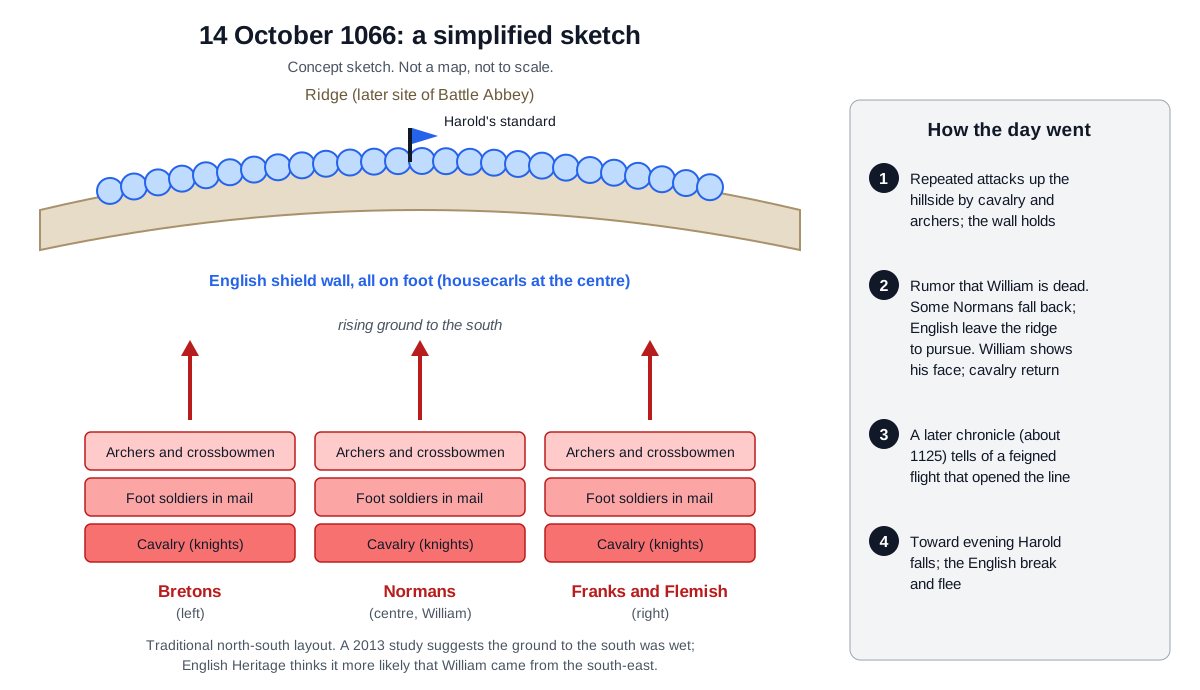
The fighting lasted the whole day. That was very long for a medieval battle, and English Heritage reads it as a sign that the two armies were closely matched. Behind their joined shields, the English held off attack after attack by Norman horsemen and archers coming up the slope.
For a while, things seemed to tilt toward the English. The Normans could not push the enemy off the hill and lost many men, and a rumor spread that William was dead. When some Normans fell back toward the sea, English troops left their places on the slope to chase them. William took off his helmet to show his face, and the Norman horsemen came forward again.
William of Malmesbury, writing around 1125, nearly 60 years later, describes a different scene. Here the duke signaled his men to pretend to run, and when the tight English line opened to chase them, the Normans turned and struck. This is known as the feigned flight. Norman knights who had long fought side by side were able to pull off such a hard move together.
Toward evening, Harold fell. His brothers Leofwine and Gyrth died with him. Without their leader, the English broke and ran, and according to Malmesbury the flight went on until night.
Shield wall and knights: the weapons of two armies
The two armies wore similar armor and carried similar weapons. The clear differences were horses and bows. The English rode to the battlefield but always fought on foot.
At the heart of the English army were the housecarls, highly trained elite foot soldiers who served the king closely. Their favorite weapon was a long-handled battle-axe. People also called it a Danish axe, since the design came from the Vikings. It was swung with two hands, but it was light and balanced enough to use in one hand with a shield in the other.
A shield wall is a wall of shields held edge to edge by soldiers standing close together. The long kite-shaped shield carried mostly by Norman knights could lock together this way, and so could the heavier, stronger round wooden shields used by some English soldiers. Each shield overlaps the next, like tiles on a roof, to form one surface. Unlike a roof, though, this wall is held up by people, so a gap opens wherever the line breaks.
The Normans had many archers. English Heritage estimates more than 1,000 in William's army. After William ordered them to aim high, their arrows fell on the heads of the men behind the shield wall. Only one English archer appears on the Bayeux Tapestry.
There were crossbows too, though none appear on the Tapestry. In 1066 the crossbow was a fairly new weapon. It shot far more slowly than an ordinary bow, but its bolts could go through a shield. Both sides carried iron-headed spears, which could be thrust or thrown like a javelin.
The biggest difference was the knight: a mounted fighter armed with lance, sword and shield. At Hastings the knights were the Norman secret weapon, and England had never seen anything like them. Knights learned mounted fighting from childhood, and they used their long lances to stab through gaps in the shield wall, or threw them.
Numbers and stories differ by source
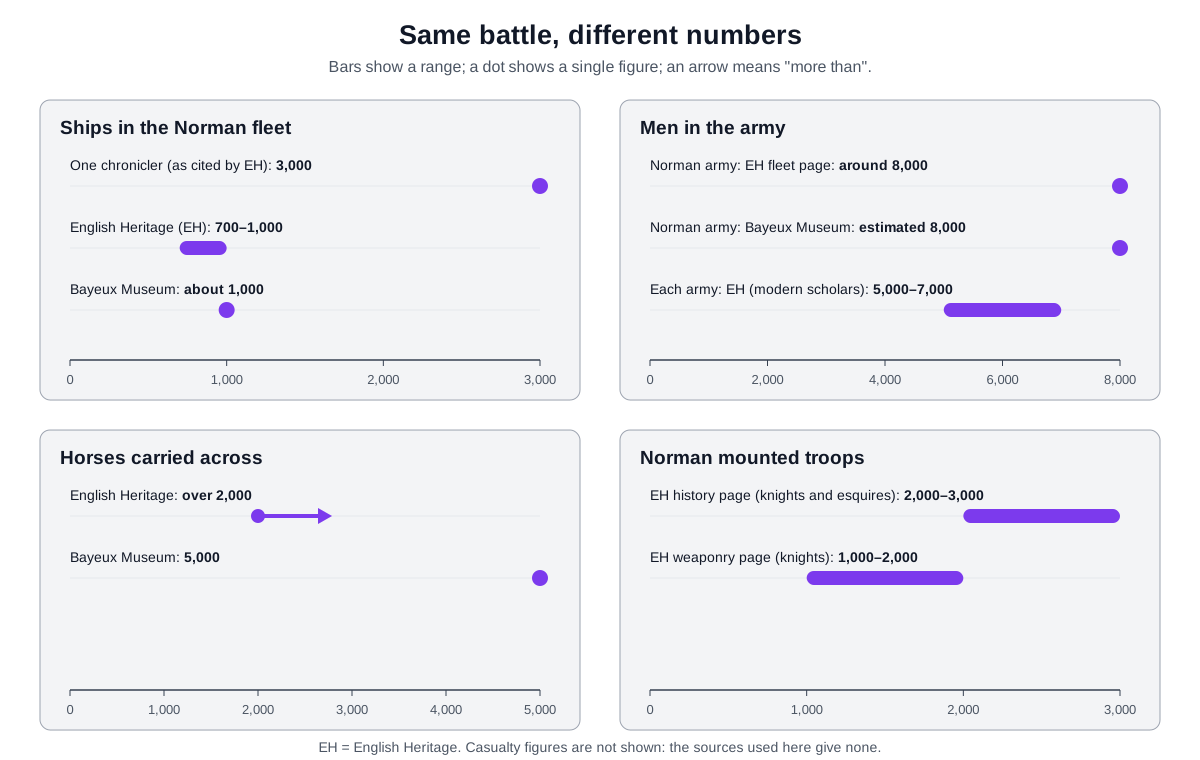
Hastings is unusually well recorded. English Heritage names the Bayeux Tapestry and William of Poitiers as the main sources. Together they give more information than exists for any other medieval battle, yet many details are still unclear. Numbers are a good example.
| What | Source | Figure |
|---|---|---|
| Ships in the Norman fleet | One chronicler (as cited by English Heritage) | 3,000 |
| Ships in the Norman fleet | English Heritage | 700–1,000 |
| Ships in the Norman fleet | Bayeux Museum | about 1,000 |
| Norman army | English Heritage (fleet page), Bayeux Museum | around 8,000 |
| Each army | Modern scholars, as cited by English Heritage | 5,000–7,000 |
| Horses carried | English Heritage | over 2,000 |
| Horses carried | Bayeux Museum | 5,000 |
| Norman mounted troops | English Heritage (battlefield history) | 2,000–3,000 knights and esquires |
| Norman mounted troops | English Heritage (weaponry page) | 1,000–2,000 knights |
English Heritage adds its own warning to the 3,000 ships: chroniclers often exaggerated. Even within one organization the cavalry figure changes from page to page, so it is safer to read these as ranges than to memorize a single number.
Harold's death is told in more than one way. The story that he was shot in the eye appears even in an education resource from the UK National Archives, labeled as legend. In one of the best-known scenes of the Bayeux Tapestry, he is shown with an arrow wound to the face. Malmesbury wrote that an arrow pierced his brain, while the Anglo-Saxon Chronicle simply records that he was killed.
The site of the fight has also been questioned. Two other places have been proposed: Crowhurst, roughly 3 miles to the south of the town, and Caldbec Hill, roughly 1 mile to its north.
Supporters of these sites argue that the monks made up the link between abbey and battlefield. They point to the Chronicle of Battle Abbey, which dates from the late 1100s, at least a century after the battle.
English Heritage answers with an earlier text. William's obituary in the Anglo-Saxon Chronicle, under 1086, already says he built a great abbey "on the very spot." On that basis it sees good reason to trust the traditional site.
Some questions remain open. No objects tied to the fighting have turned up at the abbey site.
A 2013 study of the landscape suggests that the ground south of the abbey was cut by streams and probably wet. William may instead have come from the south-east, along high ground from Hastings. If so, the north–south layout seen in almost every traditional picture of the battle may need adjusting.
What remains: an abbey and Domesday
Winning the battle did not make William king at once. He went back to Hastings to wait for the English to submit. When no one came, he moved inland, plundering as he went, until he reached Berkhamsted. There Archbishop Aldred, Edgar, Earls Edwin and Morcar and the leading men of London gave in.
William was crowned in Westminster Abbey on 25 December 1066 and ruled until he died in 1087.
Around 1071, William founded Battle Abbey on the battlefield. It honored the dead of the battle and served as penance for the blood shed in the Conquest. The first monks objected to the site, but William demanded that the church's high altar mark the place where Harold had died. The church was consecrated in 1094.
The top of English society changed as well. William's victory put a Norman ruling class in place and brought in the common law. A great wave of building followed to show Norman rule, and castles, cathedrals, abbeys and churches went up across the country. The Anglo-Saxon Chronicle records that Bishop Odo and William built castles far and wide and oppressed the poor.
A record made 20 years later shows the change too. In 1085 William was short of money, and Normans were quarreling over the estates granted to them, so he ordered a survey of the kingdom. The result was Domesday Book, which names more than 13,000 places. A National Archives education resource sums up that most land once held by 2,000 Saxons belonged to 200 Norman barons by 1086.
The story was also told in thread. The Bayeux Tapestry is not really a tapestry but an embroidery in wool of ten colors on linen, nearly 70 m long and 50 cm high. It was probably ordered by Bishop Odo, William's half-brother, and it is listed in UNESCO's Memory of the World. During the Bayeux Museum's renovation, the French state is lending the Tapestry to the British Museum for a London exhibition running from September 2026 until July 2027.
The battlefield itself has survived too, remarkably intact, and the UK government's battlefield data lists "Battle of Hastings 1066" with a start date of 6 June 1995. In the popular imagination, 1066 remains the last time an invasion of England succeeded.
What to read next
- The First Crusade: Why European Armies Marched to Jerusalem: the next article in the war history series.
- Turning points in military technology: moments in the 20th century when new weapons and organization changed how wars were fought.
- A history of laser weapons: from chemical to electric lasers: how long it takes a new weapon to find its place, seen from the laser side.