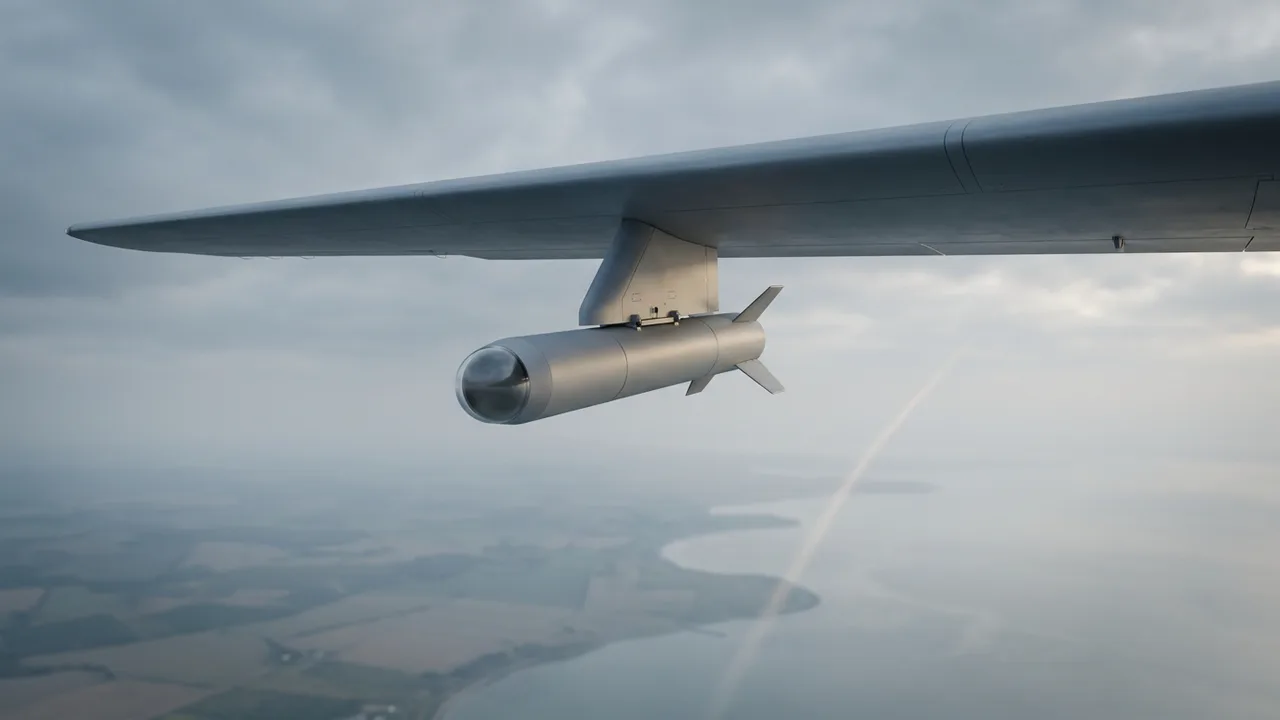
A slim missile hanging from the side of an attack helicopter looks nothing like a large missile slung under a bomber's wing. Both are still called air-to-surface missiles. What do they share that puts them under one name?
The name tells you only where the missile starts and where it goes. It leaves an aircraft and heads for a target on the ground or on the water.
To look inside the category, you need three questions: what is it meant to hit, how does it find its way, and what carries it? The examples below are missile names from public U.S. Navy and Air Force records, sorted along those three lines.
From the air to the ground, correcting the path
The Congressional Research Service (CRS) quotes the Department of Defense definition of a precision-guided munition (PGM): a "guided weapon intended to destroy a point target and minimize collateral damage." An unguided shell or rocket cannot change course once it is fired. A guided weapon adjusts its path in flight, fixing errors in aim or drift caused by weather, and so becomes more likely to hit.
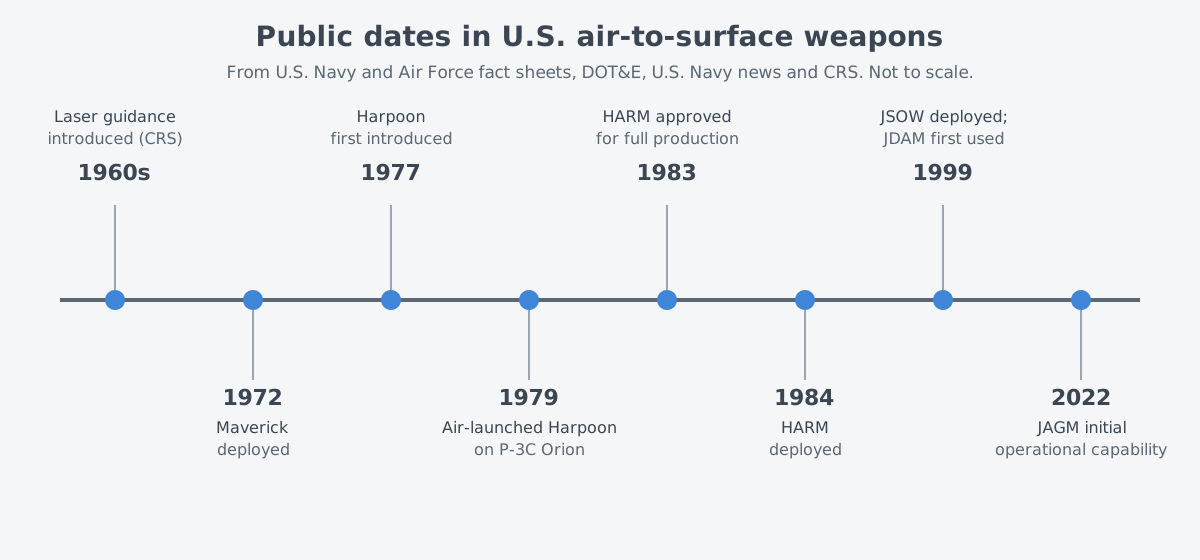
Correcting a path means measuring something. Guided weapons therefore carry parts such as inertial measurement units, GPS receivers, and seekers that use a laser or millimeter-wave radar. Guided weapons go back as far as World War I, but CRS notes that laser guidance, semiconductors and other advances in the 1960s made hits more accurate.
How a missile differs from a guided bomb
Some guided weapons dropped from aircraft are bombs. The Joint Direct Attack Munition (JDAM) is a well-known example. CRS describes JDAM as a guidance kit that bolts onto the tail of unguided bombs of several weights.
The Air Force first used JDAM in 1999. The Small Diameter Bomb (SDB) is another guided bomb released from aircraft, and its first version steers with inertial navigation helped by GPS.
A missile is different. Navy and Air Force fact sheets list a propulsion system for each missile. Hellfire is driven by a solid-propellant rocket, Maverick by a solid rocket motor sitting behind its warhead, and HARM by a solid-propellant rocket motor. The anti-ship missile Harpoon flies on a turbojet; a booster is added for surface and underwater launches, and aircraft release it without one.
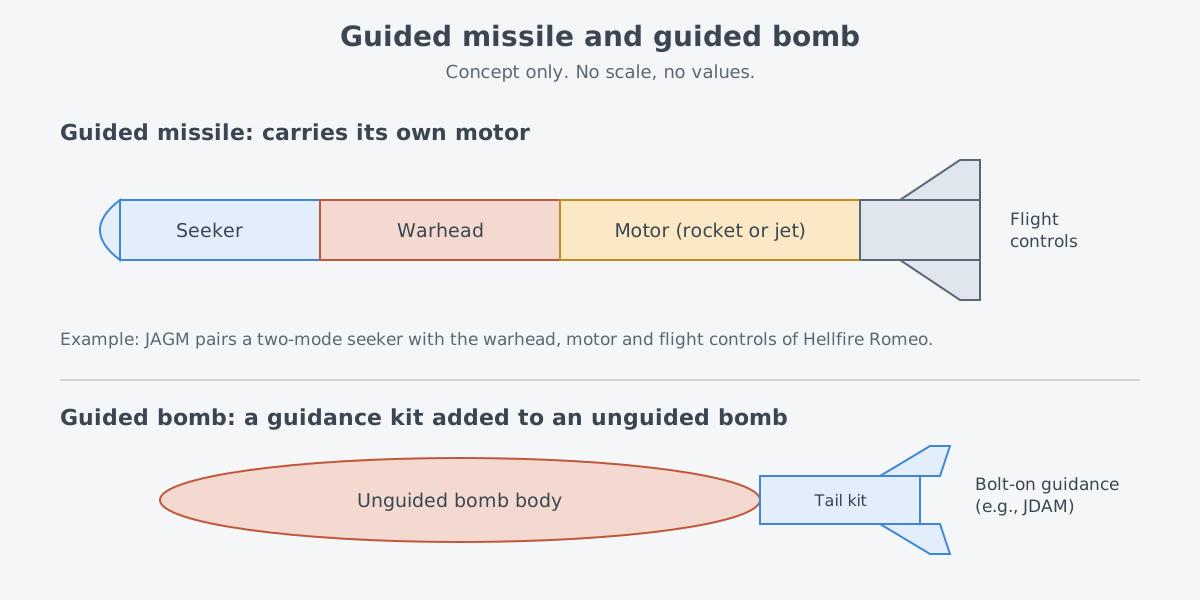
Missiles can also gain a new model by swapping parts. The Joint Air-to-Ground Missile (JAGM) is one example. The Director, Operational Test and Evaluation (DOT&E) reports that it pairs a two-mode seeker and guidance unit with the warhead, motor and flight controls of the Hellfire Romeo model. The diagram shows this layout only as a concept, and the size and placement of the parts do not match any real model.
Sorting by what they are meant to hit
The first question is the target. The Navy presents Hellfire as a laser-guided missile for striking ground targets with strong antitank capacity, and gives its primary function as a "point target/anti-armor weapon." Yet Hellfire can also be turned against helicopters or slow fixed-wing aircraft in the air. The air-to-surface label does not lock a missile into a single use.
Some missiles go after radar. The AGM-88 HARM is built to seek out and destroy enemy air defense systems that rely on radar. Missiles of this kind are called anti-radiation missiles. HARM follows the radio waves an enemy radar sends out, and the fixed antenna and seeker head that pick up that signal sit in the missile's nose.
Missiles that go after ships at sea are also fired from the air. Harpoon is an all-weather anti-ship missile that can reach targets beyond the horizon, and both aircraft and ships use it. LRASM is another anti-ship cruise missile launched from the air.
One missile can also cover many targets. Maverick's targets range from armor and air defenses to ships, ground vehicles and fuel storage sites.
JSOW is described by a slightly different measure. It can be released from far enough away to stay beyond the reach of enemy point defenses while it attacks the target. A weapon fired from beyond that reach is called a standoff weapon.
Sorting by how they find their way
The second question is guidance, and the seeker at the front of a missile falls into one of three types, depending on what it receives: passive, semi-active or active. A passive seeker picks up heat or radio waves that come from the target. A semi-active seeker picks up the reflection of energy aimed at the target from somewhere else, and an active seeker sends out its own energy and catches the echo. Missile seekers: the eye at the front covers seekers in more detail.
Guidance can differ even within one missile family. Maverick A and B models use electro-optical (TV) images, D, F and G models use imaging infrared, and the E model is laser guided. The F model, an infrared version tuned for tracking ships, flies on Navy P-3 aircraft, while the laser-guided E model is carried by the AV-8 and F/A-18. The name alone is not enough: the model letter tells you which kind of eye the missile has.
Radio waves are used in two ways as well. Harpoon finds its target in the final stage with active radar. HARM sends out no radio waves of its own and follows the signal an enemy radar gives off. The first is active and the second is passive.
Other missiles find their way with satellites and inertial sensors. JSOW steers with GPS and inertial navigation (INS), and only the AGM-154C adds an infrared seeker for the final stage. Harpoon Block II also added GPS-aided inertial navigation, which lets it attack both ships and land targets. How the two kinds of navigation support each other is explained in Inertial and satellite navigation: knowing where you are.
Two methods can also share one seeker. JAGM merges semi-active laser sensing and millimeter-wave radar in a single seeker and guidance unit. It is meant for targets on land and at sea, whether they are standing still or moving.
Sorting by what carries them
The third question is the aircraft that carries the missile. Hellfire is carried by the Navy's MH-60 family, the Army's AH-64 Apache and the Marine Corps' AH-1W/Z Cobra, all of them helicopters. JAGM is meant for aircrews flying the Army AH-64E Apache and the Marine Corps AH-1Z Viper.
The Marine Corps declared initial operational capability for JAGM on the AH-1Z on March 1, 2022. JAGM was designed mainly for attack helicopters, but it also works with some fixed-wing aircraft.
Fighter and attack aircraft carry air-to-surface missiles too. Which aircraft carries Maverick depends on the model. Maverick A, B and D models are used by the Air Force F-16 and A-10. The E model flies on the AV-8 and F/A-18, and the F model on Navy P-3 aircraft.
The Air Force fact sheet, current as of August 2020, says the F-16C is its only aircraft that uses HARM. The Air Force is buying the Joint Strike Missile, the NSM adapted for launch from aircraft, for the F-35A.
Bombers and maritime patrol aircraft are platforms as well. JASSM is a cruise missile family that fits many fighters and bombers. JSOW has been integrated on several fighters as well as B-52, B-1B and B-2 bombers. The air-launched Harpoon first entered service in 1979 on the Navy's P-3C Orion patrol plane and was later adapted for Air Force B-52H bombers.
Uncrewed aircraft are on the list too. JAGM is a precision-guided air-to-surface weapon for helicopters, uncrewed aircraft systems and fixed-wing aircraft.
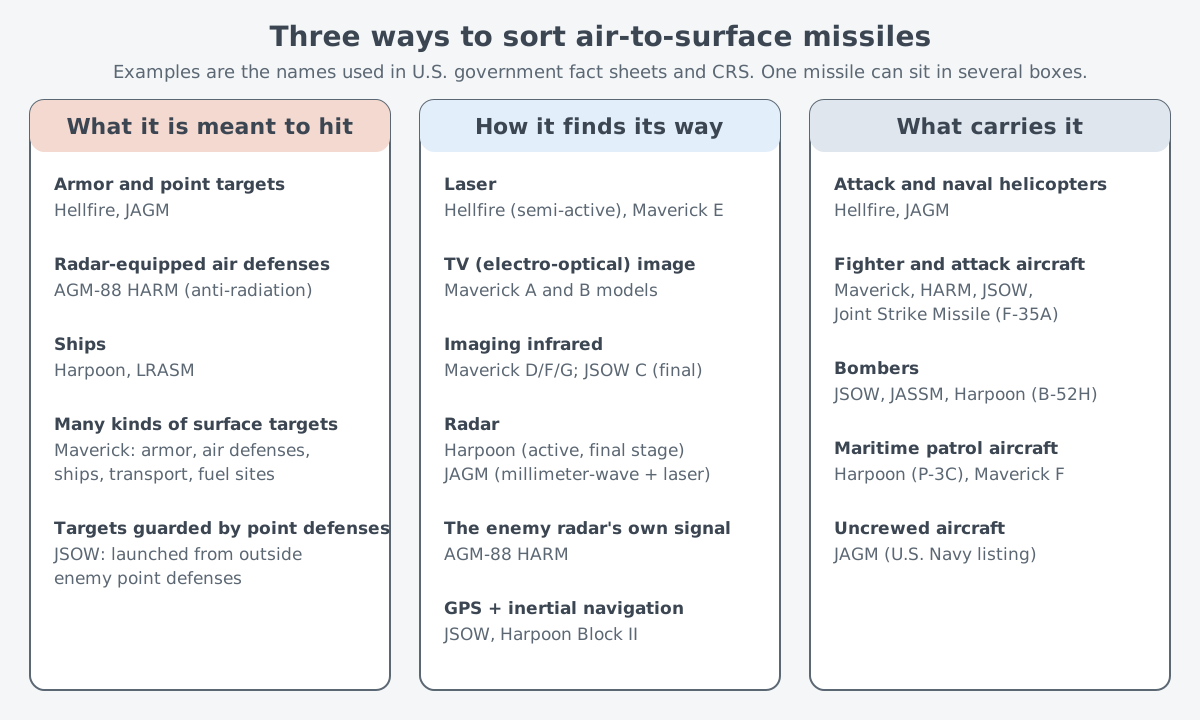
Laying the three questions over one another gives a sketch of a single missile. For Hellfire, it reads "aims at point targets, finds its way by semi-active laser, fired from helicopters." Within one name, though, guidance and platforms change from model to model, so it pays to check the model letter and the update date in the official record.
Where this meets lasers: following reflected light
In semi-active laser guidance, the laser does no damage itself; it shows the way. The Johns Hopkins University Applied Physics Laboratory (APL) Technical Digest explains the idea like this. A beam of light, laser, infrared or radio energy is shone on the target, and the missile's seeker tracks the target by the energy reflected from it. The beam comes from the aircraft that fired the missile or from somewhere close by, so the side doing the illuminating largely decides which target is chosen.
The Navy fact sheet says a Hellfire can be steered to its target from within the launching aircraft or by a laser located elsewhere. Think of one person shining a flashlight on a spot on a wall while another walks toward that spot. In reality, a seeker rather than a human eye reads the reflection, and a laser beam stays far narrower than a flashlight beam.
The idea of sending out laser light and reading what comes back from a target is also used outside weapons. Range finders and lidar measure distance by timing the light's round trip. Measuring with lasers: range finding and lidar basics explains the same idea from the measurement side.
What to read next
- Missile seekers: the eye at the front: what passive, semi-active and active seekers receive as they follow a target.
- Inertial and satellite navigation: knowing where you are: the basis of the GPS and inertial guidance used by JSOW and Harpoon Block II.
- Air-to-air missiles: what the missile sees: missiles fired from the same aircraft at targets in the sky.
- Cruise missiles: how they resemble aircraft: a look at the cruise missiles that JASSM and LRASM belong to, compared with aircraft.