A few burning ships drift across the winter Yangzi on the wind, toward the far bank. If you know the Three Kingdoms from a novel or a game, other pictures probably come with it. Zhuge Liang calls up an east wind by magic, and Guan Yu lets Cao Cao go on the Huarong road.
How much of that is in the records? The battle at the Red Cliffs in 208 is one of the most famous fights in Chinese history.
Yet so many stories have grown around it that you could almost doubt there was a battle at all. That is how Rafe de Crespigny, who wrote a full-length history of Wu in this era, put it. After weighing the sources, he concluded that some military activity did happen at that place and time.
This article first follows the battle as the official history Sanguo zhi and its commentary describe it. Next it looks at the ships and fire of the period. Last, it sets the novel Romance of the Three Kingdoms beside the records to see what the novel changed and added.
208: Cao Cao moves south
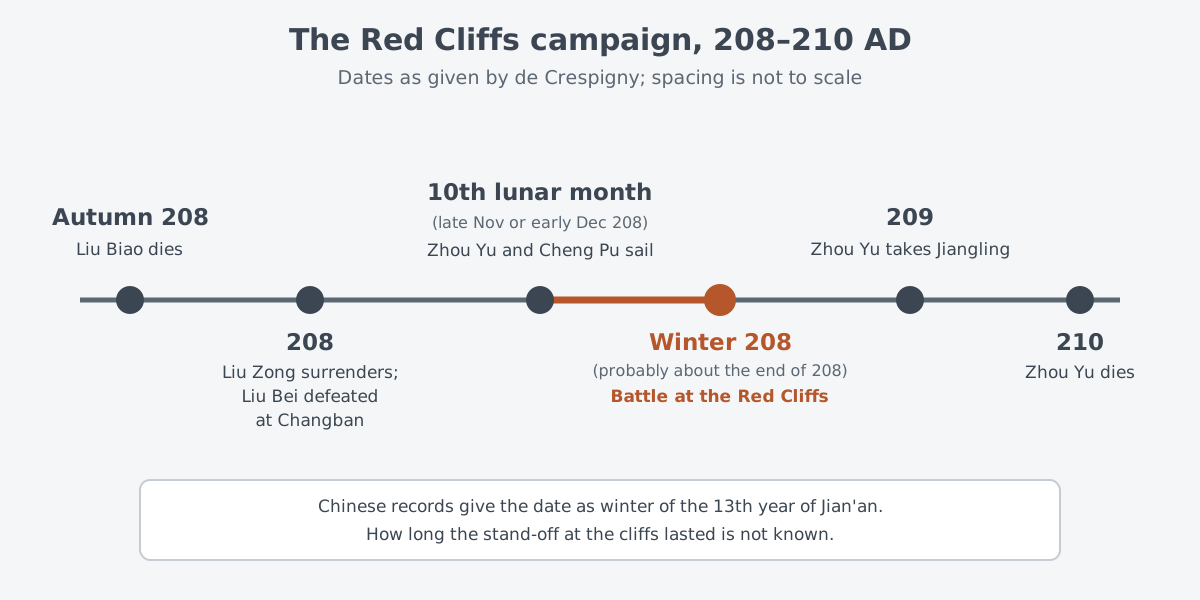
Liu Biao, who ruled Jing province, died in the autumn of 208. As Cao Cao's army approached, the supporters of his son and heir Liu Zong urged surrender. Liu Zong had no real alternative.
Liu Bei, who had taken refuge with Liu Biao, was also in Jing province. He tried to reach Jiangling on the Yangzi. Jiangling, the capital of Nan commandery, was a key army base and storehouse, and Cao Cao knew it.
His troops caught Liu Bei's column at Changban near Dangyang and defeated it completely. Liu Bei had to flee, leaving behind his followers and even his own family.
Liu Bei linked up with Guan Yu, who had the fleet from the Han River, and fell back to Xiakou, where the Han meets the Yangzi. Then, encouraged by Lu Su, an envoy sent by Sun Quan, he moved further east and set up a new headquarters at Fankou. Jiangling, home of the larger Yangzi fleet, now belonged to Cao Cao.
Why Sun Quan's court chose to fight
Sun Quan, who held the Yangzi below present-day Wuhan, now had to choose: surrender or fight. Even the records of this debate split in two. The biography of Zhou Yu, on the Wu side, shows Zhou Yu as the one counselor who opposed the general mood for surrender. In the biography of Zhuge Liang, it is Zhuge Liang's eloquence that wins over a reluctant Sun Quan.
Both passages sit in the same history, written by Chen Shou. He kept the contradiction between the two traditions, and the later commentator Pei Songzhi pointed it out. Zhuge Liang, as the celebrated counselor, was given an almost decisive role, and later writers knew how events turned out. Both facts have clouded the record of the debate.
The outline is clear enough. Lu Su favored joining Liu Bei and acting in Jing province, while cautious advisers such as Zhang Zhao opposed sending an army so far from home. Then a letter arrived from Cao Cao. As preserved in a work called Jiangbiao zhuan, it said he commanded a fleet of 800,000 men and was coming to go hunting in Wu.
Zhou Yu saw things differently. Cao Cao's men were inexperienced on water, he argued, and the coming winter would make fodder for their horses hard to find. Jiangbiao zhuan also records a private talk that night in which Zhou Yu ran the numbers. Cao Cao had brought no more than 150,000–160,000 troops from the north, he said, and had gained 70,000–80,000 at most from Liu Biao, whose loyalty was uncertain.
Fifty thousand good soldiers would be enough, Zhou Yu said. This night conversation, though, may never have been formally recorded. Both Cao Cao's letter and Zhou Yu's count are best read as each man's own claim.
Sun Quan drew his sword and struck the desk before him. Any officer who argued for surrender again, he said, would be dealt with like this desk. Fifty thousand men would be hard to gather right away, he added, but he had already chosen 30,000.
For him this was not an all-or-nothing gamble. If the forward defense failed, he expected to pull back most of his men and still have a reserve army for bargaining.
Zhou Yu and Cheng Pu set off upriver with troops and ships in the 10th lunar month, which fell in late November or early December 208. Zhuge Liang claimed that Liu Bei had 10,000 men and Liu Qi another 10,000, but de Crespigny thinks he was probably exaggerating.
What happened at the Red Cliffs
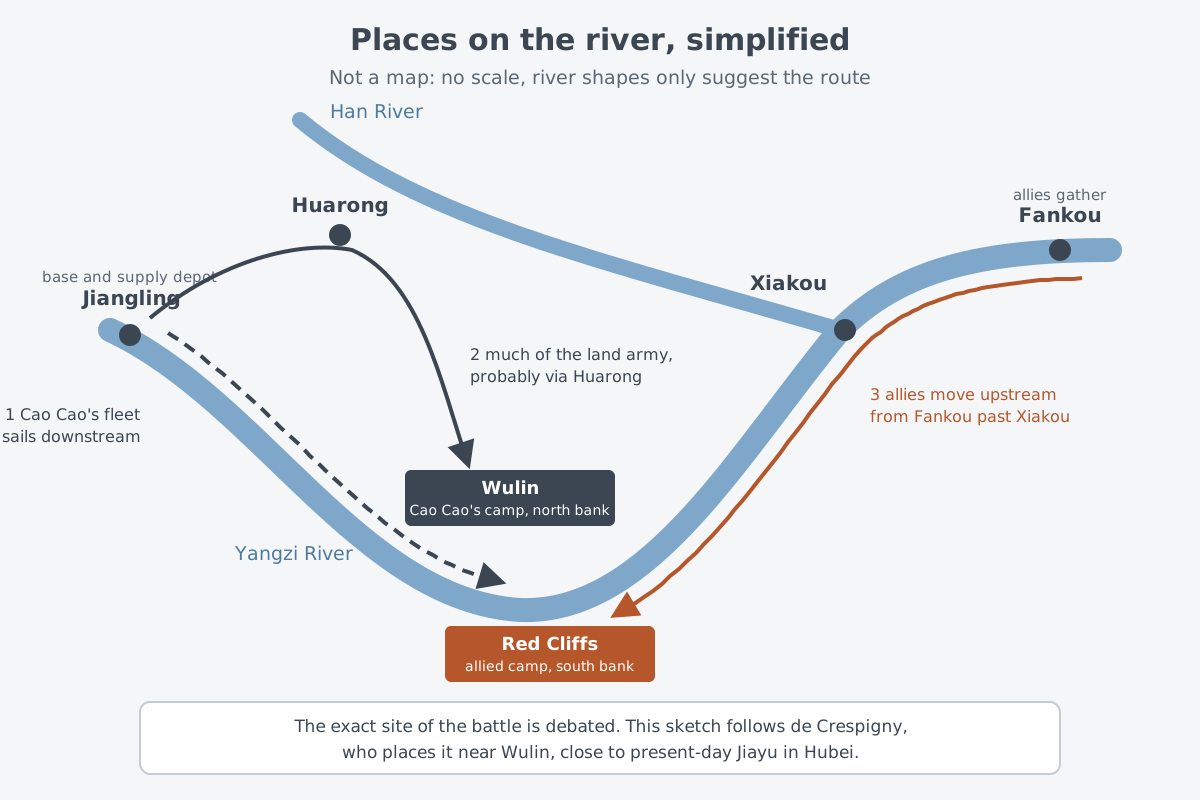
From Fankou the allies moved upstream and ran into the leading part of Cao Cao's army at a spot known as the Red Cliffs. The site lies on the Yangzi somewhere between today's cities of Wuhan and Yueyang, near Jiayu in Hubei province.
Its exact location has long been debated. De Crespigny puts the fighting around Wulin, on the north-west side of the river. In Wuhan, a local tradition says the fight happened where the two rivers meet.
Cao Cao's fleet came down the Yangzi from Jiangling. A large part of his land army probably marched overland, east from Jiangling by way of Huarong, and met the fleet near the Red Cliffs.
Cao Cao's troops were in bad shape. The long march south had worn out the northern troops, and there was sickness in the camp. The allies won the first clash.
After that, Cao Cao camped close to Wulin on the north-west shore, with the allies across the water below the Red Cliffs. How long this stand-off lasted is hard to tell.
Huang Gai, an officer under Zhou Yu, broke the deadlock. He sent a messenger to Cao Cao offering to surrender. Then he filled a squadron of warships with dry reeds and brushwood, poured oil over them, covered them with red tent-cloth, and raised banners. A small boat was tied to the stern of each ship.
As the ships crossed the middle of the river, Huang Gai set them alight, and the commanders of the other ships did the same. The crews climbed into the small boats, and the empty fireships, driven by the wind behind them, crashed into Cao Cao's fleet and camp. This story appears not in Huang Gai's own biography but in the biography of Zhou Yu.
Cao Cao's ships are said to have been moored stem to stern, so the fire spread through the fleet and the army. Some steps may still have been taken to keep units apart. Zhou Yu followed up at once with a light-armed force, and Cao Cao ordered a retreat.
One record says Cao Cao burned his own ships so they would not fall into enemy hands. It is also possible that many of the men from Jing province changed sides, taking their ships and weapons with them. Even while heading north, Cao Cao kept a strong force in Jiangling and a second army at Xiangyang, farther north.
The casualties cannot be counted. Grim stories tell of many deaths on the retreat toward Huarong, but de Crespigny doubts that fighting and killing took place on the scale tradition claims. The lack of a number does not mean that sick and worn-out men did not fall by that river in winter.
Ships and fire on the river
What did Huang Gai's ships look like? Honestly, little is known. The wars of Wu cannot be separated from river fighting on the Yangzi, yet very little is known about the tactics, ships, or weapons used in those battles.
The records call Huang Gai's vessels mengchong doujian, a general term for warships at the time. In the account of the Tang scholar Li Quan, the mengchong was covered with raw ox-hides against fire and missiles, and it was light and narrow, built for speed. The book that holds this account was compiled in the middle of the 8th century, more than 500 years after the Red Cliffs.
Even the number of ships differs between texts. Sanguo zhi gives Huang Gai "several tens" of vessels, but the same passage in Zizhi tongjian drops one character and gives him only ten. A single missing character changes the size of the attack several times over.
Fire itself was a common weapon in that era. Fireships have often been used by a weaker navy against a stronger one. Faced with wooden hulls, tents and huts that burned easily, and a wind that was wrong for the season, Cao Cao likely had few options.
What about the wind? On the middle Yangzi in winter it blows mostly from the northwest, so on most days it would have favored Cao Cao. Still, a south or east wind is not completely unusual. De Crespigny took this point from Zhou Zhenhe, a professor at Fudan University who spent several years near Jiayu.
Fire alone did not decide the outcome. By the records, disease among Cao Cao's troops did much to bring about his defeat.
Jiangbiao zhuan also preserves a letter from Cao Cao to Sun Quan. In it, Cao Cao grumbles that illness alone made him burn his ships and withdraw, and that Zhou Yu had no right to claim the victory. Jiangbiao zhuan itself adds that the letter may simply be an attempt to paint Zhou Yu as a boaster.
The later scholar Wang Fuzhi compared the positions of Cao Cao and Zhou Yu. At Guandu, eight years before, Cao Cao had stayed on the defensive and ground down Yuan Shao's army. At the Red Cliffs the roles were reversed, and Zhou Yu's resistance pressed on Cao Cao's forces. On this view, the fireships were the trigger for a collapse that had grown more likely with each passing day.
What the records say and what the novel added
First, what kind of book is the record? The official history Sanguo zhi combines Chen Shou's main text, written in the 3rd century, with Pei Songzhi's commentary from the early 5th century. Pei Songzhi received an imperial order in 428 to write the commentary, and he named the book and author of each source he quoted.
Jiangbiao zhuan, quoted above, gathers local material collected soon after Jin conquered Wu in 280, and it survives inside Pei Songzhi's commentary. Sources like this also contain many largely fictional anecdotes. A named source is not a guarantee that a story is true.
The account of the battle sits mainly in Zhou Yu's biography and the commentary attached to it. The Wei part of Sanguo zhi mentions it only very briefly, and the Shu-Han part says little more. Credit is also divided. One early work, Shanyang gong zaiji, unusually gives the credit for the fire attack mainly to Liu Bei.
The novel Romance of the Three Kingdoms is another matter. Its core is usually credited to Luo Guanzhong, who lived in the late 14th century.
A version titled Sanguo zhi tongsu yanyi appeared in 1522, and a revision by Mao Zonggang in the mid-17th century is the basis of today's text. Of the several lines of editions, the Mao Zonggang version, which settled the chapters at 120, became the most widely read. The Red Cliffs story fills chapters 43–50, the very center of the novel.
The novel took its mature shape over a thousand years after the battle, and it sides heavily with Liu Bei, Zhuge Liang, and their state of Shu-Han.
The records state three things clearly. Sun Quan's forces, led by Zhou Yu and Cheng Pu, made up the main allied strength, and the decisive act was Huang Gai's fireship attack. Illness in Cao Cao's ranks weighed heavily in his loss. The novel puts Zhuge Liang at the center of this stage.
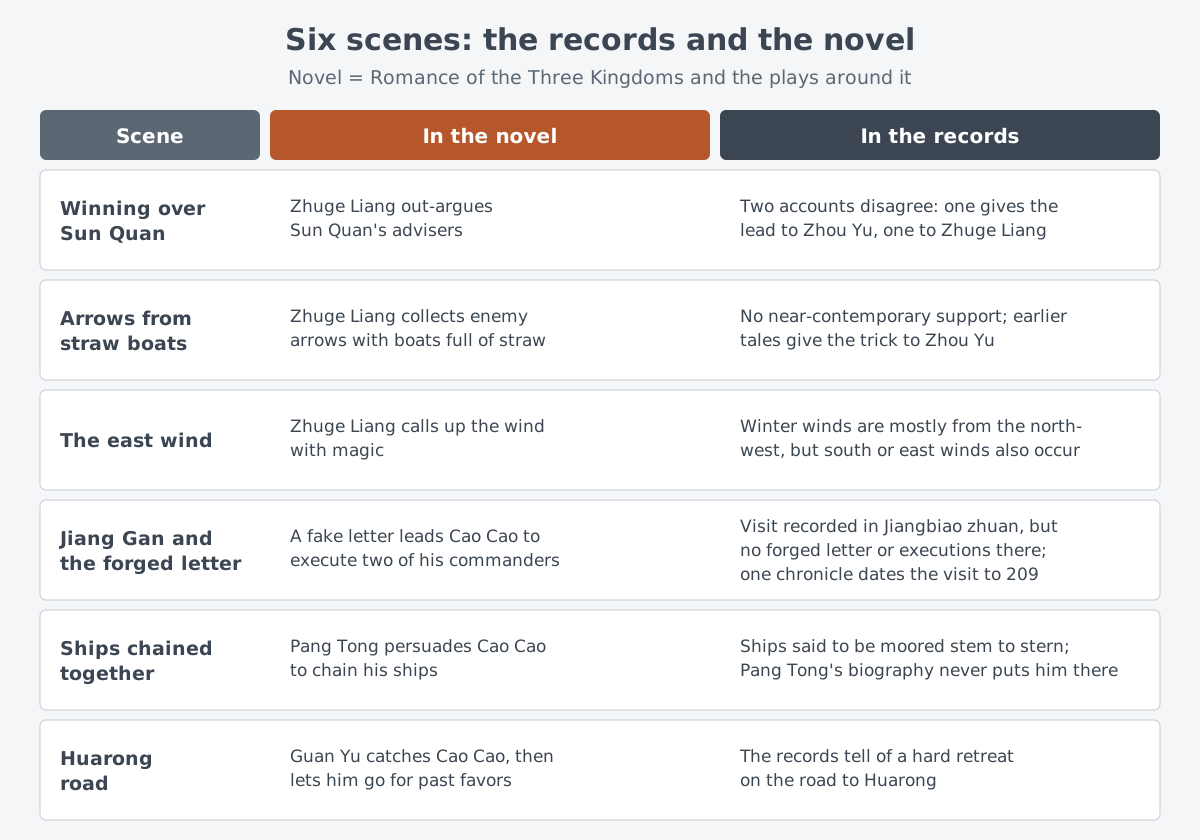
In the stories, Zhuge Liang floats boats loaded with straw past Cao Cao's lines to collect the enemy's arrows, and he calls up an east wind by magic. In the records, neither tale has support from any near-contemporary source, and both look almost wholly fictional. An earlier story collection, Sanguo zhi pinghua, even gives the straw-boat trick to Zhou Yu.
A likely seed of the straw-boat tale lies elsewhere. According to Wei lue, in 213 at Ruxu, Sun Quan took a boat out to observe the enemy. Arrows stuck so thickly in one side that the boat began to tip.
He turned the boat to take arrows on the other side, leveled it, and returned safely. De Crespigny thinks this probably exaggerated incident was later transferred to Zhuge Liang as a clever trick.
In the stories, Jiang Gan, sent by Cao Cao, visits Zhou Yu's camp and steals a forged letter, and Cao Cao executes Cai Mao and Zhang Yun because of it. Pang Tong persuades Cao Cao to chain his ships together. In the records, neither episode appears in Sanguo zhi. Pang Tong's biography does not even mention him at the Red Cliffs, and Zizhi tongjian places Jiang Gan's visit in 209, after the battle.
On the Huarong road, Guan Yu catches Cao Cao and then lets him go out of gratitude for past favors. That scene also belongs to the novel and the plays. Zhou Yu's image changed greatly in the novel as well. He appears as a talented man who keeps losing to Zhuge Liang and grows frustrated and jealous.
Still, the line is not a neat "records are true, the novel is false." Within the records, the Zhou Yu and Zhuge Liang accounts disagree, and the sources Pei Songzhi gathered contain fiction too. De Crespigny notes that the gap between Sanguo zhi and the novel is often less truth versus falsehood than one story set against another.
What the battle left behind
The battle came in the winter of the 13th year of Jian'an, most likely near the close of 208. For Cao Cao it may not have been a heavy defeat on the battlefield itself. He left the region in fairly good order, and he still controlled the north of Jing province, from Jiangling on the Yangzi up through the Han valley. But his hope of a fast win against the allies was gone, and his armies never reached so far south again.
A year later, Zhou Yu's troops captured Jiangling, and in 210 Zhou Yu died. Liu Bei made a base for himself in the south of Jing province. Looking back, the campaign was the empire's last real chance at reunification for a long time. As Liu Bei and Sun Quan kept their independence, the lasting split into three kingdoms set in.
The battle has also been read in Korea for a long time.
Based on a 1569 entry in the Annals of the Joseon Dynasty, the Romance is thought to have reached Joseon around the 16th century. Some 200 different versions, including translations and hand-copied texts, have been identified so far.
The Korean classic novel Hwayongdo is built around the Red Cliffs section of the Romance. It shares its content with the pansori song Jeokbyeokga and forms one of the six pansori texts compiled by Sin Jae-hyo.
Hwayongdo gained a large readership from the late Joseon period through the Japanese colonial period. In 2008 and 2009, John Woo's two-part film Red Cliff was released. The Red Cliffs most people know is usually the one from the stories.
The Red Cliffs of the records is quieter. Instead of magic winds, it has a worn-out army, sickness in the camp, a south or east wind that sometimes blows even in winter, and a squadron of burning ships. Reading the two side by side shows where the story began and how it grew.
What to read next
- Alexander at Gaugamela: What Set the Macedonian Army Apart. Another battle where ancient numbers and scenes differ from record to record.
- Turning points in military technology. Modern cases where technology and organization changed together and reshaped warfare.
- A history of laser weapons: from chemical to electric lasers. From ships carrying fire to machines that send light, a look at how long it takes a new weapon to find its place.