In late July 1588, strange ships appeared off the Lizard in Cornwall, England. A fast ship raced off with the news, and warning beacons were lit one after another along the coast. The English fleet in Plymouth harbor hurried out to sea.
The ships belonged to a fleet sent by King Philip II of Spain: the Armada. The word simply means a fleet, but in Korean the fleet is usually called the "Invincible Fleet." John Hawkins, one of the English commanders who faced it, wrote in a letter that 50 of its ships were "forcible and invincible."
Yet by that autumn only about half of the fleet had reached Spanish ports again. What happened in the Channel, and how much did sea and weather change the outcome? This article sets letters and statements from 1588 beside the accounts of today's archives and museums.
Why Philip II sent a fleet
The plan was simple. The fleet would sail up the English Channel, pick up the Spanish army fighting in the Netherlands, and carry that army into England.
The expedition was carried out in the name of religion. England had turned Protestant and rejected the Pope's authority over its Church. Spain was a Catholic power, and the Pope encouraged Philip.
Politics was tangled up in it too. The Netherlands, ruled by Spain, had risen in revolt, and Elizabeth's England was supporting the rebels. In 1587 Mary, Queen of Scots, a Catholic, was executed, and English sailors were raiding Spanish ships and towns in the New World. England had a complaint of its own, because its ships were shut out of trade with the Spanish Empire.
Sources differ slightly on when the invasion plans began. A teaching resource from The National Archives in the UK gives 1585, while a research guide from Royal Museums Greenwich gives 1586, under the Marquis of Santa Cruz. In 1585 an English army crossed the sea to help the Dutch rebels, and in 1586 Elizabeth's navy gained nine newly built warships.
On 19 April 1587, Francis Drake took 23 warships into the Spanish port of Cadiz, where 33 Spanish vessels were destroyed. He called this "singeing the King of Spain's beard." As the phrase suggests, only the edges were burned: the preparations were delayed, not stopped, and the fleet could still put to sea in 1588.
The command changed a few months before the voyage. Álvaro de Bazán, Marquis of Santa Cruz, who first proposed the Armada, died suddenly on 30 January 1588. His successor, the Duke of Medina Sidonia, was far less experienced. His task was to bring the fleet to the Netherlands, where the Duke of Parma would take charge of the whole invasion once the ships arrived.
England did not simply wait. In December 1587 Elizabeth gave Lord Howard of Effingham, the Lord High Admiral, charge of the defense, and Drake became his vice-admiral. Howard was not a famous seaman, but he was known for listening to more experienced men such as Drake. All the while, Elizabeth kept negotiating with Parma over the Netherlands.
The English fleet was split in two. About 94 ships under Howard and Drake waited at Plymouth in the west to meet the enemy as it entered the Channel. About 35 ships under Henry Seymour lay in the Downs near Dover, watching Calais in case Parma's army tried to cross.
The fleet had around 16,000 men in all, and a large army was also gathered on land. The English government had known about the Spanish preparations for years. It had been building ships and forts and setting up warning beacons.
From Lisbon to Calais
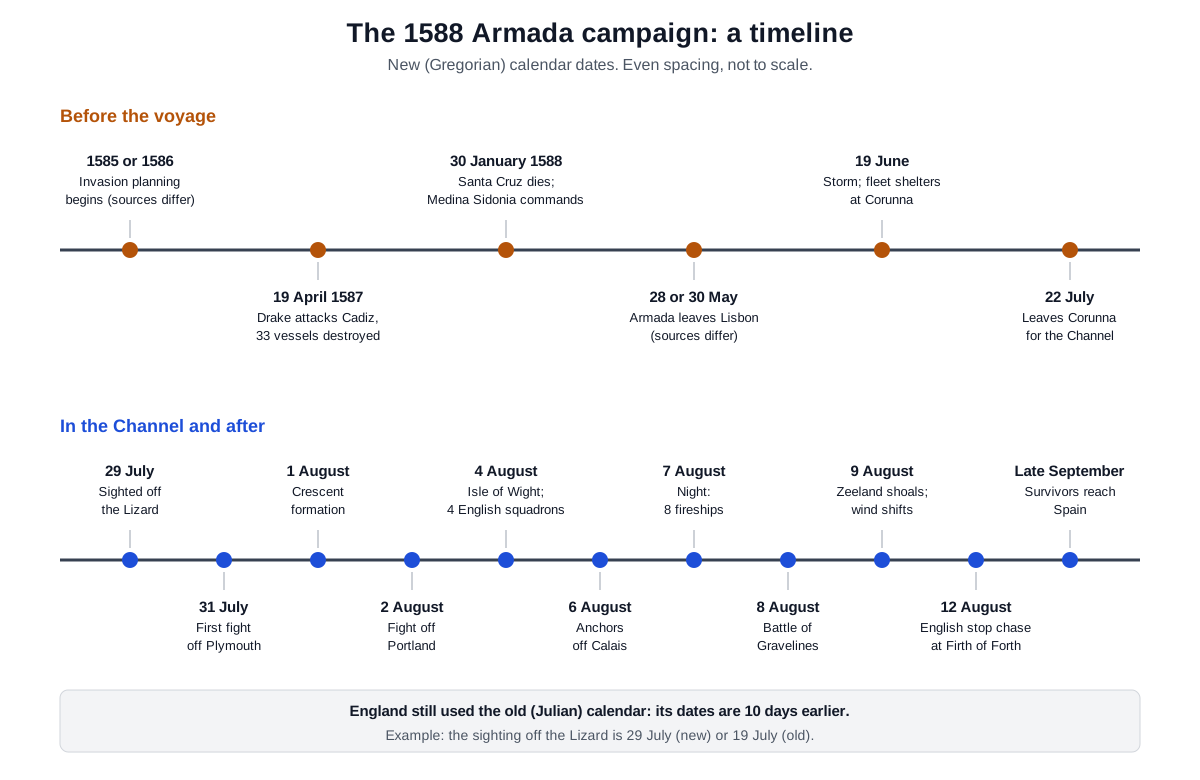
Before following the dates, a word about calendars. England still used the old Julian calendar, which differs slightly from the Gregorian calendar in use today. That is why one museum page gives the sighting off the Lizard as 19 July and another as 29 July. This article uses new-style dates.
Medina Sidonia's fleet sailed from Lisbon in late May 1588. The National Archives puts the departure on 28 May, and the Greenwich research guide on 30 May. Heading north, the fleet soon ran into rough weather and scattered, and on 19 June it took shelter in the Spanish port of Corunna. Repairs cost a month, and the fleet only set out again for the Channel on 22 July.
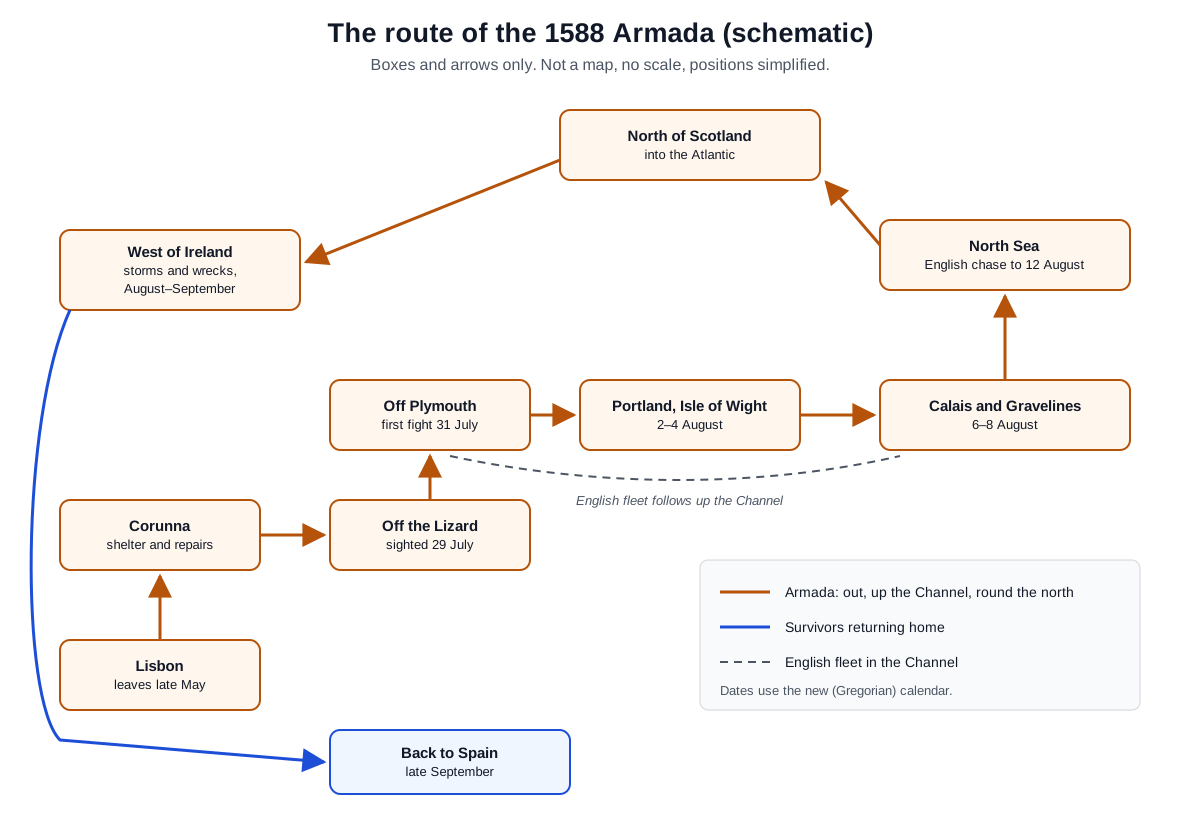
On 29 July the fleet was seen off the Lizard, and the next day Howard and Drake took their ships out of Plymouth. In a letter written on 31 July (21 July in the old calendar) aboard the Ark off Plymouth, Howard counted 120 Spanish ships, many of them large.
He wrote that the fleet was "so strong" that he did not dare push in among it. A postscript begs for heavy shot and powder to be sent quickly.
The first clash came off Plymouth on 31 July. It settled nothing, but several Spanish ships were damaged, and the English captured two of them the next day. On 1 August the Armada took up a defensive crescent formation and moved slowly up the Channel.
On 2 August the fleets met again off Portland Bill in Dorset. The fighting was fierce but did little damage to either side, and it stopped when both began to run short of powder and shot. On 3 and 4 August more fighting followed off the Isle of Wight. The English fleet now attacked in four groups led by Howard, Drake, Hawkins and Martin Frobisher.
Again there was no decision. Medina Sidonia, now very short of powder and shot, turned toward Calais in the hope of new supplies. On 5 August he sent word to Parma to be ready to meet him at Dunkirk and to bring plenty of cannonballs. The English ships also asked their government for powder, shot and food, but nothing was sent.
On 6 August the Armada anchored off Calais to wait for Parma's army. Parma, however, could not move, because a Dutch fleet under Justin of Nassau had him blockaded at Bruges. Meanwhile Seymour's ships joined Howard, bringing the English fleet to about 136 vessels.
Fireships and Gravelines
Off Calais, English guns fired from a distance with almost no effect. So Howard changed his approach. He decided to move before Parma's army could arrive: old ships were packed with things that would burn, set on fire and sent toward the anchored Spanish fleet. Ships used this way are called fireships.
On the night of 7 August eight fireships came in. The Spanish first tried to fend them off with long hooks, but cannon left on those ships started to explode, and everyone tried to get clear. According to Greenwich, no Spanish ship actually caught fire. Even so, the startled Spanish crews cut their anchor cables and scattered in the dark, drifting toward the coast of Flanders.
In the confusion, the ship Hawkins called the "chief galleass" damaged its rudder and was rowed ashore near Calais. Don Lewes de Cordua, a Spanish captain later captured in Ireland, told a different story. In his account there were six fireships, and the fire spoiled a plan to land 7,000 men at Calais to go to Parma.
On 8 August the English fleet chased the scattered Armada and attacked it off Gravelines. This time the two sides fought at close range, running alongside each other all day. The English ships closed in so as not to waste their ammunition.
The Armada was badly hurt. Many ships took heavy damage, several were forced onto the shore, and no fewer than three went down. The loss of life among the Spanish fighting men was also very high.
The next day, 9 August, strong winds and the pursuing English ships nearly pushed the Armada onto the shallow banks off Zeeland. Then the wind suddenly changed, and the Spanish ships just escaped. The wind saved them, but it did not let them back into the Channel.
Sailing ships, guns and the crescent: the weapons at sea
The Spanish ships in the Channel were not all of one kind. The fleet mixed big, powerful galleons with galleys and galleasses. Armed merchantmen, transport ships and 35 small craft supported them. Just before departure, word from Lisbon put the great ships at about 73, along with 4 galleasses and 4 galleys.
The two fleets wanted to fight in different ways. The Spanish tried to come alongside English ships so that troops could storm across onto their decks. The English, in nimbler ships, preferred to fire their guns while passing quickly.
There were also more soldiers than sailors on board. The Lisbon report counted 10,000–11,000 soldiers, not including sailors, and Hawkins's letter gave 20,000 soldiers and 8,000 sailors and others. The fleet was not meant only to win at sea; it was one part of a plan to invade England together with the army in the Netherlands.
Evidence of that plan has come up from the seabed too. La Trinidad Valencera, stranded in Kinnagoe Bay in Donegal, Ireland, yielded two huge siege guns cast in 1556 and several gun-carriage wheels. A siege gun is a cannon for attacking castles and forts. National Museums NI presents these finds as evidence that the Armada intended an invasion of England.
The crescent formation worked like a shield. Held very tightly, it sheltered the smaller ships during the advance, and English attacks never got properly started. The fireships at Calais broke up the anchored fleet, but the Spanish ships got back into formation after Gravelines.
A battle of guns was also a battle of powder and shot. Hawkins wrote that after a long, sharp fight off Portland the English had used so much powder and shot that they would not engage again until they were resupplied. In the same letter he asked again and again for more powder and shot. The Spanish faced the same problem, and Medina Sidonia had headed for Calais to get supplies.
Wind and storms: the long way round Scotland and Ireland
After Gravelines the wind kept working against the Armada. The south-west winds that usually blow in those waters kept the Spanish fleet from returning down the Channel. It could neither reach Parma nor go back the way it came. So Medina Sidonia took the fleet into the North Sea, to go round the northern tip of Scotland and out into the Atlantic.
The English chased the Armada into the North Sea on 10 and 11 August, as far as the Firth of Forth in Scotland. On 12 August, with ammunition and supplies running low, they gave up the chase and went home. By then the English were also too short of shot to attack and simply followed at a distance.
Captain Cordua said that when Medina Sidonia gathered his remaining ships, he found he had lost only six. The order to sail home was given, but near Norway a great storm struck the fleet.
The voyage home became an ordeal. Storms raged in the North Sea and the Atlantic, and many ships were already damaged from Gravelines. The Greenwich research guide counts about 19 Spanish wrecks along the Scottish and Irish coasts and says the fate of others is still unknown. National Museums NI counts more than 20 on Ireland's northern and western shores alone, so the figures do not agree.
One of the wrecks was the Girona. It broke up on Lacada Point, close to the Giant's Causeway in County Antrim, Northern Ireland. Most of the survivors did not reach Spanish ports until late September.
So did the weather decide the outcome? The National Archives names the wind pushing the Spanish ships north as one important reason for England's success. The Greenwich page on Elizabeth I first describes the fighting in the Channel, the fireships and Gravelines, then says that "bad storms completed" the Spanish defeat. Neither explains the result by wind alone.
Reading the numbers: how many ships, how many people
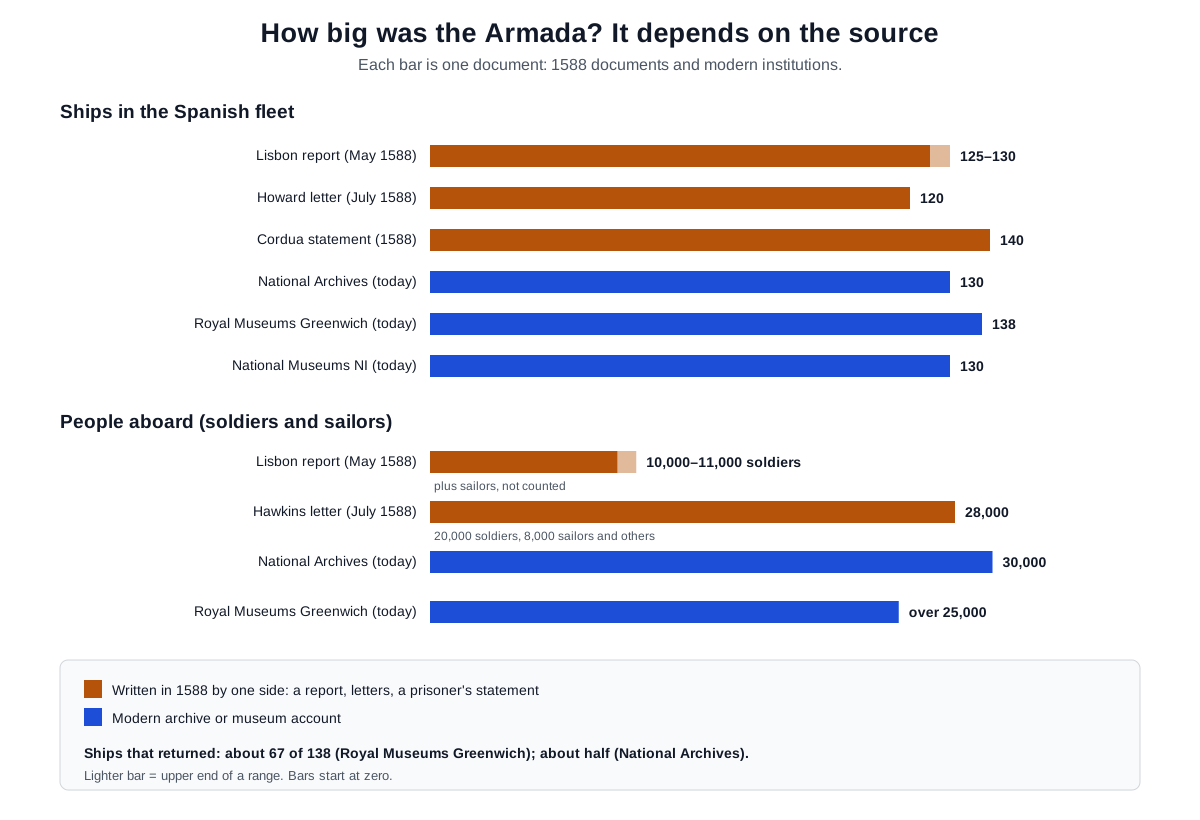
The size of the Armada depends on who counted and when. The intelligence report from Lisbon in May 1588 gave 125–130 ships large and small, Howard's letter in July gave 120, and Captain Cordua, captured in Ireland, said 140. Modern institutions also differ a little: 130 at The National Archives, 138 at Greenwich, 130 at National Museums NI.
The numbers of people vary even more. The Lisbon report counted 10,000–11,000 soldiers, not including sailors, adding that "a great many more" were rumored. Hawkins's letter put the total at 28,000 when the fleet left Lisbon. Today The National Archives gives 30,000 sailors and soldiers, and Greenwich gives over 25,000.
Every figure from 1588 was written at the time by one side. The spy report came in before departure along with rumors; Howard wrote the day after he first saw the fleet; and Cordua spoke under questioning after his capture. What was counted also differs. The Lisbon report listed about 73 great ships within its 125–130 total, so the number changes depending on whether small ships are included.
The English figures are not single numbers either. As seen above, about 94 ships at Plymouth and about 35 in the Downs came together as about 136. Cordua, however, said the Spanish met about 70 of the Queen's ships off Plymouth and that 25 more arrived at Calais.
Losses should also be read as a range. The Greenwich research guide says that of the 138 ships that sailed from Lisbon in late May, only around 67 returned. Another Greenwich page says less than half returned, and The National Archives says about half.
As many as 11,000 Spanish seamen and soldiers may have died. That figure is an estimate, not a count, and behind it were people with names.
Medals, a portrait and shipwrecks: what remained
The English read their victory as God's will. For many, the wind that drove the Spanish ships north proved that God was on their side, and pictures and medals were made to celebrate it. One medal carried the words "God Blew and they were Scattered." The National Archives uses that phrase as the title of a lesson that asks students to sort the evidence and decide whether God really helped.
Words from the weeks of waiting also survive. English troops gathered at Tilbury to meet an invasion, and Elizabeth spoke to them there. She said she might be a weak and feeble woman, yet her place as England's ruler gave her strength. The Armada Portrait, made to mark the failed invasion of summer 1588, has returned to the walls of the Queen's House at Greenwich after conservation.
The campaign was recorded in pictures as well. Soon after the battle, Petruccio Ubaldini wrote a short account of it, and Robert Adams drew the actions between the fleets on 11 charts. Augustine Ryther engraved and published the charts in 1590, and the National Maritime Museum has one colored set.
The war did not end in 1588. Philip sent further armadas against England, and the war between England and Spain went on until 1604. Even so, the Greenwich research guide concludes that the defeat removed the danger of England being invaded, at least for the years immediately ahead. The hopes of those who wanted a Catholic monarch back on the English throne were crushed as well.
Under the sea off Ireland, the belongings of the people on board remained. The excavation of the Girona produced 414 gold coins, 789 silver coins and gold jewelry. Among the jewelry are rings engraved with personal inscriptions, crosses of religious orders and chains worn as signs of office. Kept today by National Museums NI, these objects show that each loss counted in numbers was a life.
What to read next
- The Gunpowder Revolution: How Muskets and Cannon Changed Armies: how the guns carried by fleets like the Armada changed armies on land.
- Yi Sun-sin and the Battle of Hansando: a battle of formations and guns in Korean waters, read through the records.
- Anti-ship missiles: how the problem of hitting a moving ship at sea is handled with today's technology.
- Turning points in military technology: how battlefields changed as weapons changed, traced through 20th-century technology.