If a helicopter gearbox were a few hours away from breaking, could anyone know in advance? A 2022 report by the U.S. Government Accountability Office (GAO) includes a case reported by the U.S. Army. Sensors on the aircraft flagged a gearbox fault that might have failed within hours. Reading the warning signs before a part fails, and choosing the time to fix it, is called predictive maintenance.
Predictive maintenance is often presented as an AI technology, but at its core is a question older than artificial intelligence. When should you fix something? The sections below cover the three maintenance approaches, what sensors and data do, and what "remaining life" means. Then they turn to the cases the U.S. military and Korea have made public, and to the problems that are still open.
Three ways to decide when to fix
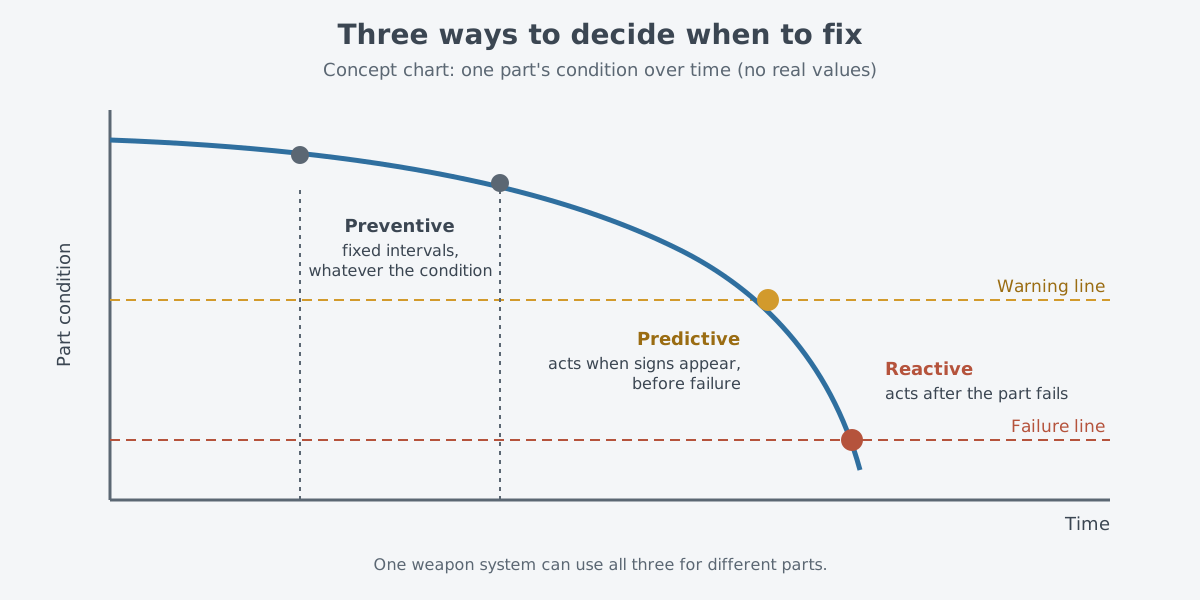
According to GAO, the U.S. Department of Defense (DOD) spends nearly $90 billion a year on weapon system maintenance. That work falls into two broad groups. Reactive maintenance happens after something breaks, with no plan. Proactive maintenance is planned ahead.
Planned maintenance splits again. Preventive maintenance is routine work done at set time intervals. Predictive maintenance looks at condition-monitoring records or past data to see ahead when work will be needed. The aim is to cut both sudden reactive repairs and overly rigid preventive schedules.
The military uses several names for the same idea. Condition-based maintenance (CBM) and CBM+ are the best known. Reactive maintenance is sometimes called "fly to fail" or "run to failure," and the services say this approach often adds effort and expense.
The three approaches are not an either-or choice. One weapon system can use all three, depending on the situation, the subsystem, or the part. The choice weighs what each approach costs against what it returns.
One tire, three approaches
A single vehicle tire makes the difference clear. Reactive maintenance means fixing the tire after it blows out at speed. By then, the suspension and other parts may be damaged, and people may be hurt.
Preventive maintenance might swap the tire at 30,000 miles or after 3 years, regardless of how it was used or how it looks. This makes schedules and planned costs easier to control. But the work may happen more often or less often than needed. A good tire may be thrown away, or a fast-wearing one may be changed too late.
Predictive maintenance combines data from electronic sensors with known historical data to pick the best time to replace the tire. That time is not so early that money is wasted, and not so late that the tire fails without warning.
It is not free. Predictive maintenance can cut reactive and preventive work and prevent failures. Still, it may need early spending: condition monitoring has to be built in, maintainers need new skills, and data analysis needs support. Even so, service officials say that fixing things after they break can cost the most of all.
What sensors and data do
Predictive maintenance is not a single measurement. It runs on a feedback loop that never stops, fed by historical records and by up-to-date condition data from the weapon system. GAO, drawing on a report by the DOD Inspector General, lists four more things the loop needs.
These are the ability to store and move data well, sound analysis, maintainers who are willing to act on the prompts, and an evaluation of whether it works. It is worth noticing that people and evaluation are part of the loop.
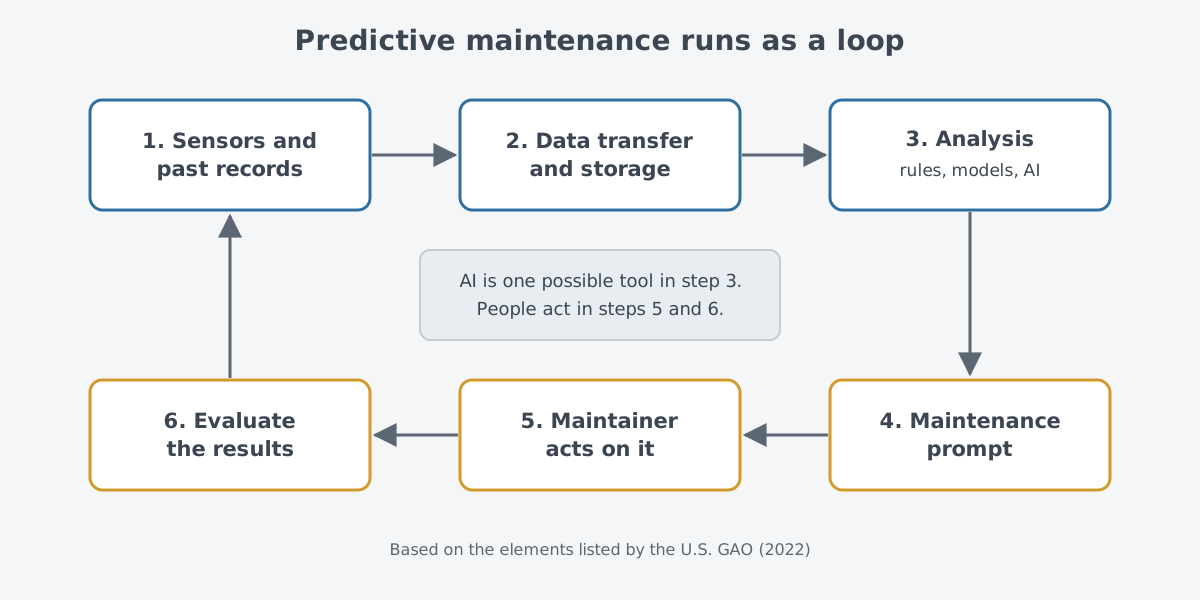
The toolkit can include sensors, analytics, algorithms, and AI. That does not mean AI is required. In a footnote, GAO points out that predictive maintenance does not always need artificial intelligence or machine learning.
New sensors are not always needed either. A weapon system's existing condition-monitoring functions and the data they produce can be used. So AI is best seen as one tool in the analysis step of the loop.
Predicting remaining useful life
The Prognostics Center of Excellence at NASA Ames Research Center calls this work prognostics. It is about forecasting how a system will be doing later on, and especially when it will fail.
Two terms come up here. End of life (EOL) is the time of failure. Remaining useful life (RUL) is the time left from now until failure.
What changes when you know the remaining life? Maintenance can follow the condition of the part instead of the clock. Maintenance schedules and spare-part plans can also be made better.
Prediction models are often sorted into two groups. "Model-based" methods use models derived from first principles, such as physical laws. "Data-driven" methods use models learned from data, such as artificial neural networks. In practice the two are mixed: a model is built from knowledge of the system plus its data, and then adjusted while in use.
A forecast always has a spread. The present state is never known exactly, future use is not fixed, and noise creeps in along the way. The NASA center's slides name these three as sources of uncertainty and treat the failure time as a probability distribution, not a single point.
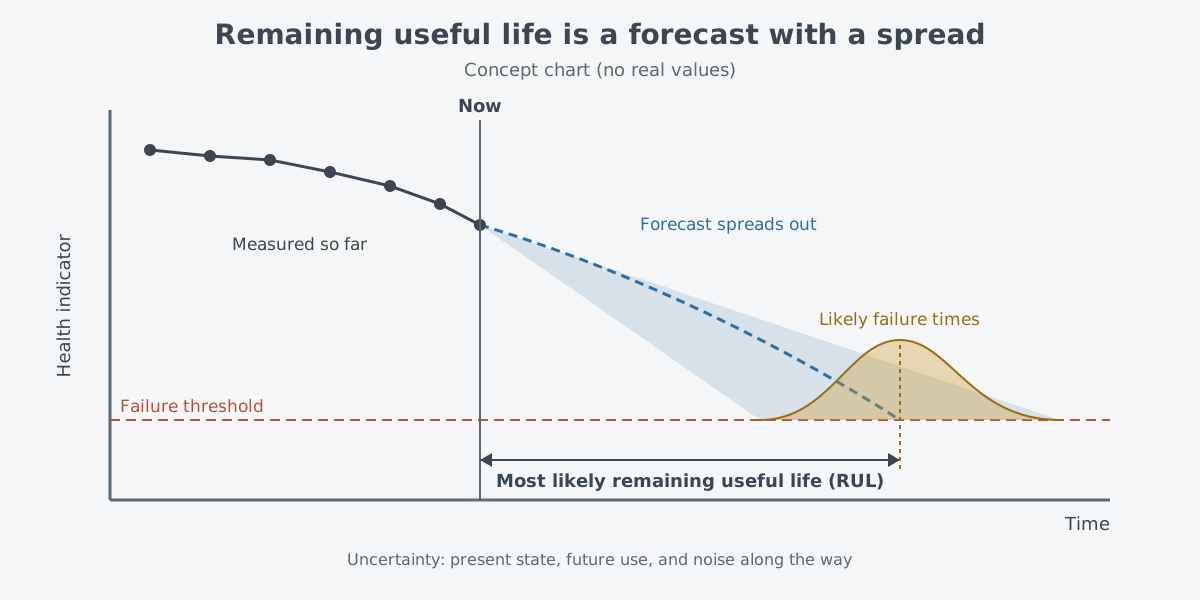
This resembles a weather forecast that gives "the chance of rain tomorrow." There is a real difference, though. Rain falls whatever people do, but a part's future depends on how it is used.
Cases on the public record
DOD put out its first, interim policy on predictive maintenance in 2002. In 2007, it directed each service to pick one office to lead the effort, fund it, and begin wherever the practice was technically possible and worth it. GAO found, however, that the services made limited progress until recently.
As of June 2022, no weapon system had fully implemented predictive maintenance.
Aircraft were furthest along. All four services got relatively further with aircraft than with their other weapon systems. Service officials say part of the reason is that some aircraft have had the sensor technology since 2002. The Army started fitting sensors to its AH-64 Apache helicopters in 2005.
Here are four of the cases the services gave GAO. All of them come from service officials or service documents.
| System | What was made public |
|---|---|
| AH-64 Apache helicopter (Army) | Health monitoring sensors flagged a nose gearbox fault that might have led to failure in a matter of hours. According to the head of Army Aviation and Missile Command, catching it early may have prevented an accident and saved two lives |
| H-1 helicopters (Navy and Marine Corps) | Using predictive maintenance from fiscal year 2016, faulty parts such as contaminated or cracked bearings were replaced before failure, avoiding an estimated 29 emergency landings |
| Medium Tactical Vehicle Replacement (Marine Corps) | Condition-monitoring technology found a fault serious enough to deserve a dashboard warning light. The warning light itself failed to alert maintenance personnel |
| B-1 bomber (Air Force) | Predictive maintenance analysis helped a contractor find a shorted wire hidden in the airframe, one the maintainers themselves could not track down |
This does not mean predictive maintenance has become routine. No Army aircraft was routinely using it to push back scheduled maintenance or to swap parts. Across the services, parts were not regularly replaced based on its forecasts.
What is still hard
As of GAO's review through June 2022, three obstacles stood out.
First, there is no good yardstick for results. Service officials admitted that their examples come from limited experience and that the services generally lack metrics to judge predictive maintenance. Army aviation officials, for their part, said they lack a specific metric and enough historical data to show cause and effect between predictive maintenance and better readiness or availability. That is why the table above should be read as examples, not as proof of results.
Second, data has to be moved and stored. The services acknowledge major technology challenges, such as limits on data transfer, putting maintenance manuals into digital form, and aging information systems. In the examples Navy officials gave, data can move around on board a ship, but bandwidth between ship and shore is limited. When the sensor reading rate rose from one per hour to one per second, the amount of data to store grew along with it.
Third, people have to trust the forecast. According to Navy officials, in the first demonstration aboard a ship, the crew doubted the predictions because of problems such as incorrect algorithms, and did not act on the prompts. In a second demonstration on the same ship, fixed algorithms plus coaching led to a higher rate of action. Busy maintainers are also reluctant to work on equipment that has not failed yet.
So predictive maintenance does not erase preventive maintenance. Service officials said it was especially important not to set aside safety-critical preventive maintenance, and that any stretching of preventive intervals must rest on analysis people are confident in. Another obstacle is the many different names for the practice, which key people may not know well.
The services see the shift as a cultural challenge that needs steady attention from leaders. GAO issued 16 recommendations to the Air Force, Army, Marine Corps, and Navy, asking them to plan the rollout and measure how well it works. DOD generally agreed.
Korea's public research effort
The same trend shows up in Korea as a public program. In March 2023, the Defense Acquisition Program Administration (DAPA) and the Korea Research Institute for Defense Technology Planning and Advancement opened a new center. It is the "Weapon System CBM+ Specialized Research Center" at the Korea Institute of Science and Technology Information (KISTI).
The government's policy briefing describes CBM+ as using sensor data built into weapon systems to assess their condition in real time. Faults are diagnosed and predicted early, and the best maintenance needs are decided from that.
The center plans to spend about 30.9 billion won through 2028 on basic technology for collecting condition-based maintenance data and setting up diagnosis and prediction procedures. Six specialized labs, including ones for ground systems and naval systems, will carry out 12 detailed projects, with staff from 9 universities and institutes and 11 companies taking part. The DAPA Minister named AI-based prediction algorithms and a logistics data collection system among the research goals.
Material from both countries puts systems for collecting and moving data right next to the prediction algorithms.
What to read next
- Simulation versus testing: why CG is not proof: how to tell published examples from evidence.
- Military logistics: performance must be sustainable: maintenance seen as part of logistics as a whole.
- Digital twins: testing before building: models that copy equipment in a virtual form.
- Environmental durability: rain, dust, heat, cold and salt: what laser equipment must withstand outdoors, and the tests that check it in advance.