Picture an antenna finding a single ship on the sea north of Australia from thousands of kilometers away. It sounds odd. The Earth is round, and at that distance the ship sits far below the horizon. Even so, Australia has grown a radar that does this, starting as a core research project in 1970.
The trick is a layer of electrically charged air high above us: the ionosphere. Start with why ordinary radar stops at the horizon, and two things come into view: what over-the-horizon radar (OTHR) changed, and what it costs to depend on the sky.
Why ordinary radar stops at the horizon
A radar sends out radio waves and listens for the reflections that bounce back from objects. The basics are in Radar: measuring distance and motion with radio waves. The catch is the path those waves take.
The microwave radars you see at airports send their waves out in a straight line. So they cannot find anything past the line of sight (LOS), the visible horizon. The U.S. National Weather Service describes the same limit for weather radar. The beam goes straight and does not bend with the Earth's surface, so even the lowest scan may only catch the middle part of a distant storm.
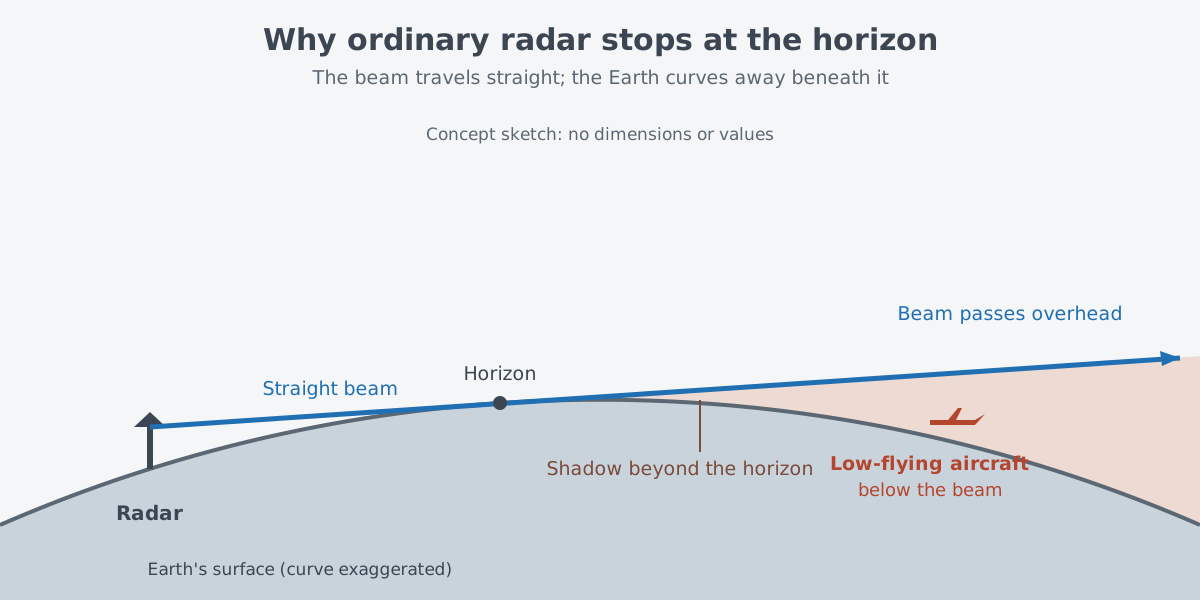
Lay a straight stick against a ball and you can see why. The stick touches the ball at one point, and past that point the ball's surface drops away from it. Real radio waves are not a rigid stick, but as long as they travel straight, low areas beyond the horizon stay in the shadow under the beam.
The ionosphere: a radio mirror in the sky
The ionosphere is the upper part of Earth's atmosphere. Extreme ultraviolet light and X-rays from the Sun knock electrons off atoms and molecules, building a layer rich in electrons.
Sources give different heights. The NOAA Space Weather Prediction Center (SWPC) places it from 80 to roughly 600 km up. The U.S. Space Force base fact sheet on the Jindalee radar gives 75 to 450 km.
The layer matters because it reflects and reshapes the radio signals people rely on to communicate and navigate. Inside it form several layers, named D, E and F.
The ionosphere never stays the same. Most of its ionization comes from sunlight, so the Earth's night half has far less of it than its daytime half. Solar activity matters too. The Sun's extreme ultraviolet and X-ray output swings by nearly 10 times across its 11-year cycle, and the density of the ionosphere follows.
High frequency (HF) radio feels these changes right away. When the density and structure of the ionosphere shift, the path of the signal shifts too, and sometimes the signal is cut off completely. During a solar flare, a thickened D layer reflects radio waves at some frequencies and soaks them up at others. Flare blackouts hit the sunlit half of the planet and peak when the Sun is straight overhead.
Skywave over-the-horizon radar
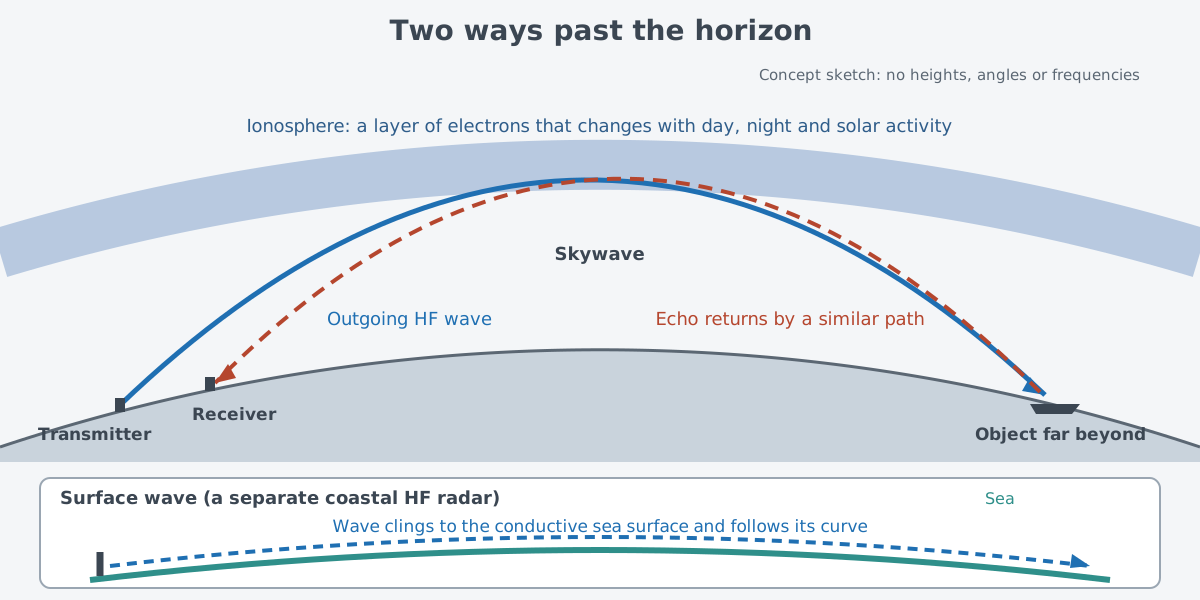
If the ionosphere bends HF waves back toward the ground, could a radar use that? That is the idea behind skywave over-the-horizon radar. A transmitter fires HF waves up at the sky, and the ionosphere refracts them so they curve back down toward the Earth. The waves that come down light up the sky or sea far beyond the horizon.
When the waves hit an object with a large enough metal surface, part of the energy travels back along the way it came. In Australia's Jindalee radar, that echo came back by a similar route to a receiver site set apart from the transmitter. Radars like this usually consist of very large fixed antennas for sending and for receiving.
So how does the radar pick an object out of such a wide area? Over-the-horizon radar relies on the Doppler shift. If something moves toward or away from the radar differently from what surrounds it, the radar can detect it. Computers then sort through the returned energy to find the objects.
How far can it see? Australia's Defence Science and Technology Group (DSTG) says the Jindalee Operational Radar Network (JORN) watches wide areas at ranges of 1,000 to 3,000 km. Canada's Department of National Defence, introducing its new Arctic over-the-horizon radar, shows a figure of targets observed up to 3000 km away.
That range is not fixed, though. The U.S. Space Force base fact sheet notes that the reach in range depends mainly on the state of the ionosphere.
Surface waves that follow the sea
The sky is not the only way past the horizon. An HF radar on the coast can send its waves along the surface of the sea. Seawater conducts electricity well, and vertically polarized waves hug the curved sea surface. That lets the signal follow the Earth's curve past the visible horizon.
NOAA's Integrated Ocean Observing System (IOOS) uses radars like these to track how fast surface ocean currents move and which way, in close to real time. They are ocean instruments, not weapons, but they see past the horizon by a related principle.
Lower frequencies carry the signal farther past the horizon. In an IOOS example, a radar at 5 MHz commonly reaches 200 km, while a microwave radar in the same spot may see a horizon just 30 km off. Once the frequency passes 100 MHz, the waves are held to the line of sight, just like microwaves and light.
This method only works if the signal travels along the sea surface. What kind of water lies underneath makes a big difference. The same 12 MHz signal can go 90 km over coastal ocean, yet over a single Great Lake, rather than the sea, it manages only about 5 km.
The public record: Australia, the U.S. and Canada
In Australia, the technology grew out of ionosphere research at the Weapons Research Establishment in the 1950s. The Jindalee HF over-the-horizon radar became a core research project in 1970, built to watch the sea and air approaches to northern Australia. Jindalee is an Aboriginal word for "a place the eye cannot see," somewhere beyond sight, like over the horizon.
The first over-the-horizon radar went up at Alice Springs in 1974 as a research program. It found its first ship in early 1983 and automatically tracked its first aircraft in early 1984. Going from a concept demonstrator to a working operational capability took from 1971 to 1987.
The 1987 Australian Defence White Paper took up the advice to invest in over-the-horizon radar research and acquire an operational system. As a result, JORN was commissioned in 2003, handing two more radars to the Australian Defence Force alongside the original Jindalee site at Alice Springs.
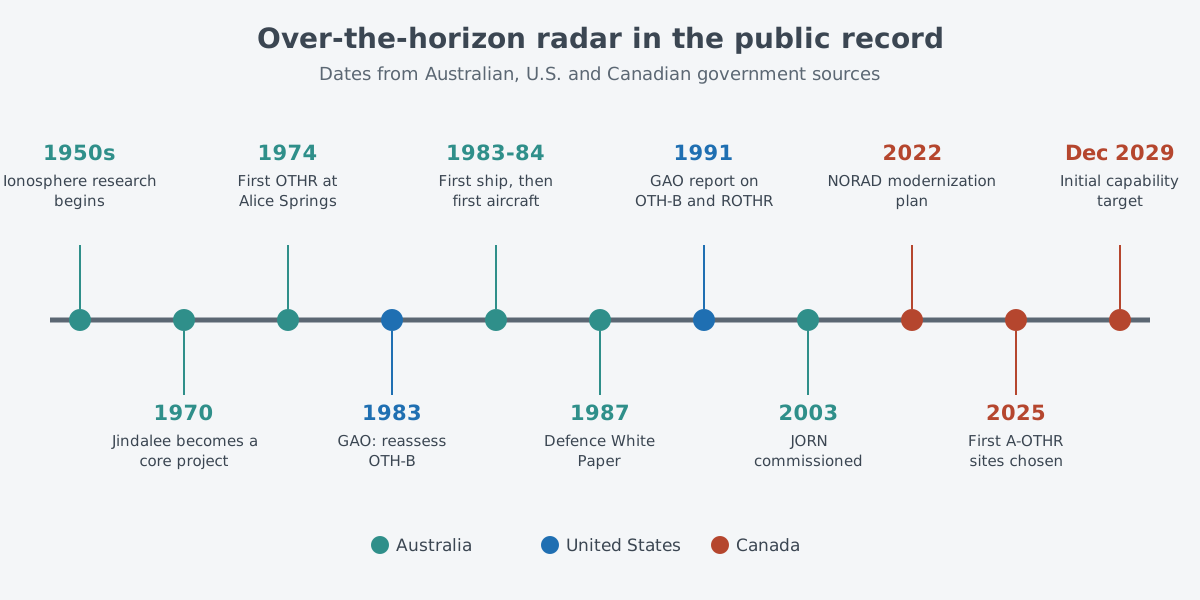
The United States had a program of the same kind: the U.S. Air Force's Over-the-Horizon Backscatter (OTH-B) radar. The U.S. Government Accountability Office (GAO) examined it in a 1983 report. The radar was designed to give long-range tactical warning against a "precursor" attack by Soviet bombers on the U.S. mainland. GAO recommended that the need for it be fully reassessed.
A 1991 GAO report looked at plans by the Department of Defense to use OTH-B against drug trafficking, and it also covered the Navy's Relocatable Over-the-Horizon Radar (ROTHR) program. The department later cancelled its plans to buy the central radar system and more OTH-B sectors.
The most recent chapter is in Canada. In 2022, Canada announced a 20-year plan to modernize its part in the North American Aerospace Defense Command (NORAD). An Arctic Over-the-Horizon Radar (A-OTHR) is part of it. In July 2025 it chose its first transmit and receive sites, and the full system needs four sites: two to transmit and two to receive.
In 2026 Canada and Australia signed an acquisition arrangement between their two governments, setting up the framework for buying Australian over-the-horizon radar technology. Canada expects initial capability by December 2029.
When the sky changes, so does the view
The strength of over-the-horizon radar and its limits come from the same place: the ionosphere it uses as a mirror keeps changing. The U.S. Space Force base fact sheet lists what can affect JORN on a given day. Besides solar activity, the list includes meteors, geomagnetic activity and day-night changes in the ionosphere. Lightning from thunderstorms can also change the ionosphere locally.
The sea adds its own trouble. Rough seas and wind raise the radar clutter and can make ships on the water very hard to detect.
A signal that has traveled so far comes back weak. Canada's Department of National Defence explains that by the time the signals have gone out and echoed back to the receive sites, they will be very weak. That makes site choice demanding. The land has to be remote, flat and dry, a suitable distance from sources of radio noise, and close to electrical power.
This difficulty was clear from the start. In a DSTG article recalling Jindalee's development, the ionospheric physicists on the project said the biggest challenge was "knowing how this supposedly reflective layer really behaved." You can call the ionosphere a mirror, but it is a mirror whose density and structure change with day and night and with solar activity.
Where this meets lasers: wavelength sets the path
In the end, the story of over-the-horizon radar is about how the path of an electromagnetic wave depends on its wavelength. HF waves bend in the ionosphere and cling to seawater, but waves above 100 MHz are held to the line of sight, just like microwaves and light.
A laser is light too. If light is held to the line of sight, a laser beam reaches only as far as it can see in a straight line. How differently electromagnetic waves of different wavelengths meet the atmosphere continues in Why wavelength matters: visible and invisible light.
What to read next
- Radar: measuring distance and motion with radio waves: the basic idea of measuring distance and motion with round-trip time and the Doppler effect.
- Airborne early warning and control: a control tower in the sky: another way to push back the horizon, by lifting the radar high.
- Why wavelength matters: visible and invisible light: how the meeting between light and the atmosphere changes with wavelength.