In the south of North Pyongan Province, a river flows southwest into the Yellow Sea. Today it is called the Cheongcheon, and it is the river that old records call the Salsu. In July 612, a retreating Sui army was halfway across it when Goguryeo troops struck from behind.
Many people know the names Eulji Mundeok and the Battle of Salsu. The battle is often told together with the phrase "an army of a million." Which record does that million come from, and who was being counted?
This article follows the war between Goguryeo and Sui from 598 to 614 and reads those numbers one at a time. The guide is a set of entries in the Encyclopedia of Korean Culture, published by the Academy of Korean Studies. Different scholars wrote different entries, so the numbers do not always match, even for the same war.
What changed when Sui unified China
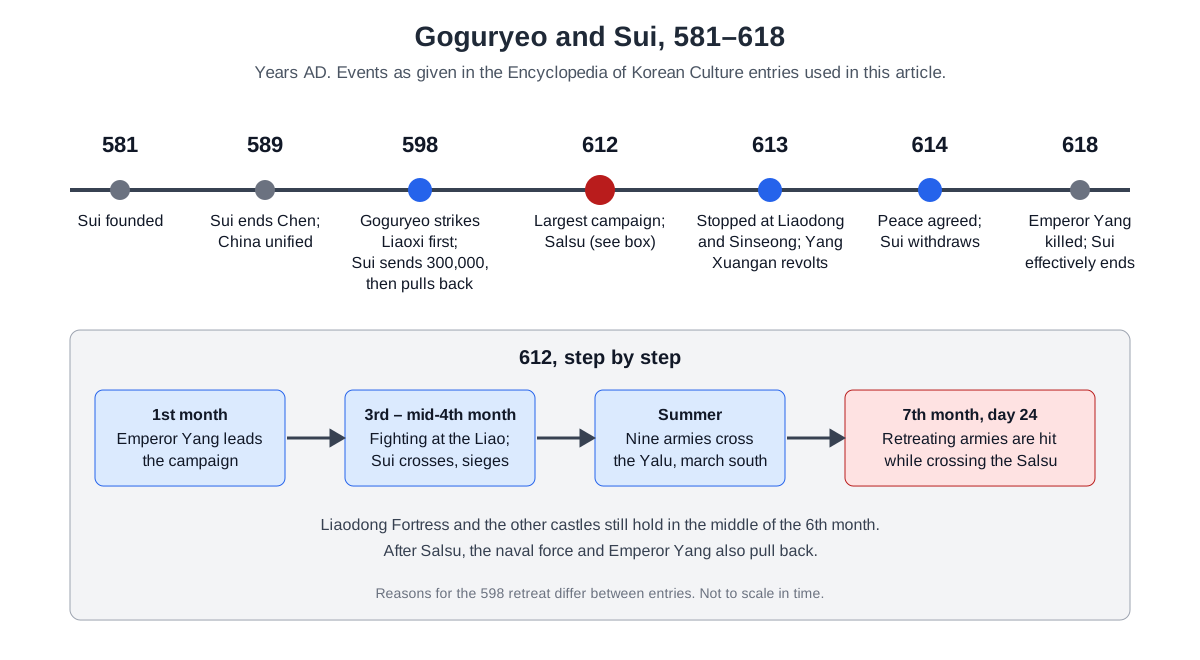
The Sui dynasty was founded in 581. It defeated the Turks to the north, and in 589 it destroyed the Chen dynasty in the south. China, divided for more than 300 years, was under one dynasty again.
Until then, Goguryeo held its own sphere of power in Northeast Asia. Noh Tae-don, who wrote the entry "Yeo-Su War," explains that Goguryeo and the Chinese dynasties recognized each other's spheres and coexisted. A unified Sui rejected that sphere and demanded submission. Some of the Khitan and Malgal people under Goguryeo drifted over to the Sui side.
When news came that Chen had fallen, Goguryeo began preparing for war at once. King Yeongyang took two paths at the same time. On taking the throne, he received a court title and the rank of Duke of Liaodong from Emperor Wen of Sui, and he sent tribute to keep diplomatic ties. He also strengthened the border, drew the Malgal and Khitan to his side, and looked for an alliance with the Turks.
Submit to Sui, or fight to keep its own sphere? Goguryeo chose to fight.
598: the first expedition
The first clash came in 598. Goguryeo attacked first, striking a Sui forward base in the Liaoxi region, and the "King Yeongyang" entry says the king led Malgal troops.
Emperor Wen sent 300,000 troops into Goguryeo by both land and sea. The expedition ended without success.
The entries explain the retreat differently. "Yeo-Su War" says Sui lost and withdrew because of Goguryeo counterattacks and disease, among other causes. "King Yeongyang" says the army pulled back on its own because of famine, disease and heavy rains. Disease appears in both, but they weigh the Goguryeo counterattack differently.
612: the 1.13 million on record
After Emperor Wen, Emperor Yang planned another invasion. Goguryeo tried to team up with the Turks to press on Sui's northern border, but the Turks had already submitted to Sui, so it did not work.
In the first month of 612, Emperor Yang personally led an army of 1.13 million and a navy of 40,000. The people mobilized to carry supplies were twice the number of combat troops. The "Yeo-Su War" entry calls this the largest force mobilized anywhere in the world up to that time.
The army was split into 40 units, and each unit was called a gun, or "army." Yu Zhongwen and Yuwen Shu, among others, commanded nine of them. These nine armies had 305,000 soldiers.
Serious fighting began in the third month at the Liao River. Goguryeo held the far bank and kept the Sui troops from crossing. They crossed only in the middle of the fourth month. From then on, Liaodong Fortress and the other castles in the Liaodong region fought sieges from behind their walls.
Goguryeo avoided large pitched battles in open country. It burned supplies in the fields and held its main fortresses to stop the enemy's advance. Small units harassed the enemy and cut its long supply lines. The war dragged on.
With the cold season coming, Emperor Yang left the castles along the way and sent 300,000 elite troops straight toward Pyongyang Fortress. The plan was to meet the Sui navy there, which would cross the sea and sail up the Taedong River, and then take the capital together.
The road to the Salsu
According to the "Salsu" entry, each man and horse in the nine armies received food for 100 days at the start. With weapons and other supplies added, each soldier's load came to more than three seom. Despite strict orders not to throw food away, officers and soldiers alike dug pits under their tents and buried it. About halfway along the march, food was already close to running out.
The man facing this army, gathered west of the Yalu River, was Eulji Mundeok. He crossed the Yalu to the Sui camp and offered a false surrender to see the situation inside. The "Eulji Mundeok" entry says he saw then that the Sui troops were short of food. After returning, he lost on purpose and fell back each time he fought the cavalry that Yu Zhongwen sent after him.
Around then, Eulji Mundeok sent Yu Zhongwen a short poem. The Samguk sagi biography of Eulji Mundeok records how it came about, and the title was added later. The lines below are an English rendering of the Korean translation in the encyclopedia entry on the poem.
> "Your divine plans have searched the heavens, your clever reckoning has mastered the land. You have won battles and your merit is already high, so be content and stop here"
Yu Zhongwen wrote back to win him over, but Eulji Mundeok refused.
The Sui commanders were split. Yuwen Shu wanted to turn back because food was short, while Yu Zhongwen favored giving chase to win glory. Yu Zhongwen, who held more authority from Emperor Yang, won the argument. The nine armies crossed the Yalu and came within 30 li of Pyongyang Fortress.
The nine armies appear to have planned to meet Lai Hu'er's naval force and get food from it. That fleet had crossed the sea into the mouth of the Taedong River and camped at a port 60 li from Pyongyang Fortress, and its main job was carrying food. But Goguryeo's feigned defeats made it overconfident, and it attacked Pyongyang Fortress on its own and was badly beaten. The nine armies never joined it.
Then Eulji Mundeok sent envoys with a second false surrender. If the Sui army turned back, he said, he would bring King Yeongyang to meet Emperor Yang. Yu Zhongwen and Yuwen Shu now had a reason to go home. The nine armies decided to withdraw, and Goguryeo troops soon followed them.
On July 24, the date given in the "Salsu" entry, the nine armies reached the Salsu. When they were halfway across, Goguryeo troops attacked the rear guard first. The Sui general Xin Shixiong was killed. The record says the Sui troops fled all the way to the Yalu within a single day.
With the nine armies broken, Lai Hu'er's force, stuck at its port, also pulled back. Emperor Yang heard of the defeat and turned his army around as well. Lee Jeong-bin, who wrote the "Salsu" entry, sees the battle as the decisive fight of the 612 war.
Walls and siege engines
Liaodong Fortress was the most rugged and solid Goguryeo stronghold along the Liao. In 612 and 613, Sui troops attacked it with siege tools called biru, dongcha, unje and jido, but could not take it.
The names hint at how each one worked. A dongcha was a large wheeled box: men inside it pounded the base of the wall with something like an iron weight. An unje was a tall ladder for attacking a wall, and jido meant digging a tunnel close to the walls to attack.
The defenders' side survives in a painting. A tomb found in 1953 at Yongbong-ri, Sunchon County, South Pyongan Province, holds a drawing of Liaodong Fortress. Its walls carry parapets of several shapes, along with arrow slits through which archers could shoot while staying hidden. Gate towers stand over the gates and corner towers at the corners.
Most Goguryeo fortresses were mountain fortresses. With a high peak behind, the builders ran walls down the ridges on both sides, wrapping around a valley, until they reached flat ground. This left room and water for people inside. The shape looks like an armchair.
The real sizes varied far more than a single chair suggests. They ranged from small redoubts only 100–200 m around to large fortresses more than 10 km around. The lower walls were built with a stepped-in face, and some had protruding bastions and walled outer gates.
Fortresses were also centers of government. Local governors such as the yoksal and cheoryeogeunji held both military and civil power, and their offices were often inside mountain fortresses. Local administration and the military system were bound together in this way.
Seen from a distance, the whole war looks like this. Sui sent huge forces by land and sea to destroy Goguryeo in one quick blow. Goguryeo held out around its fortresses, disrupted Sui's long supply lines, and waited for autumn, when cold and short supplies would wear the enemy down.
How to read the numbers
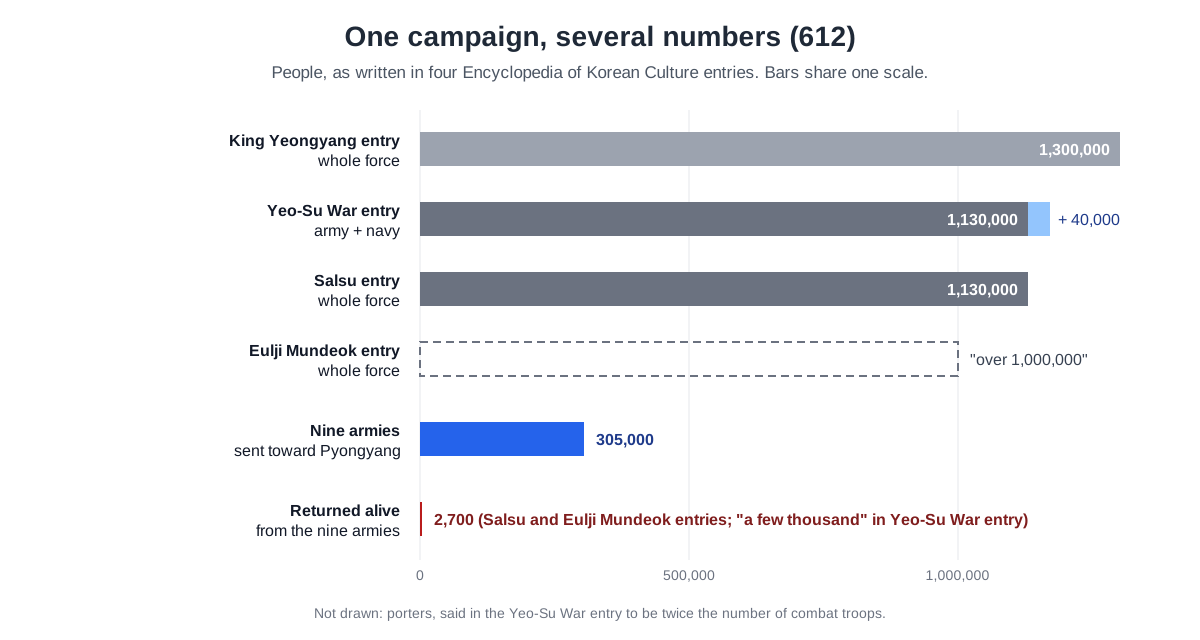
The 612 campaign is the same, but the numbers change from entry to entry. "Yeo-Su War" and "Salsu" say 1.13 million, "King Yeongyang" says 1.3 million, and "Eulji Mundeok" says only "over a million." On hearing "an army of a million," the first questions are which of these numbers it is and what it counts.
| Encyclopedia entry | Force in 612 | Detached force sent toward Pyongyang | Returned alive |
|---|---|---|---|
| "Yeo-Su War" | Army 1.13 million, navy 40,000, porters twice the combat troops | 300,000 elite troops | A few thousand |
| "Salsu" | 1.13 million, army in 40 units | Nine armies, 305,000 | 2,700 |
| "King Yeongyang" | 1.3 million | No number | No number |
| "Eulji Mundeok" | Over a million | 305,000 | 2,700 |
The 1.13 million in "Yeo-Su War" is the army alone. There is also a navy of 40,000, and the porters were twice the combat troops. By that entry, the total number of people mobilized was far above 1.13 million. The force that collapsed at the Salsu was the nine armies, 305,000 men.
For those who made it back, "Salsu" and "Eulji Mundeok" give 2,700, and "Yeo-Su War" says a few thousand. If it was 2,700, fewer than one in a hundred returned. Behind that figure are more than 300,000 men who set out carrying 100 days of food and never came back.
Even the counting of the wars differs. "King Yeongyang" counts four invasions starting in 598 and calls 612 the second. "Liaodong Fortress" calls 612 and 613 the first and second invasions. The same "second invasion" can point to different years.
Records about Eulji Mundeok himself are thin. The Samguk sagi biography says his family background cannot be known, and the Zizhi Tongjian also writes his name as Wiji Mundeok. A book from the late Joseon period gives his birthplace, but the "Eulji Mundeok" entry says that, as a later record, its accuracy is uncertain. Views also differ on his family name, Eulji, and the question remains debated.
Each entry carries a note: it is the scholarly view of its author and may differ from the official position of the Academy of Korean Studies. Among its references, "Yeo-Su War" lists the Samguk sagi and the Book of Sui. It also lists a 1991 history of Goguryeo's wars with Sui and Tang by a Ministry of National Defense committee. That is why a number should be quoted with the entry and the old history it comes from.
613, 614, and the end of Sui
In the fourth month of 613, Emperor Yang invaded again. Once more, Sui troops were stopped around Liaodong Fortress and Sinseong. Then Yang Xuangan, who was in charge of all military supplies, rose in revolt. The Sui army pulled back in a hurry, and Goguryeo troops attacked it as it went and won a major victory.
Another expedition came in 614. After repeated defeats and heavy losses of people and goods, Sui peasants rose up in many places, and raising troops became hard. Goguryeo was also worn out by the long war. The two sides agreed to peace, and the Sui army withdrew.
Another campaign was planned for 615, but it was called off amid revolts across the country and the threat of a stronger Turkic state. Emperor Yang was killed in 618, and the Sui dynasty effectively came to an end. In the last years of Sui, a song called "Do not go to Liaodong to die in vain" spread widely among the common people.
In "Yeo-Su War," Noh Tae-don names the failed Goguryeo campaigns as the decisive cause of Sui's fall. In "Goguryeo," he lists repeated defeats, the suffering of war and financial collapse as the main causes. Baekje and Silla had at times asked Sui to attack Goguryeo, but once the fighting began, both stepped back and watched. Goguryeo kept its independence but took heavy damage, and the wars among the three kingdoms on the peninsula went on.
What to read next
- Military logistics: performance must be sustainable: The nine armies and their 100 days of food show how old the supply problem is. This article looks at what modern militaries mean by logistics.
- The Goguryeo-Tang War and Ansi Fortress: a planned article on the war between Goguryeo and Tang, the dynasty that followed Sui.