Thirteen ships. That is the first number people bring up about the Battle of Myeongnyang. In the 9th month of 1597, in Uldolmok, a narrow channel between Jindo Island and Haenam, the Joseon navy turned back a much larger Japanese fleet. Dates in this article are the months and days of the old calendar, as written in the records.
Lay the records side by side, though, and the numbers do not settle on one value. One source says the Joseon side had 12 ships. The counts for the Japanese fleet and for the ships it lost also vary a little.
This article follows that day at sea through two kinds of record. One is Yi Sun-sin's report, copied into the Annals of King Seonjo (Seonjo Sillok) about two months after the battle. The other is a set of entries in the Encyclopedia of Korean Culture, written by modern scholars who read those records.
A renewed war and a navy in ruins
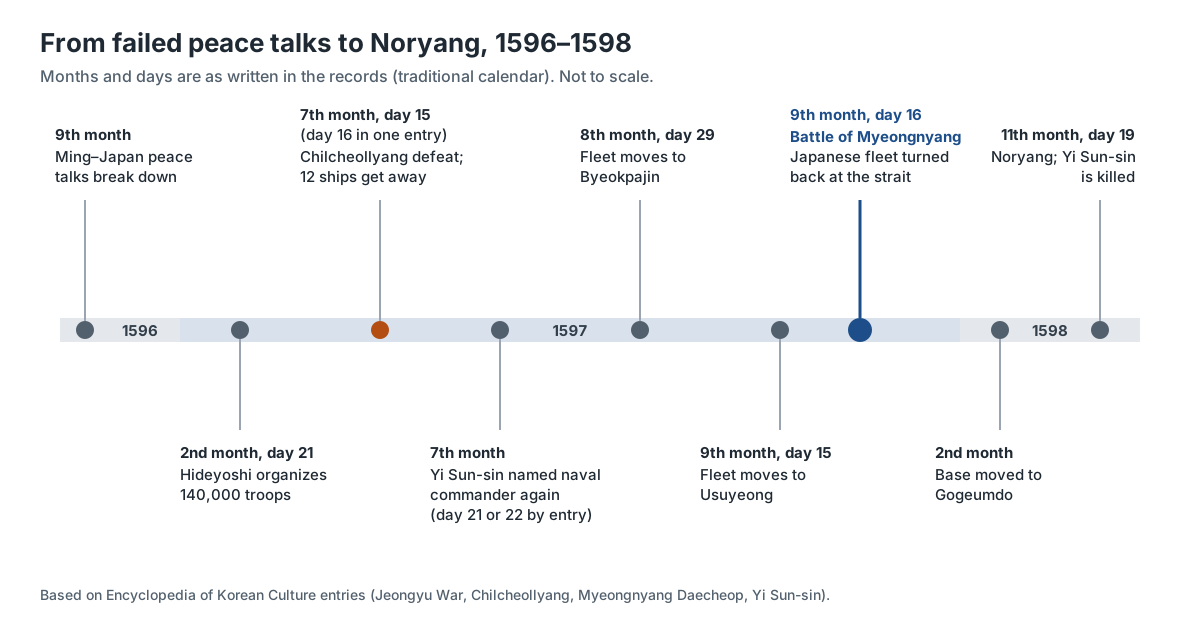
Peace talks between Ming China and Japan, carried on during the Imjin War, broke down in the 9th month of 1596. On the 21st day of the 2nd month of 1597, Toyotomi Hideyoshi organized another force of 140,000 troops. Its first aim was to take the Honam region in the southwest. This second invasion is called the Jeongyu War.
At that moment, Yi Sun-sin was not in command of the navy. The court had jailed him and made Won Gyun naval commander. After his release, Yi was serving as a soldier without rank under Field Marshal Gwon Yul.
On the 15th day of the 7th month of 1597, the Joseon navy under Won Gyun suffered a heavy defeat by the Japanese navy at Chilcheollyang. The Jeongyu War entry gives the date as the 16th. The battle is counted as the only naval battle Joseon lost in the whole Imjin and Jeongyu wars. Only Bae Seol, the Right Naval Commander of Gyeongsang, got away with 12 ships, and control of the southern sea passed to the Japanese navy.
In the 7th month, the court named Yi Sun-sin Naval Commander of the Three Provinces again. The day is the 21st or the 22nd, depending on the entry. The usable warships left were the 12 that Bae Seol had brought out, and local people later brought one more, making 13. The Yi Sun-sin entry also records that only 120 soldiers remained.
The Japanese navy aimed to push into the West Sea while its army advanced north on land. To guard Myeongnyang, the gateway to the West Sea, Yi moved by way of Ijin and Eoranpo and reached Byeokpajin on the 29th day of the 8th month. The Japanese navy raided the Joseon fleet at Byeokpajin several times at night, but each raid ran into Joseon lookouts and failed.
Uldolmok, the roaring strait
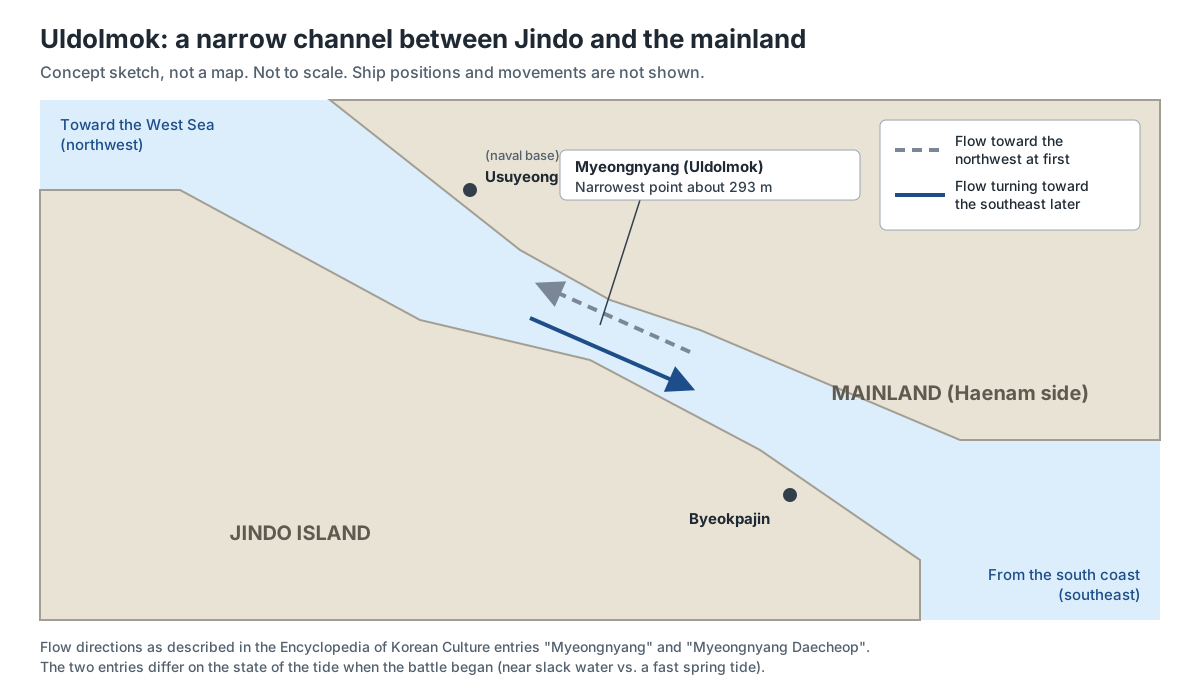
Myeongnyang is the strait between Nokjin-ri on Jindo and Hakdong-ri in Haenam. The figures given in the Myeongnyang entry put the narrowest point at 293 m, the spring-tide current at 11.5 knots, and the depth at 19 m. The water runs so fast and so loud that the channel seemed to be crying, which is where the name "Uldolmok" comes from.
In the Joseon period, Nokjin at the northern end linked Jindo with Usuyeong, and Byeokpajin to the south was a ferry landing leading to Haenam. Usuyeong was the headquarters of the Jeolla Right Province navy, built in Haenam in the early Joseon period. The place is still widely known for the Myeongnyang victory.
Yi judged that fighting with Myeongnyang at his back would be a serious disadvantage, and on the 15th day of the 9th month he moved the fleet to Usuyeong.
How the 16th day of the 9th month unfolded
Early in the morning, the Japanese fleet entered Myeongnyang. Yi gave the order to sail and led from the front. According to the Myeongnyang Daecheop entry, the tide was then close to slack water, when the flow almost stops, and the Japanese warships numbered 133.
Yi tried to block the channel with a line formation, ships spread out side by side like the character "一", and a wild melee broke out. The water slowly began to turn and flow southeast. The Japanese fleet looked ready to surround the ship Yi was on.
At the most dangerous moment, Yi ordered Geoje County Magistrate An Wi, Middle Division commander Kim Eung-ham, and others who had fallen behind to charge into the enemy. The fighting peaked at this point. The turning current hurt the larger Japanese fleet more than the smaller Joseon fleet. In the uneven flow of the narrow channel, the formations and ranks of both sides were breaking apart.
The Myeongnyang entry tells the tide a little differently: it was a spring tide, so the current was fast. The water that flowed northwest as the Japanese came in gradually turned southeast, in Joseon's favor. The two entries differ on whether the water was nearly still or fast at first, but they agree that the flow turned southeast.
During the fight, Junsa, a surrendered Japanese man aboard Yi's ship, pointed at a man in a patterned robe. He shouted that this was Madasi, a Japanese naval commander from Angolpo. Yi had him pulled aboard, executed, and his head displayed, and the morale of the Japanese fleet dropped sharply when they saw it.
The Joseon fleet pressed on, firing hyeonja cannons and fire arrows. When commanders such as Song Yeo-jong of Nokdo and Jeong Eung-du of Pyeongsanpo had broken 31 enemy ships, the Japanese fleet pulled back.
Panokseon warships and their guns
The Joseon warships at Myeongnyang were panokseon. The encyclopedia describes this warship, first tested in 1555, as "a battleship roofed with planks." The older maengseon was a flat boat with a deck and oars. The panokseon added a whole extra story on top of the hull, giving it two levels.
The lower level belonged to the rowers. They pulled their oars between the two decks, out of the enemy's sight, while the fighting men stood on the wide, high upper deck. Think of the lower level as an engine room and the upper level as the fighting deck. The real difference is that there was no engine: many people rowed the ship.
The high upper deck made it hard for enemies to climb aboard and let guns sit in a high position. By the Imjin War, a panokseon already carried more than 125 soldiers, while the older large maengseon had a crew of at most 80. The panokseon became the base for the turtle ship and stayed the main warship into late Joseon.
The guns on board included the chongtong cannons. The hyeonja chongtong was a barreled cannon of the early Joseon period, the size after the cheonja and jija types, first made under King Taejong. Yi Sun-sin's report in the Seonjo Sillok also includes the line "broke more than 20 enemy ships with cannon fire."
Thirteen, twelve, 133: how to read the numbers
Start with the oldest record. A Seonjo Sillok entry for the 10th day of the 11th month of 1597 records a letter from the Joseon court to a Ming commander (jedok). It reported enemy movements and the results won by Joseon commanders. Yi Sun-sin's report is quoted inside it.
According to the report, almost all warships and weapons were lost after the fall of Hansando. Yi, with Jeolla Right Naval Commander Kim Eok-chu and others, gathered 13 warships and 32 small scout boats to block the key passage of the Haenam sea route.
The same report puts the enemy fleet at "130-some" ships and names the battle site as "the sea in front of Byeokpa Pavilion on Jindo." It says cannon fire broke more than 20 enemy ships, and then Song Yeo-jong and Jeong Eung-du arrived and broke 11 more. Added together, that comes to 30-some ships.
In the encyclopedia, the Myeongnyang Daecheop entry has 13 Joseon ships, 133 Japanese ships and 31 ships broken. The Myeongnyang entry puts the Joseon side at 12, and the Yi Sun-sin entry at 13, adding "12 in another account." Following the Myeongnyang Daecheop entry, twelve is the number of ships that escaped Chilcheollyang, and 13 adds the one ship that local people brought later.
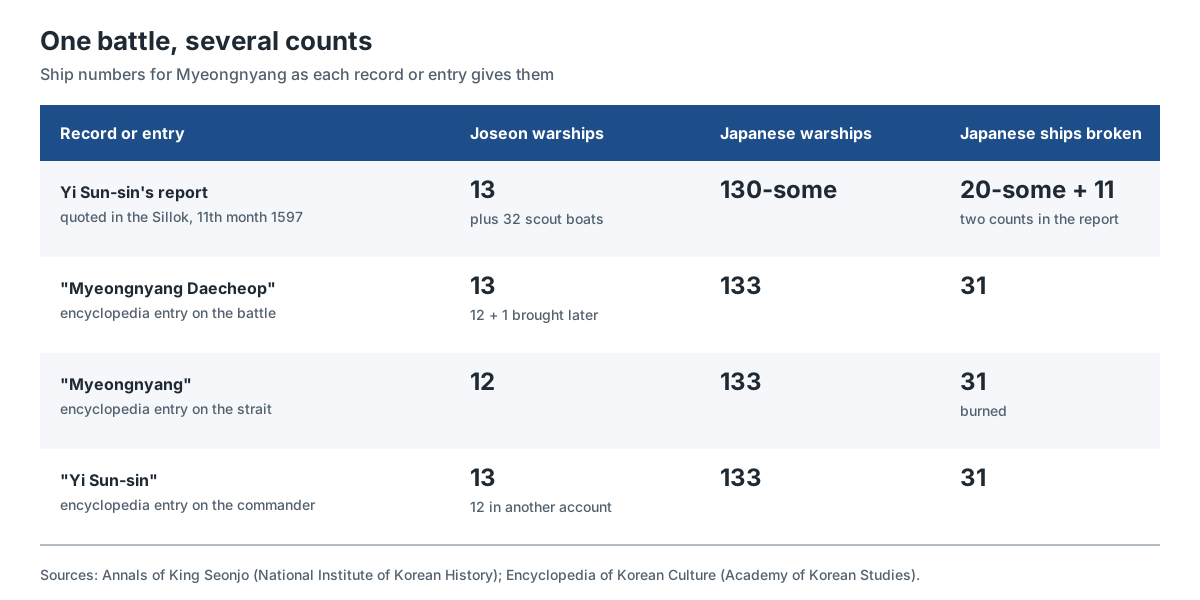
Read that way, the gap between 12 and 13 comes down to when the ships were counted. The Myeongnyang entry, however, puts the battle itself at 12 ships, so the gap is not fully closed. The report uses round figures such as "130-some" and "more than 20," while the encyclopedia entries use exact numbers like 133 and 31. Rather than picking one as correct, it is safer to read each number together with the name of the record it came from.
Stories passed down need separate reading too. One says some 100 refugee boats were dressed up as warships and placed behind the fleet. Another says iron chains were laid across the channel to overturn enemy ships. Even the Myeongnyang Daecheop entry keeps these apart from its main account, presenting them only as records "partly handed down."
That entry's reference list includes the Seonjo Sillok, the Nanjung Ilgi war diary and Ryu Seong-ryong's Jingbirok. A 1924 history of the war by the Japanese Army General Staff is listed alongside them. This article compares only Joseon records and the accounts of Korean scholars; it does not cover the numbers given in Japanese records.
What the battle left behind
Within the Jeongyu War, Myeongnyang was a turning point at sea. On land, the Japanese army swept through Namwon and Jeonju. On the 7th day of the 9th month, a Ming army stopped it at Jiksan, and it could not move north to Seoul. Nine days later, at sea, the Joseon navy drove off the Japanese fleet at Myeongnyang and won back control of the sea.
The Myeongnyang Daecheop entry says the Joseon navy faced more than ten times its number and used the narrow channel to block the move into the West Sea.
The Myeongnyang entry says the battle closed the route toward the Han River basin. The letter the Joseon court sent to the Ming commander about two months after the battle called it "a small victory." It predicted that, because of it, enemy ships would not be able to enter the West Sea.
The navy recovered after that. Yi moved his base to Bohwado, today's Gohado near Mokpo, and in the 2nd month of the next year to Gogeumdo.
When news of Toyotomi Hideyoshi's death arrived, the Japanese army began to pull out. On the 19th day of the 11th month of 1598, at Noryang, Yi attacked Japanese ships gathered there to withdraw. He was killed by a stray bullet while chasing the fleeing ships. With the Japanese withdrawal, the war ended.
Behind the record of victory was long suffering. The Jeongyu War, aimed at Jeolla Province, left the region thoroughly ravaged. The war laid the land waste, farmland shrank to a third, and amid famine and disease the lives of farming families became miserable.
The Myeongnyang Victory Monument (a designated Treasure), set up in 1688, was moved from Gyeongbokgung Palace to Hakdong-ri, Munnae-myeon, Haenam, in 1947.
What to read next
- Yi Sun-sin and the Battle of Hansando: the sea battles early in the Imjin War
- The Turtle Ship: What the Records Confirm and What We Don't Know: records of the ship built on the panokseon design
- Destroyers and frigates: why warships have different names: how modern warships are sorted
- A history of laser weapons: from chemical to electric lasers: from cannons to light, another branch of how weapon technology changed