On the morning of 2 December 1805, mist began to lift from a low plateau north of Vienna. On this ground, now in the Czech Republic, the army of the French emperor Napoleon faced a Russian and Austrian coalition army. With the coalition army were the Austrian emperor Francis I and the Russian tsar Alexander I. Three emperors stood on one battlefield.
By the afternoon, the coalition retreat had turned into a general flight. The victory ended France's German campaign, and a little over three weeks later Austria signed a peace treaty at Pressburg.
The Battle of Austerlitz was the last scene of a campaign that began at the end of August. This article follows why the war started again, how the day on the Pratzen Heights unfolded, and how the French army of 1805 was organized. It also looks at how to read the numbers in the proclamation the victor gave his soldiers the next day.
The Third Coalition
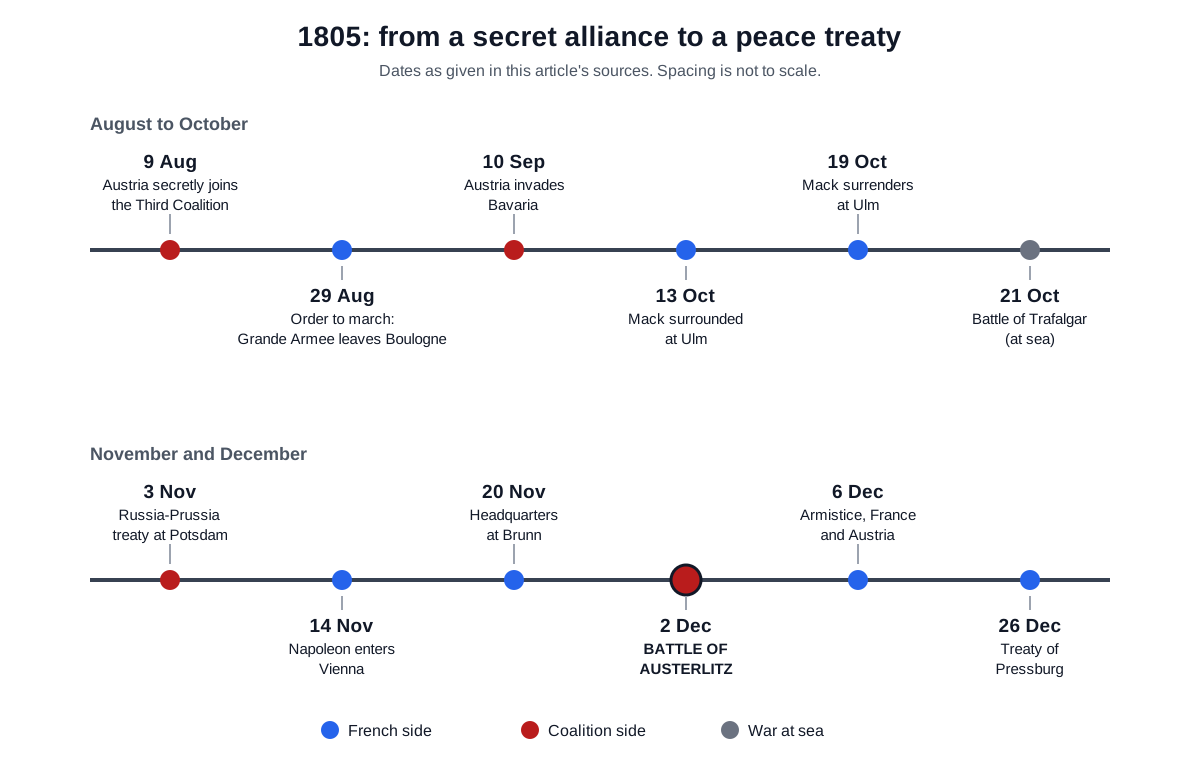
On 9 August 1805, following negotiations with British diplomats, Austria secretly agreed in writing to join an alliance with Britain and Russia. This alliance is called the Third Coalition, and the Kingdom of Naples and Sweden soon joined it. On the other side stood France and its allies, among them Spain, the Netherlands, Bavaria, Baden, Württemberg and Hesse-Darmstadt.
Why another war? The peace treaties of Lunéville and Amiens, signed a few years earlier, began to slip almost as soon as the ink was dry. According to the German Historical Museum (Deutsches Historisches Museum), the signatories soon showed they had no intention of keeping the terms. A coalition against Napoleon then formed once more.
The fighting began on 10 September, when Austrian troops entered Bavaria. Bavaria was on the French side.
From Boulogne to Vienna
That summer, Napoleon's army was camped along the coast around Boulogne, ready for a possible landing in England, and Napoleon himself spent all of August there. On 26 August he began to break up the camp and turn 200,000 troops toward Austria. On 29 August he gave the order to march. The Fondation Napoléon timeline marks that day as the birth of the Grande Armée.
The army moved in seven corps. It moved fast. Murat's men covered 390 km between 25 September and 1 October.
On the evening of 13 October, the Austrian general Mack and his army were completely surrounded at Ulm. With every line of communication cut, Mack surrendered on 19 October. The next day, 25,000 Austrian soldiers and 60 cannon filed past Napoleon.
Two days later, the war at sea went the other way. On 21 October, the joint fleet of France and Spain lost to the British in a battle off Cape Trafalgar. Nelson, the British commander, was wounded in the fighting and died. Napoleon heard the news on 17 November, almost a month later.
On land, the road led to Vienna. On 3 November Russia and Prussia signed a treaty of alliance at Potsdam, though the timeline calls Prussia's entry into the coalition timid. On 14 November Napoleon entered Vienna and set up headquarters at Schönbrunn.
The Russian army was still in the field. At Hollabrunn on 15 November, Bagration was beaten by Murat, but he held up the French long enough for Kutuzov's army to get away. On 20 November Napoleon set up headquarters at Brünn, and the next day he looked over the ground that would become the battlefield. On 29 November the coalition armies took up positions around Austerlitz.
A day on the Pratzen Heights
Austerlitz is today's Slavkov u Brna. The battlefield measures about eight miles by six, one of the largest of the Napoleonic era. The coalition placed the centre of its line on a plateau called the Pratzen Heights.
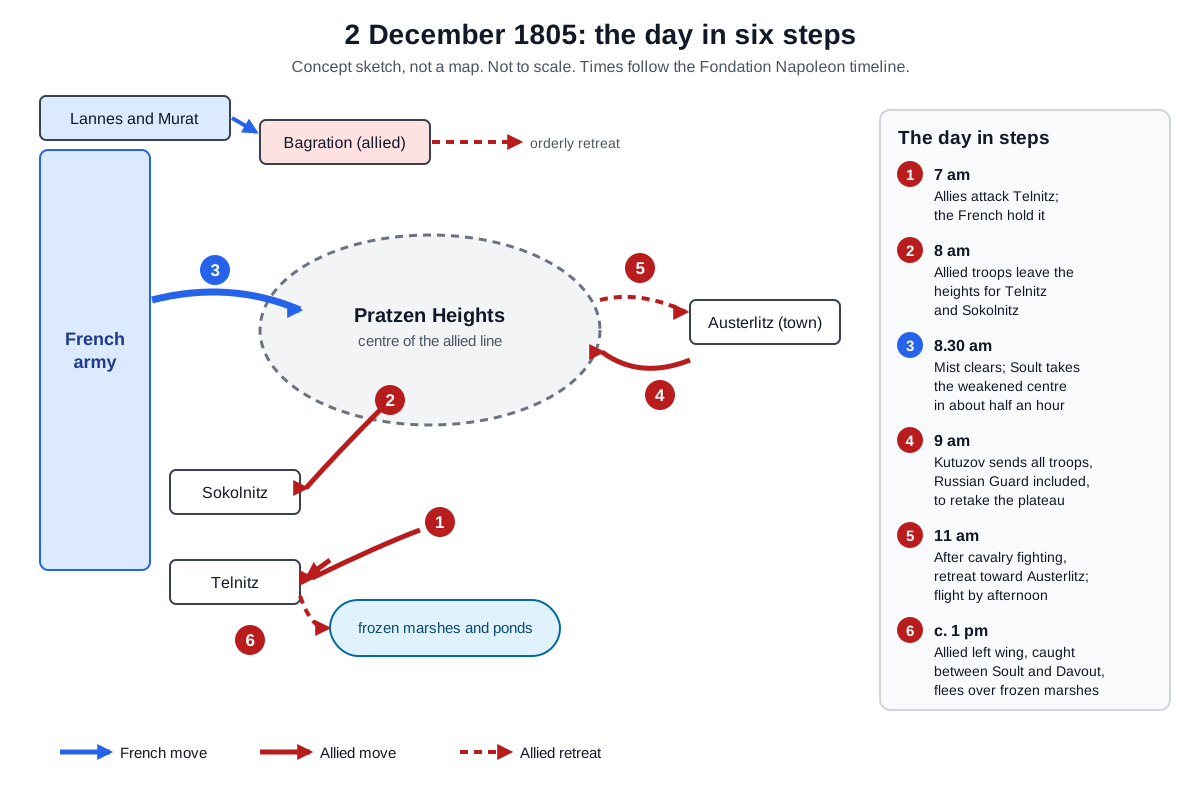
At 7 am, coalition troops under Kienmayer attacked the village of Telnitz. The French 3rd Line Infantry Regiment and the Tirailleurs du Po were dug in there. The attackers had far more men, yet they could not drive out the stubborn French defenders.
At 8 am, Buxhöwden started sending his men off the Pratzen Heights to back the assault on Telnitz. Langeron, another coalition commander, also came down from the plateau and struck at Sokolnitz, a village close by.
At 8.30 am, the morning mist cleared. Napoleon saw that the coalition had badly weakened its centre on the heights to support the attacks on the two villages, and he ordered Soult forward to seize them. Soult did it in about half an hour.
At 9 am, Kutuzov tried to repair the error of giving up the heights. He threw in all his troops, the Russian Imperial Guard included, to win the plateau back. Meanwhile, on Kutuzov's right, Bagration pulled back in good order as Lannes and Murat pressed him. The French Imperial Guard moved up to support Soult on the heights.
After fierce cavalry fighting, at 11 am Kutuzov ordered a retreat toward Austerlitz. In the afternoon that retreat became a general flight. Around 1 pm, the coalition left wing, caught between Soult and Davout, had to flee across the frozen marshland to the east of Telnitz.
From the Chapel of Saint Anthony at Ujezd u Brna, Napoleon watched the coalition armies fall into disorder on the frozen ponds. The day was also exactly one year after his coronation as emperor. In his proclamation the next day, Napoleon told his soldiers they had wrecked the enemy's plans "on the very anniversary day of the coronation of your emperor."
The French army of 1805: corps, muskets and guns
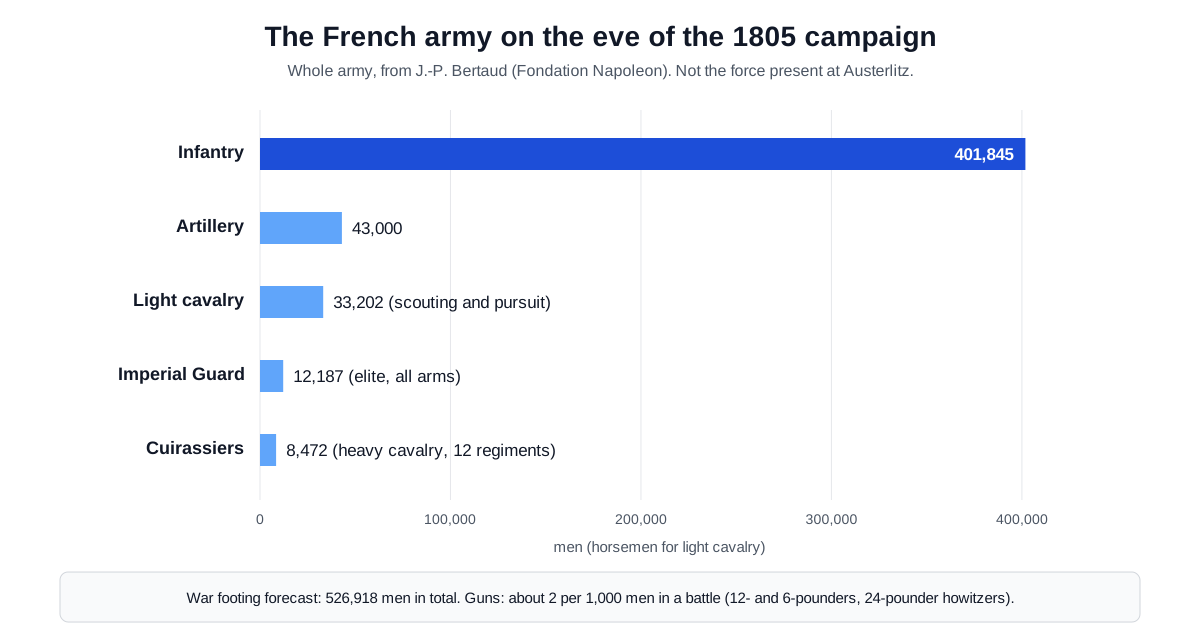
How was an army organized that went from Boulogne to beyond Vienna in a little over three months? An article by the historian Bertaud for the Fondation Napoléon gives the French army in numbers on the eve of the campaign. The war ministry forecast a war footing of 526,918 men, 401,845 of them infantry. More than half were new conscripts; over 300,000 young men were called up between 1800 and 1805.
The biggest change was the corps (corps d'armée). Divisions, created in 1793, already combined infantry, cavalry and artillery regiments, and now several divisions could be grouped into a corps. One general could command two or three infantry divisions, a cavalry brigade and an artillery detachment.
Napoleon deliberately limited the cavalry and artillery attached to divisions and corps. He wanted to keep a separate reserve of both to decide a battle.
Infantry was still the centre of the fight. Bertaud calls it "the queen of battles," with the fire of its muskets and the shock of its bayonets. The line infantry had 71 regiments of three battalions and 19 of four, and a battalion had nine companies, one of them grenadiers, for 1,071 men. The soldier's musket was the 1777 model, modified in 1801, 1.51 m long and 4.37 kg in weight.
The cavalry had separate jobs. Twelve cuirassier regiments with 8,472 men were meant to smash into the enemy formation and break the front, and the infantry would then exploit the gap. The light cavalry, with 33,202 horsemen, handled scouting and pursuit.
The artillery had 43,000 men, and a battle could field about two guns for every 1,000 men. An order of 2 May 1803 modified the Gribeauval system, giving units 12- and 6-pounder guns and 24-pounder howitzers. The numbers 12, 6 and 24 give the weight of the shot in the old French unit, the livre.
Then there was the Imperial Guard. It had 12,187 elite men under Napoleon's sole command, and in Bertaud's words it was already "a small army within the army." Time at the Boulogne camp went into training, and Soult drilled his divisions in the field three times a week.
Reading the numbers in a proclamation
On 3 December, the day after the battle, Napoleon issued a proclamation to his soldiers. He wrote it at the 18th-century Baroque palace in Austerlitz. The same palace had been the headquarters of Alexander I and Francis I the day before the battle, and Napoleon stayed there from 3 to 6 December.
The proclamation's numbers are big: in less than four hours, it says, an army of 100,000 men led by two emperors was cut to pieces or scattered. It lists 40 standards, 120 cannon, 20 generals and more than 30,000 prisoners. It also says those who escaped the blades drowned in the lakes, and that the enemy infantry was "greater in number." It ends with a promise: say "I was at the Battle of Austerlitz," and people will answer, "There goes a brave man."
These numbers should not be copied straight into a battle record. The proclamation is a winning commander speaking to his own soldiers, and it does not include the other side's count. The timing is also worth a second look: in the timeline, the first attack comes at 7 am and the coalition left wing flees around 1 pm. The proclamation alone does not say where its four hours start.
Setting other records beside it helps give a sense of scale. The Austrian force that surrendered at Ulm numbered 25,000 men and had 60 cannon. The column in the Place Vendôme in Paris was cast from 1,200 guns captured from Russian and Austrian forces. Work on the 42 m column ran from 25 August 1806 to 15 August 1810, and it went through several names, the first being the Austerlitz Column.
The Treaty of Pressburg and after
On 4 December, at the "Burnt-Down Mill" ten miles southeast of Slavkov, Napoleon met the Austrian emperor. France and Austria agreed an armistice on 6 December and signed a peace treaty on 26 December at Pressburg, today's Bratislava.
The treaty text calls the Austrian ruler "Emperor of Germany and Austria." He gave up the former Venetian lands he had received under the treaties of Campo Formio and Lunéville, and those lands were joined to the Kingdom of Italy for good. He recognized Napoleon as King of Italy and handed the County of Tyrol, including Brixen and Trento, and other lands to the King of Bavaria. Salzburg and Berchtesgaden became part of the Austrian Empire.
Under a separate article, the Austrian emperor had to pay 40 million francs in specie. The money bought out war levies that the French army had imposed on occupied lands but not yet collected. French troops would leave the Austrian hereditary lands within two months of the exchange of ratifications, drawing food and supplies from their own depots along the route. Prisoners of war not yet released would be returned within 40 days.
The shape of Germany changed as well. The Elector of Bavaria became king on 10 December and the Elector of Württemberg on 11 December, and the treaty recognized both royal titles. According to the German Historical Museum, in July 1806 several German princes placed themselves under Napoleon's protection in the Confederation of the Rhine (Rheinbund) and left the Holy Roman Empire. Francis II then declared the empire dissolved and laid down its centuries-old crown, having already created a new imperial title for himself in Austria.
The battlefield keeps another kind of memory. On top of the Pratzen plateau stands a peace monument designed by the architect Josef Fanta, whose plans date from 1909–1912. Under its "Peace-Honour" slab lie the remains of soldiers found on the battlefield, and statues at its four corners stand for the soldiers of all three armies that fought there.
What to read next
- The 1812 Russian Campaign: Why the Grande Armée Didn't Come Back: what happened to the army that won at Austerlitz seven years later.
- Military logistics: performance must be sustainable: the food, depots and supply that even the treaty had to spell out, explained in today's terms.
- Turning points in military technology: the technologies that changed war after muskets and cannon.